

Skip to Content Facebook Feature Image

Washington Eyes Offensive Strike on China's Space Arsenal

Blog

Washington Eyes Offensive Strike on China's Space Arsenal
Blog

Blog

Washington Eyes Offensive Strike on China's Space Arsenal

2026-05-29 14:01 Last Updated At:14:01

As the United States continues to push the militarisation of space, competition between Chinese and American satellites is intensifying. According to the South China Morning Post, a former US Pentagon intelligence official said on 26 May that Washington is preparing offensive weapons designed to disable China's military satellites in any future conflict. The former official also warned that China and the US currently lack any safety dialogue mechanism. If an American satellite were about to collide with a Chinese one, the US could do little more than send an email and wait — and the responsibility for evasive action would fall squarely on Washington.

Kari Bingen, director of the Aerospace Security Project at the Center for Strategic and International Studies (CSIS), was blunt at a recent event. She said Washington is actively discussing how to threaten "the satellites that underpin Chinese targeting of American forces in any Indo-Pacific conflict."

Kari Bingen, director of the Aerospace Security Project at the Center for Strategic and International Studies (CSIS).

Kari Bingen, director of the Aerospace Security Project at the Center for Strategic and International Studies (CSIS).

Bingen claimed that China currently operates more than 500 intelligence, surveillance and reconnaissance (ISR) satellites. She alleged that Beijing has been “practising out in the Gobi Desert, targeting our ports, our ships, our airfields” by pairing space sensors with battle networks to close ‘kill chains’ against US forces. 

"We’re now having to think ... how do we, the United States, hold those assets at risk, so that they can’t use space to target us on the ground," she said. In her view, that logic is driving more open debate about offensive strategy — specifically, how the US could deny China the use of its space capabilities. Bingen further warned that even the basic safety dialogue mechanisms that still exist between the US and Russia are absent in the US-China relationship.

She painted a stark picture of communication breakdown. "We send an email," she said of a potential satellite collision. "We don’t know if it gets answered. The onus is on our side to take that evasive manoeuvre."

At the same event, Heather Williams, director of the Project on Nuclear Issues at CSIS, said the complete freeze in China-US military dialogue has now spread into the orbital domain. The message is clear: Washington fears space is becoming a new front line for strategic rivalry and potential conflict. That fear is already shaping an increasingly hardline US posture, one now aimed more frequently at China's commercial aerospace sector.
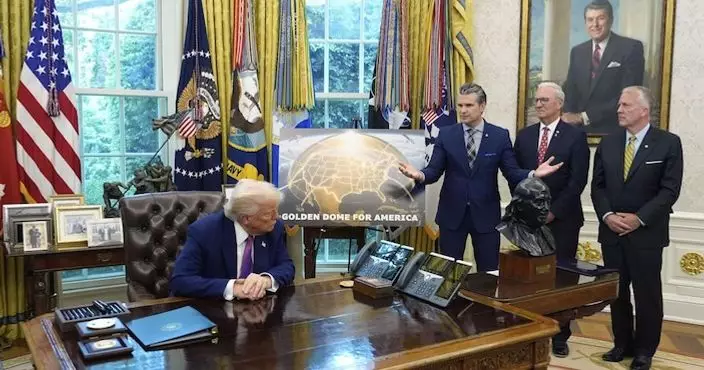
After Donald Trump returned to the White House, he committed substantial resources to advancing the so-called “Golden Dome” missile defence plan, hoping to put it into operation before the end of his term.

After Donald Trump returned to the White House, he committed substantial resources to advancing the so-called “Golden Dome” missile defence plan, hoping to put it into operation before the end of his term.

The reality is that Washington itself has done the most to militarise space. According to Guancha.cn, the United States has defined space as a "warfighting domain," developed and deployed offensive space weapons, and organised military offensive-and-defensive drills and technical experiments. It has even maliciously tracked and dangerously approached other countries' spacecraft, creating collision risks in orbit. The US has become the biggest driver of the "militarisation" and "battlefield-isation" of space — and the greatest threat to space security.

After Donald Trump returned to the White House, he committed substantial resources to advancing the so-called "Golden Dome" missile defence plan. The goal is to have it operational before his term ends in January 2029. Its intent against China and Russia is obvious — though whether it can deliver on its promises remains a wide-open question.

The price tag is staggering. Earlier this month, The New York Times cited a new report by the Congressional Budget Office (CBO) estimating that "Golden Dome" could cost taxpayers US$1.2 trillion over the next 20 years — far above the earlier estimate of US$175 billion.

The scale of hardware required is equally daunting. To protect the US homeland, Alaska, and Hawaii, the system would need thousands of satellites, plus radar and missile bases for intercepting intercontinental ballistic missiles (ICBMs), and additional regional bases to defend against hypersonic and cruise missiles. If the US wanted to intercept up to 10 enemy ICBMs simultaneously in space, the military might need to deploy around 7,800 armed satellites.

There's a built-in obsolescence problem too. Because these interceptors would operate in low Earth orbit, atmospheric drag would cause them to lose altitude and fall out of orbit within five years. The entire system would face continuous and extremely costly replacement cycles — a financial black hole with no clear bottom.

The CBO report also found that even if the system were completed, adversaries with large nuclear arsenals — such as China and Russia — could still penetrate the shield, with some missiles successfully hitting their targets. The Congressional Research Service (CRS) had previously warned that building such missile defence systems could trigger serious strategic miscalculation and prompt China and Russia to expand their nuclear arsenals in response.
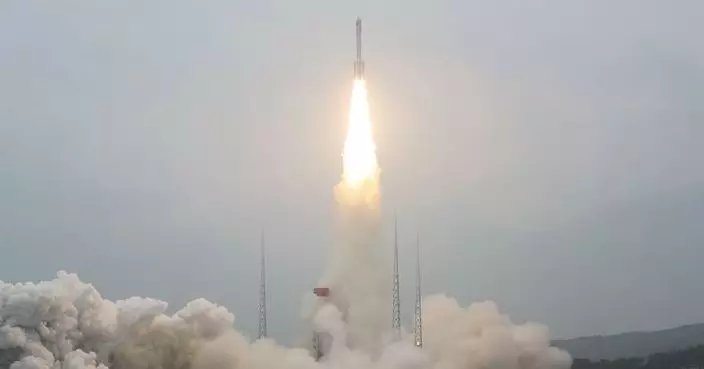
China launches a satellite.

China launches a satellite.

China has pushed back firmly. Foreign Ministry spokesperson Mao Ning said the "Golden Dome" plan aims to build an unconstrained global, multi-layered and multi-domain missile defence system. The plan openly calls for a major expansion of outer-space combat capabilities, including the development and deployment of orbital interception systems. Mao said it carries a strong offensive character, violates the principle of peaceful use enshrined in the Outer Space Treaty, and will heighten the risks of turning outer space into a battlefield and fuelling an arms race — thereby undermining the international security and arms-control system.

Mao added that the United States is pursuing "America First" and remains fixated on seeking absolute security for itself — in violation of the principle that "the security of all countries should not be diminished." This harms global strategic balance and stability. China is seriously concerned, Mao said, and urges the US to abandon the development and deployment of a global missile defence system, and to take concrete steps to enhance strategic trust among major powers and safeguard global strategic stability.


Deep Throat

** 博客文章文責自負,不代表本公司立場 **

Starlink has proved its worth in combat. But winning on the battlefield has opened a bitter new front — this time between Elon Musk's SpaceX and the US Pentagon over who pays what. SpaceX insists the Pentagon has been enjoying a premium service at a bargain-basement price.

Foreign media, citing informed sources and internal Pentagon documents, reported that SpaceX executives met Pentagon officials face to face shortly after the United States launched its bombing campaign against Iran. Their message was blunt: the US military was paying roughly US$5,000 per terminal connection for a service actually worth closer to US$25,000 — a fourfold gap.

This row did not erupt overnight. For months, the two sides have been grinding away at each other over Starlink's use on LUCAS kamikaze drones — low-cost American weapons reverse-engineered from Iran's Shahed-136, designed to loiter over a target before diving in for the kill. Beyond drone pricing, the two sides have also failed to agree on the cost of direct-to-cell services.

Under a 2023 agreement, SpaceX supplied the Pentagon with the military version of its system — "Starshield" — not the consumer-grade Starlink terminals sold at stores like Walmart. Starshield terminals, according to people familiar with the matter, can connect to both commercial Starlink satellites and a separate, more secure military satellite constellation that also carries the Starshield name.

SpaceX argues that the combat environment in which LUCAS drones operate should qualify for an aviation-tier subscription, not the cheaper ground or mobility-tier rate. The Pentagon pushed back hard. The US$25,000 monthly rate, it said, was designed for manned aircraft — not for kamikaze drones that connect for only a few minutes to a few hours at a time.

In the end, the Pentagon blinked. To keep the strikes against Iran going, it accepted SpaceX's higher pricing. The consequence was immediate: the unit cost of each LUCAS drone nearly doubled, climbing from roughly US$30,000 to close to US$60,000.

Reuters put its finger on the deeper issue. These disputes reveal just how dependent the Pentagon has become on SpaceX — and how much leverage that dependence hands to Musk on matters central to US national security. The timing matters too: SpaceX is preparing for an IPO next month that could rank among the biggest listings in history, giving the company every incentive to push revenue higher beforehand.

Since the Ukraine Crisis in 2022, Starlink has become indispensable to modern warfare. SpaceX now operates around 10,000 satellites in orbit — more than 60 percent of all active satellites worldwide. That scale dwarfs the satellite constellations of rivals like OneWeb and Amazon.

But the Ukraine Crisis also gave the world its first hard look at the risks of Starlink dependency. During a Ukrainian counteroffensive in 2022, Musk abruptly cut service in certain areas, disrupting the advance. Last summer, a US Navy test was derailed when a global Starlink outage left unmanned vessels without connectivity.

Clayton Swope, a senior fellow at the Center for Strategic and International Studies, is blunt: SpaceX has pushed the US government into a no-win position. Unlike traditional defence contractors, SpaceX commands far greater bargaining power in front of the Pentagon. Beyond rockets and AI, it controls a vast commercial Starlink market — and the Pentagon cannot simply walk away. According to documents filed with the US Securities and Exchange Commission, roughly 20 percent of SpaceX's total revenue comes from the US government.

From the start of the Middle East conflict, Starlink was already woven into the core of US military operations. Sources familiar with the matter say that during the bombing campaign, Starshield terminals were deployed on more than a dozen drone models. Then on February 28, the United States struck Iran — and the relationship between the two sides tightened sharply. The very next day, on March 1, Musk responded on X to a photo of a LUCAS drone. He wrote that the drone appears to have a Starlink terminal integrated(找不到原文), and added: "It is a violation of commercial Starlink terms of service to use the terminal for weapon systems. This applies to all users and is shut down when discovered. There is a separate network called Starshield, which is operated by the US government. This is not under SpaceX control."

The Pentagon quickly denied any breach. But according to two informed sources, SpaceX executives met Pentagon officials again within days, once more insisting the military was paying too little. One source said that although the Pentagon initially agreed to pay more for satellite connectivity on attack drones, senior officials — including the Deputy Secretary of Defense — remained uneasy. During the subsequent ceasefire, the two sides reconvened in April to reopen the pricing discussion.

The dispute is far from settled. According to relevant documents, the Department of Defense is still weighing an additional purchase of more than 3,500 Starshield terminal subscriptions, including 100 higher-priced aviation-tier services. That deal could generate hundreds of millions of dollars in annual revenue for SpaceX. Whether it will be finalised — and at what price — remains unknown.

Meanwhile, The Wall Street Journal previously reported that after large-scale protests erupted in Iran in January, the Trump administration secretly moved more than 6,000 Starlink terminals into the country, claiming the aim was to give local people internet access. The plan backfired: the Iranian government confiscated the devices and deployed jamming equipment to cut the connections.

Almost simultaneously, Pentagon officials opened talks with SpaceX on deploying a "direct-to-cell" service capable of bypassing jamming. The technology functions similarly to 5G, enabling users to connect directly without ground terminals. SpaceX — which earned US$11.4 billion from Starlink in 2025 — quoted an eye-watering price: up to US$500 million to launch the service, plus US$100 million a month for operations. The figure gave Defence Department officials a serious headache. Whether the two sides ultimately struck a deal remains unconfirmed.

The reality is that this bust-up between SpaceX and the Pentagon has spread from drones to mobile phones, and from the Middle East all the way to Washington. There is no sign of it ending anytime soon.

Recommended Articles