Roses bursting into full bloom across Beijing have transformed the Chinese capital’s streets into a floral wonderland that blurs the line between roadside and park.
Along Chaoyang Park Road, lines of green bushes are adorned with roses and other colorful flowers, creating a vibrant sight that has impressed locals and visitors alike.
"The avenues are very, very beautiful. It's a beautiful place and the flowers are beautiful, very beautiful," said an Italian tourist.
Thousands of rose varieties bloom in succession at the National Botanical Garden, where a 7-hectare sea of flowers fills the air with fragrance.
"I love taking photos of flowers the most. The roadsides are lined with rose flower beds. So, you can see flowers anytime. There are also plenty of flowers in the residential community," said a local resident.
Beijing now boasts over 1,000 kilometers of rose landscape belts, covering more than 2,000 hectares across the city.

Roses bloom across Beijing in full splendor

Roses bloom across Beijing in full splendor
Lebanese President Joseph Aoun stressed in a phone call with U.S. Secretary of State Marco Rubio on Friday that achieving a ceasefire is the key first step and necessary foundation for tackling all other pressing issues.
The call came as a previous truce between Israel and Lebanon, which began in mid-April, has all but collapsed. Israeli forces have continued to launch strikes across multiple areas in Lebanon, citing Hezbollah's violations of the ceasefire agreement.
Separately, Lebanese and Israeli military delegations failed to reach a ceasefire agreement during talks held in Washington, D.C. on Friday, according to a report early Saturday by Lebanon's pan-Arab al-Mayadeen TV.
Citing an official Lebanese source, al-Mayadeen reported that the Lebanese delegation insisted on an immediate ceasefire, but the request was repeatedly rejected by the Israeli side. The Israeli delegation also refused to withdraw from occupied Lebanese territory and demanded the disarmament of Hezbollah.
When visiting Israel's northern border on Friday, Israeli Prime Minister Benjamin Netanyahu confirmed that the Israeli ground forces had crossed the Litani River, pushing northward and seizing strategic high ground.
Netanyahu said Israeli operations now extend across "the entire front," including the Lebanese capital Beirut and the Beqaa Valley in eastern Lebanon, in order to strike Hezbollah.
According to Lebanon's National News Agency, the Israeli Defense Forces launched airstrikes on multiple areas in southern Lebanon on Friday, killing 11 people and wounding five others. Hezbollah issued a series of statements claiming multiple attacks on Israeli troops and military vehicles along the Lebanon-Israel border.
Lebanon's Public Health Emergency Operations Center said that between March 2 and May 29, Israeli attacks in Lebanon had killed 3,355 people and wounded 10,095.
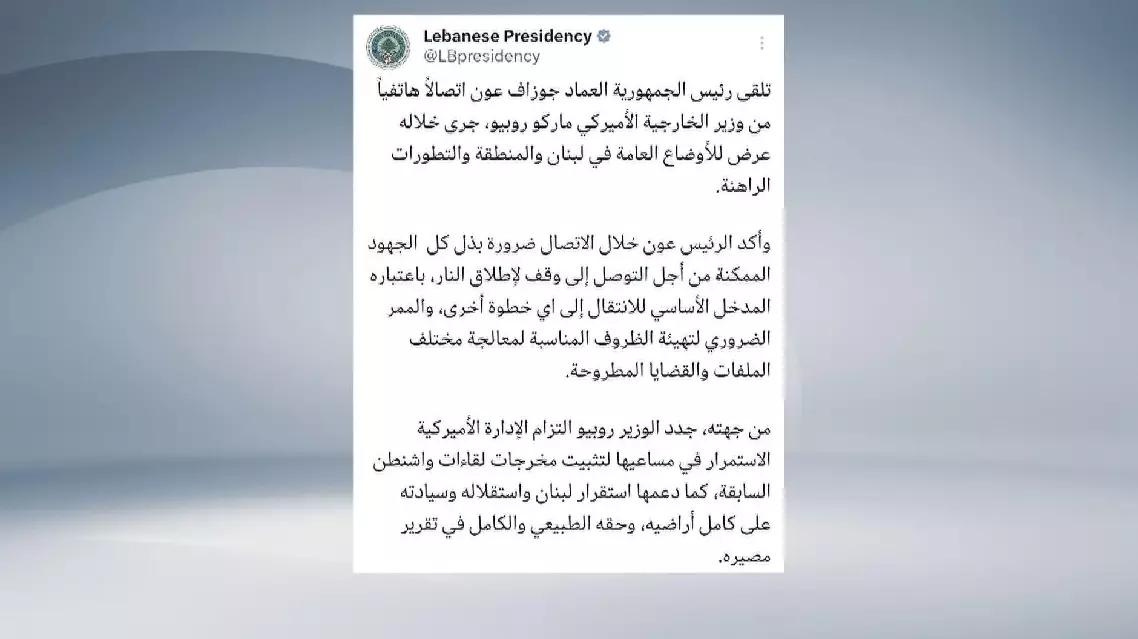
Lebanese president urges ceasefire in call with US secretary of state