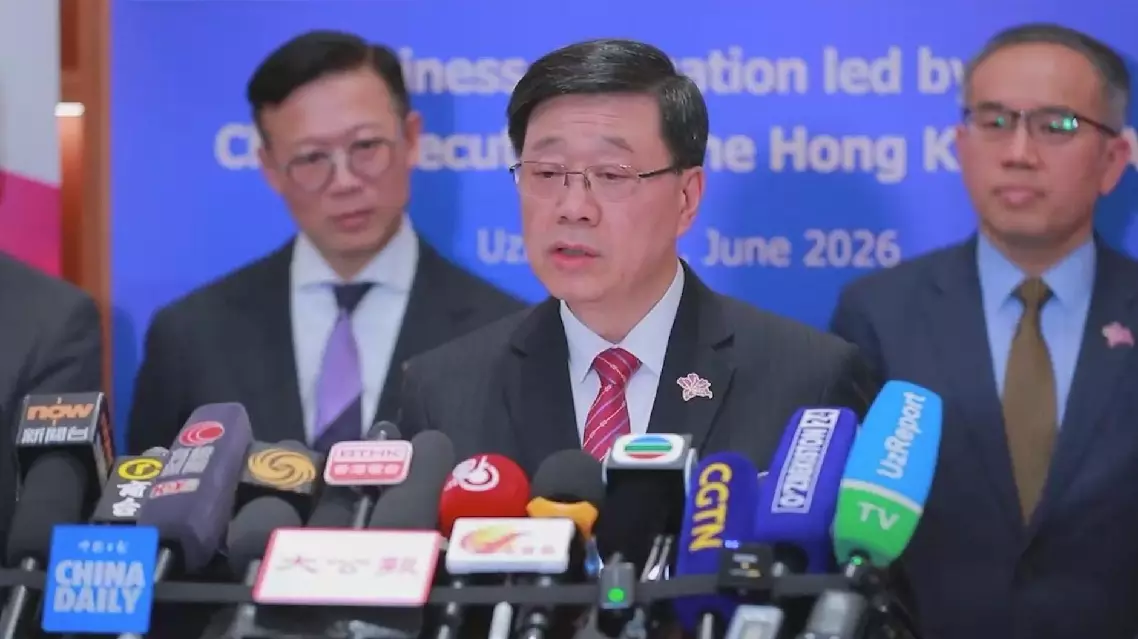
Chief Executive of China's Hong Kong Special Administrative Region (HKSAR) John Lee led a business delegation on a visit to Uzbekistan from Wednesday to Friday, meeting with Uzbek President Shavkat Mirziyoyev, Prime Minister Abdulla Aripov and Foreign Minister Bakhtiyor Saidov.
During the visit, the two sides concluded 35 memorandums of understanding and agreements covering trade, investment, finance, technology, aviation and other fields.
Mirziyoyev said he looks forward to further unlocking the potential of existing economic partnerships between Uzbekistan's various regions and Hong Kong, expressing confidence that the Hong Kong business delegation's visit would make a strong contribution to this goal.
Saidov said Hong Kong possesses unique experience and significant potential as an international financial and business center, and will play an important role in Uzbekistan's economic modernization and the implementation of high-tech cooperation projects.
Lee said that under the principle of "one country, two systems," Hong Kong enjoys both national and international opportunities. He said Hong Kong will continue to serve as a "super connector" and a "super value-adder," further deepening cooperation and exchanges with Uzbekistan across various sectors, supporting the country's high-quality development goals, and jointly seizing with partners opportunities arising from Belt and Road cooperation to promote common development in both places and across Central Asia.
Lee noted that Hong Kong and Uzbekistan are important trade and investment gateways in the Asia-Pacific and Central Asian regions, respectively, and can leverage their complementary strengths to expand economic and trade cooperation and help businesses access broader markets.
"Uzbekistan sits in the heart of the corridor of Asia and Europe. So logistical development, railway development, and also how we can complement and supplement each other in cargo handling, will be an area for a very wide range of cooperation. And technology I think is also an important area, because technology is the future of, I think, different parts of the world. Without technology, we will all fall behind. So IT cooperation will be an area we'll focus on," Lee said.
He added that Uzbekistan's abundant gold reserves and Hong Kong's efforts to develop into an international gold trading center create opportunities for mutually beneficial cooperation in gold trade and related professional services.
As one of the outcomes of the visit, Lee said the Uzbek government had agreed to establish a Consulate General in the HKSAR. Hong Kong and Uzbekistan also initialed an air services draft agreement, enabling airlines from both sides to use traffic rights to develop routes.
The two sides agreed to extend the period of mutual visa-free travel to 30 days to facilitate people-to-people exchanges. In addition, the Hong Kong Palace Museum and the State Museum of the History of Uzbekistan will establish a partnership and jointly organize exhibitions in future.
China's Hong Kong, Uzbekistan to deepen economic, business ties