Ahead of the second World Conference of Classics, scholars in China have highlighted the enduring relevance of classical works, noting that ancient wisdom still holds important lessons and practical value for solving modern challenges and advancing social progress.
The conference will be held in Athens, Greece, on June 9 and 10. It will bring together leading scholars in classical studies, as well as experts in civilization, culture and archaeology from China and other countries, to discuss issues related to classical civilizations and to promote academic exchanges and consensus-building in global classical studies.
After nearly a year of work, Huang Weiwei, a professor at Beijing International Studies University, has finished translating an Aristophanes comedy into Chinese. For her, the classical literature from 2,500 years ago feels remarkably close to home.
"The work is very close to real life. The latter half of it shows us that good people can easily become bad once they have money, but is it true that bad people will become better just because they don't have money? It's actually not like that. Returning to classical and ancient times, we will see that ancient wisdom has a profound understanding of the world and humanity. It can provide us with infinite wisdom, and at this point, the classical is connected to the modern. They are all dealing with human problems," Huang said.
According Chen Siyi, a tenured assistant professor at Peking University, the development of spiritual civilization demands constantly returning to where it all began to draw renewed wisdom from the past. He calls this the "eternal shuttle run."
"In fact, it is a primitive expression of each culture's own survival experience and civilization ideas. I think this original expression is not replicable and will never be outdated. Throughout world history, the creation and development of spiritual civilization has seen every innovation as a new era where cultural practitioners constantly return to the starting point of civilization and extract resources from it," Chen said.
Roger T. Ames, humanities chair professor at Peking University, emphasized that classical traditions from China in particular offer essential frameworks for addressing contemporary global crises through shared human values.
"World hunger, all of these different problems facing the next generation, require cooperation. When you look at the fundamental Confucian values, they are inclusion, inclusiveness. They are getting the most out of human experiences, sharing," said Ames.
The second World Conference of Classics is jointly organized by the Chinese Academy of Social Sciences, the Ministry of Education and the Ministry of Culture and Tourism of China, the Greek Ministry of Culture, and the Academy of Athens.
In addition to the opening ceremony, plenary session and closing ceremony, the conference will feature four parallel forums focusing on topics including virtue and education, ethical communities in changing societies, civilization-based approaches to global order, and the role of humanistic values in the digital age.
The inaugural World Conference of Classics was held in Beijing in 2024. The event drew over 600 participants, including those from related departments and institutions of China and Greece, and experts, scholars, cultural figures, youth representatives and media professionals from around the world.
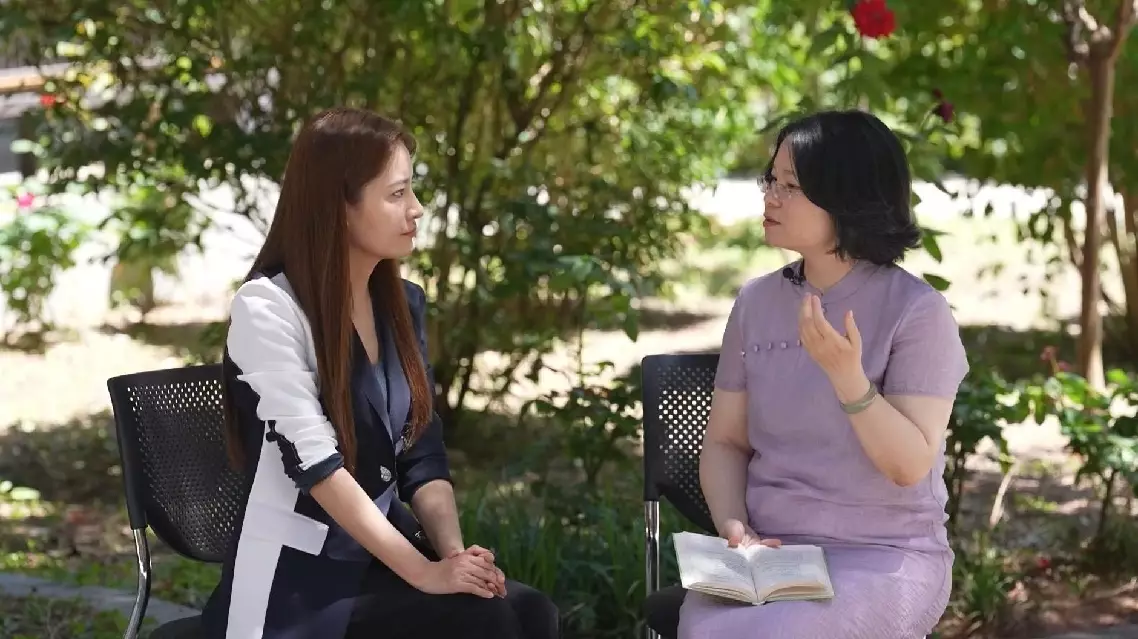
Centuries-old classics remain relevant as lens into human nature, civilization: scholars

Major breakthroughs by Chinese scientists have laid the foundation for a future where space-based solar power stations are capable of wirelessly transmitting energy to Earth and spacecraft, though significant engineering problems remain.
A research team from Xidian University in northwest China's Shaanxi Province has made significant progress on the Sun Chasing project, or "Zhuri" in Chinese. The team has developed a ground-based test system for wireless power transmission that can charge multiple moving targets at the same time.
In recent tests, the system achieved a wireless power transmission efficiency of 20.8 percent from direct current to direct current over a distance of 100 meters. It delivered 1,180 watts of power. The team has also built a wireless charging system for drones. In a test, a drone flying at 30 kilometers per hour was able to receive 143 watts of stable power from 30 meters away.
A space solar power station works exactly as its name suggests: a huge array of solar panels placed in orbit. It would collect sunlight in space, where the sun always shines, and then convert that energy into microwaves or lasers to beam down to Earth or directly to satellites and spacecraft. This could address two significant issues: supplying uninterrupted power for space missions and alleviating energy shortages on the ground.
"The construction of space solar power stations could become a major undertaking in the future. One potential benefit is access to a virtually unlimited power supply. Because energy can be collected continuously in space 24 hours a day, electricity could be supplied on an uninterrupted basis," said Fan Guanheng, an associate professor at the School of Mechano-Electronic Engineering at Xidian University.
"Secondly, it could reduce our dependence on fossil fuels, thereby lowering carbon emissions and helping protect the environment. Thirdly, it could support the development of charging infrastructure in space and enable wireless microwave charging for spacecraft, changing the way power is supplied to space vehicles," the professor added.
In 2018, the research team launched the first phase of the Sun Chasing project to build a ground test system. By June 2022, they had completed the world's first full-link, full-system ground validation system for a space solar power station. Now, the team has moved to phase two. The goal now is to solve the challenges of generating high power in space and transmitting it efficiently over long distances.
According to Duan Baoyan, an expert at Xidian University and an academician of the Chinese Academy of Engineering, recent breakthroughs include improving the efficiency of solar energy collection and conversion, increasing the precision of microwave beam control to reduce energy loss, and making the transmitting and receiving antennas smaller and lighter, which is critical for space application.
The team has also solved the problem of how to power multiple moving targets at once using a single transmitter. This means that in the future, one space power station could potentially supply electricity to several satellites or ground vehicles at the same time, Duan said.
Despite the advances in ground-based validation, a series of technical challenges must still be overcome before the technology can be deployed in space.
"The first issue that needs to be addressed is the adaptability of components to the space environment, as conditions in space are completely different from those on Earth, including radiation exposure and extreme temperatures. Another challenge involves the deployment and retraction design of transmitting and receiving antennas. We also need to develop thermal management systems to cope with extreme temperatures and temperature fluctuations in space. These are all areas where further breakthroughs are needed," said Qian Sihao, an associate professor at the School of Mechano-Electronic Engineering at Xidian University.
"We have now completed the development and validation of a ground-based test system, and our next step is to carry out in-orbit wireless microwave power transmission," Fan said.
With ground validation complete, the team now turns its attention to overcoming the harsh realities of space, aiming to demonstrate in-orbit wireless power transmission and bring the vision of orbital solar energy closer to reality.
Space-to-earth solar power moves closer to reality although hurdles remain: scientists