Zhejiang has become the hottest stop on any foreign leader's China itinerary. In just over three months — from late February to early June this year — German Chancellor Friedrich Merz, Pakistani Prime Minister Shehbaz Sharif, Serbian President Aleksandar Vučić, and Lao Party General Secretary and President Thongloun Sisoulith all made Zhejiang a core part of their visits.
That so many are arriving in delegations says something. Zhejiang has quietly become a magnet for those chasing the future — in industry, in the digital economy, in how development itself gets reimagined.
Click to Gallery
Zhejiang has recently become an absolute must-visit destination for foreign leaders touring China.
China's first visiting foreign leader this year, Merz flew straight from Beijing to Hangzhou — first stop: Unitree Robotics.
Serbian President Vučić at the Minth Group's future factory in Jiaxing.
Serbian President Vučić at the Minth Group's future factory in Jiaxing.
Lao President Thongloun chose to visit Deep Robotics – one of Hangzhou's "Six Little Dragons."
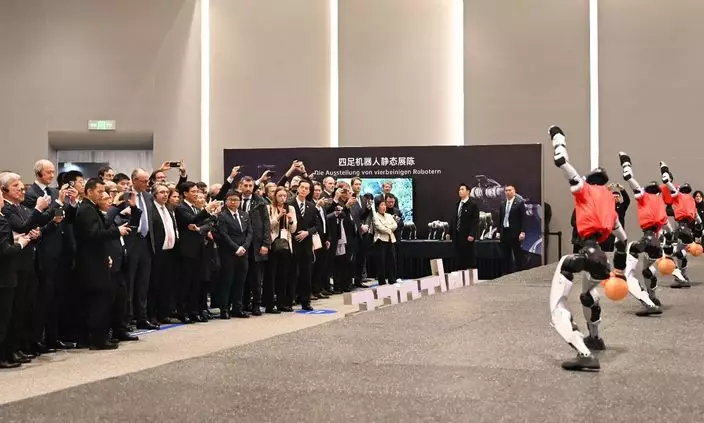
Zhejiang has recently become an absolute must-visit destination for foreign leaders touring China.
Every single one of their itineraries featured a moment with robots. That recurring scene has become a signature of Zhejiang's diplomatic circuit. Chancellor Merz — the first foreign leader to visit China this year — flew directly from Beijing to Hangzhou.
Merz‘s first stop was the new headquarters of Unitree Robotics in Binjiang District. In the exhibition hall, humanoid robots performed martial arts. When the "Wu BOT" — a robot featured in the Spring Festival Gala — completed high-difficulty jumps and flips, Merz was the first to applaud, nodding continuously.
In the components display area, the Chancellor from the "nation of engineers" picked up one of the robot's rubber "shoes" and rubbed it in his hands, examining it like a precision craft. The dozens of German corporate executives accompanying him raised their phones to film the demonstrations. One guest even took a robot's hand and danced a waltz. The whole scene looked like a massive, collective industry factory tour.
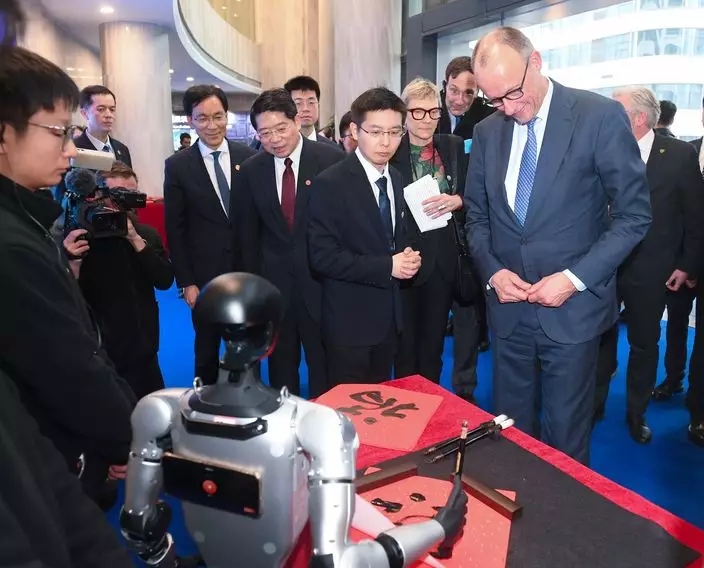
China's first visiting foreign leader this year, Merz flew straight from Beijing to Hangzhou — first stop: Unitree Robotics.
Serbian President Vučić drove to Minth Group's future factory in Jiaxing. At the entrance, five Agibot Lingxi X2 humanoid robots stood in a row, hands on hips, dancing gracefully to traditional Serbian Kolo music. Vučić later wrote on social media: “They dance better than me.”
Vučić watched quadruped robots conduct inspections, humanoid robots write calligraphy, mix cocktails, and perform Chinese martial arts. He marveled: This place is like the 22nd century. He then revealed that Serbia plans to partner with Agibot and Minth to build Europe's first large-scale humanoid robot production base, with mass production expected to begin between 2026 and 2027.
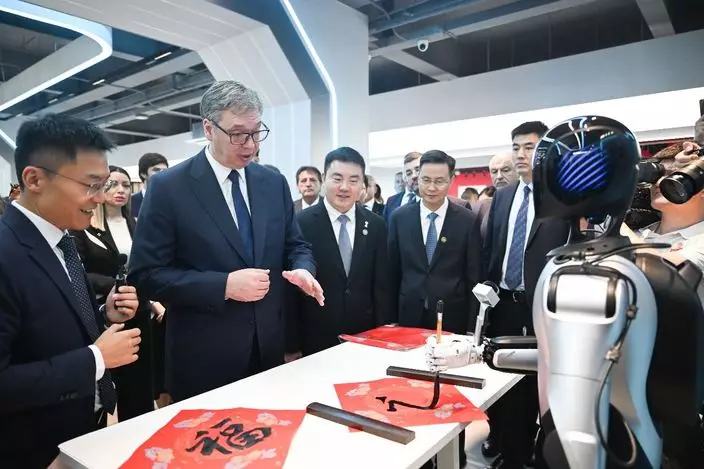
Serbian President Vučić at the Minth Group's future factory in Jiaxing.

Serbian President Vučić at the Minth Group's future factory in Jiaxing.
Lao President Thongloun chose to visit Deep Robotics — one of Hangzhou's "Six Little Dragons." He watched both humanoid and quadruped robots demonstrate their capabilities, then operated a quadruped robot himself via remote control. When a humanoid robot waved to welcome him, a beaming Thongloun waved back. When the robot handed him a gift, he said three clear words in Mandarin: "Xie xie ni" — thank you.

Lao President Thongloun chose to visit Deep Robotics – one of Hangzhou's "Six Little Dragons."
The numbers tell the story. Last year, Zhejiang's total robotics industry output reached 70.71 billion yuan. Industrial robot production hit 72,900 units — a 36.4% year-on-year increase. The province has also cultivated 20 national-level typical application scenarios in areas such as smart eldercare and digital healthcare. Zhejiang-made robots, led by companies like Deep Robotics, have accelerated their overseas expansion, landing in Europe, the Americas, Southeast Asia, Japan, and South Korea.
If robots showcase Zhejiang's hard-core innovation, Pakistani Prime Minister Shehbaz's visit spotlighted its soft power in the digital economy. Shehbaz braved the rain to head straight to Alibaba's Hangzhou headquarters as his first stop in China. His focus: the digital economy that Alibaba represents.
At the negotiation table in Hangzhou, the blueprint Shehbaz outlined had moved far beyond the railways, highways, and airports that dominated China-Pakistan cooperation for decades. He described a far grander digital ecosystem: AI digital training for 10,000 Pakistani small and medium-sized enterprises to connect them with global buyers; a "digital foundation" adapted to the local Urdu language; and the introduction of medical AI to address a shortage of imaging doctors.
During the visit, Alibaba International Station, Daraz, Alibaba Cloud, and DAMO Academy signed agreements with Pakistani institutions including the Small and Medium Enterprises Development Authority, the National Technology Fund, and cloud computing company Sky47. Shehbaz also attended the China-Pakistan B2B Investment Summit in Hangzhou. He framed the shift memorably: "Our friendship goes back to the days of silk road, when goods were transported through mules and camels and donkeys. Today here we are. Everything is now being operated through digitalization. And China excels in this field more than any other country in the world." He expressed his hope to build Pakistan into the "little China" of the region.
Zhejiang's appeal runs deeper than any single industry showcase. As a powerhouse of the private economy, the province has nurtured over two million Zhejiang merchants — the Zheshang — now spread across more than 180 countries and regions. This is the "sweet potato economy": the tubers take root and grow strong locally, while the vines stretch across the globe. The result is a cohort of Zhejiang enterprises with formidable internationalization capabilities.
Minth Group entered Serbia as early as 2018 and has since built 10 factories there. During Vučić's visit to Jiaxing, Minth, Shanghai Huizhong, and two other enterprises signed investment agreements with Serbia, adding over 900 million euros in new investment.
Zhejiang is also China's trailblazing province for common prosperity. Its urban residents' per capita disposable income has ranked first among all Chinese provinces and autonomous regions for 25 consecutive years; for rural residents, that figure stretches to 41 consecutive years. The province is also China's first ecological province.
During his visit, Lao President Thongloun made a special trip to Yucun village in Anji — the birthplace of the concept that "lucid waters and lush mountains are invaluable assets" — as well as the local homestay community, Xiaoyin Banri Village. He went there to learn about rural revitalization and green development.
In every village he visited, Thongloun set aside time to chat with villagers and homestay owners. Lao Ambassador to China Somphone said in an interview that China's development experience in areas like poverty eradication is highly useful to the world, and that Laos will base its efforts on its own national conditions to adapt the experiences learned in China.
From Merz giving a thumbs-up to robots at Unitree Robotics, to Vučić declaring in Jiaxing that "this place is like the 22nd century," to Thongloun saying "thank you" in Mandarin to a Deep Robotics machine — these vivid moments are decades of hard work made visible. Zhejiang has arrived. It now serves as a brand-new window onto China's new quality productive forces. As Vučić stated before leaving, he would undoubtedly return to Zhejiang with joy, as everything he had witnessed there had left him deeply astounded.
Mao Paishou
** 博客文章文責自負,不代表本公司立場 **
France's National Assembly has passed the "Anti-Ultra-Fast-Fashion Law." The legislation aims to curb the flood of low-cost clothing into the French market. In practice, it primarily targets Chinese cross-border e-commerce platforms such as Shein, Temu (Pinduoduo's cross-border e-commerce brand) and AliExpress.

France's new law targets Chinese low-cost clothing platforms like Shein.
However, European homegrown fast-fashion giants like Zara and H&M are exempted.
China's Ministry of Commerce has lodged a formal protest, saying the law violates the World Trade Organization's non-discrimination principle and constitutes a trade barrier. Beijing has warned it will retaliate if necessary.

Commerce Ministry blasts discriminatory curbs, vows countermeasures if Chinese firms' rights are violated.
Under the law, a fine of between €0.25 and €6 will be imposed on each qualifying item starting in 2026. That fine rises to as much as €10 per item by 2030. France's National Assembly additionally passed a government amendment that toughened the penalties further. The amendment raises the maximum per-item fine in 2030 to €20, while capping total fines at 50 percent of a product's pre-tax price.
Separately, the European Union formally scrapped the customs exemption for parcels valued under €150 starting July 1. It now imposes a flat €3 duty on every low-value parcel shipped directly from outside the bloc. Together, these two policies have created unprecedented barriers for Chinese cross-border e-commerce platforms entering overseas markets.
A Ministry of Commerce spokesperson criticized France for adopting discriminatory restrictions. The spokesperson said the legislation seriously distorts fair competition, and China views the matter with grave concern.
The law is framed under the guise of "environmental" and "sustainability" standards, but in effect it is an exclusionary measure that may breach WTO non-discrimination rules. It already constitutes a trade barrier against China, a stark departure from the fair competition and free trade principles France claims to champion.
This, the spokesperson added, would harm not only the legitimate rights of Chinese companies but also French consumers' own interests.
China has urged France to immediately correct its discriminatory practices. Beijing says it will closely monitor how the implementing rules are drafted and enforced. It will take necessary countermeasures should the legitimate rights of Chinese firms be infringed.
Three Thresholds, One Clear Target
The law sets out three thresholds for products. Platforms fall under strict regulation if they launch more than 15,000 new styles a year on the EU market, sell items averaging below €5, or offer products with an expected lifespan of fewer than 30 washes. Meeting any single criterion is enough to trigger the rules. Critics say this framework appears "tailor-made" for Shein, Temu and AliExpress.

France's law looks "tailor-made" to target platforms like Temu, critics say.
France's Minister for Small and Medium-sized Enterprises and Commerce, Serge Papin, said bluntly that the law targets the fast-fashion industry's major players. He explicitly named Shein, Temu and AliExpress, singling out their business model based on stockpiling and constant turnover.
According to China News Weekly, Shein, Temu and other Chinese cross-border platforms have reshaped France's fashion market since entering the country. They have done so by riding on rock-bottom prices and a relentless pace of new arrivals. Public data show these platforms now account for 6 percent of total apparel purchases in France. Shein ranks among the country's top five clothing brands by sales.
In terms of consumer behavior, ultra-fast fashion and second-hand resale together make up a quarter of the French apparel market. Some 38 percent of French consumers have tried a Chinese cross-border platform. That figure rises to 56 percent among women aged 16 to 24.
Liu Beibei is head of overseas business at Dongguan Tongfa Knitting, a long-time contract manufacturer for European clothing brands specializing in mid-to-high-end garments. She said overseas clients have asked her why other companies' wool products are sold so cheaply after spotting the low prices on fast-fashion platforms.
Liu admits the cross-border platforms have dealt a heavy blow to Europe's fashion industry.
Using wool products as an example, she notes that the source of the wool, farming methods and spinning techniques all affect final costs. A 100 percent wool sweater can sell for as little as €40 or as much as €200, but there is a big difference in craftsmanship and quality. "There's a lot beneath the surface," she says. She believes younger consumers' preferences are shifting toward platforms offering faster new arrivals and lower prices.
A "Tiered Eco-Fine" at the Core
Reports indicate the scheme's core mechanism is a "tiered eco-fine." In 2026, fines of €0.25 to €12 will apply per item. That maximum rises to €20 per item by 2030, capped at half the product's price. This means a dress selling for €5 could face a fine of up to €2.50. On top of the EU's flat €3 duty per parcel, this would push up costs for consumers substantially.
Media calculations suggest a T-shirt selling for €10 online costs €3.50 to manufacture. Add €2 for air freight, €1.50 in import VAT, €2.50 for last-mile delivery and €1 in platform commission. That leaves only €0.50 in profit before the new €3 duty, which would push the platform into an outright loss.

Analysts warn other European nations may follow suit against platforms like AliExpress.
Kang Di is a lawyer at Beijing Ceehin (Shenzhen) Law Firm specializing in cross-border compliance and international trade rules. She said the law poses a substantive and far-reaching impact on platforms like Shein and Temu.
Kang noted the law introduces a "tiered eco-fine" mechanism, an EPR Bonus-Malus system, that directly squeezes the price advantage and profit margins of platforms selling low-priced items. This exposes companies to clear compliance red lines.
She added that the law also cuts off the social media influencer marketing channels these platforms rely on heavily. Non-compliant influencers face administrative fines of up to €100,000.
There’s a deeper political logic behind France's tough unilateral legislation in the fast-fashion sector, according to Kang. It is well rooted in a structural crisis facing its domestic retail sector.
Homegrown brands carrying the collective memory of France's middle class, such as Camaïeu and Naf Naf, have gone bankrupt or entered judicial restructuring one after another. France's traditional retail sector largely blames external competitive pressure for these struggles. It points to the tax exemption once enjoyed by Chinese cross-border platforms on small parcels, and to China's supply-chain flexibility.
Kang suggests the law is largely a defensive response to global supply-chain restructuring, one that objectively erects a trade barrier to protect the domestic textile industry.
Zara and H&M Left Untouched
European fast-fashion giants Zara, H&M and Primark are all exempt from the law. France's commerce minister openly stated, "We are here to protect French retailers." A French Senate rapporteur reportedly confirmed the government had already run simulations before the standards were finalized, showing only Chinese platforms would fall under the regulatory net.
According to China News Weekly, citing Song Liwei, a senior consultant at Shanghai Sanwei Law Firm, France's strained textile-recycling system and above-average carbon emissions from its textile sector are shared environmental problems across Europe.
The law traces its legislative roots to France's Anti-Waste and Circular Economy Law and its Climate Change Response and Resilience Law. Environmental NGOs, circular-economy associations and the garment-repair industry all lobbied throughout the process. Curbing single-use consumption and promoting circular fashion were the law's publicly stated goals.
The text itself names no specific country, platform or region, avoiding direct discrimination on paper.
However, Song also noted the rules effectively target Chinese cross-border direct-mail platforms, while European homegrown fast-fashion brands escape regulation. This has prompted even voices within the French parliament to criticize the law as "hijacked by lobbying from the domestic fashion industry, deliberately exempting Europe's own giants."
Fears of a Europe-Wide Domino Effect
Beyond French regulation, Chinese cross-border e-commerce platforms also face spillover regulatory pressure across Europe. The EU's Environment Council has begun coordinating related action. The Netherlands is raising its clothing recycling targets, while Germany is launching legislation for textile Extended Producer Responsibility (EPR).
Song warned this could trigger a chain reaction of other EU member states following France's lead. That would eventually form a unified regulatory framework across the entire EU, one that would fundamentally rewrite the underlying logic of how Chinese fast-fashion brands expand overseas.