MIAMI (AP) — On a late March afternoon, a Florida Fish and Wildlife officer pulled up to a Guatemalan couple walking their dog in a park in the affluent beachside community of Bonita Springs, along the Gulf Coast. From his car, he asked to see the husband's identification and then ordered them to head toward the park exit, according to the wife.
When they arrived in the parking lot, the officer arrested the husband on a bogus charge, said his wife, who spoke to The Associated Press on the condition of anonymity for her and her 48-year-old husband because she didn't want to risk being detained as well or put either of their pending asylum cases at risk.
“He told us he was issuing a ticket because the dog had bitten him, but that wasn’t true because the officer never got out of the car," she said. “He started making calls, arrested him, and waited 40 minutes” for federal Immigration and Customs Enforcement officers to arrive and take her husband away.
Trump’s immigration crackdown has met with fierce resistance in Democratic-led sanctuary cities, where police are forbidden from assisting, elected officials have pushed back and local residents have tried to defend their migrant neighbors by whistling the alarm, recording cellphone videos and berating the masked federal agents viewed by many as an invading force.
That hasn’t been the case in Republican-led Florida, though, where 347 state and local agencies have signed on to take part in the crackdown and unleashed a flood of immigration arrests. Among them are police and sheriff's departments, the Florida National Guard and the Highway Patrol, but also ones as seemingly unlikely as the state Fish and Wildlife Conservation Commission and Florida Lottery.
The surge in Florida immigration arrests during Trump's second term has largely flown under the public's radar, as many start as run-of-the-mill police traffic stops, the public seems more supportive of the initiative, and participating state and local agencies are roundly rejecting requests for arrest records and body camera video at the behest of the Department of Homeland Security.
Nearly 39,000 immigrants were arrested in Florida in the 416 days beginning Jan. 20, 2025 — the start of President Donald Trump’s second term — through March 11, 2026, the last day for which data was available in a set provided to the University of California, Berkeley’s, Deportation Data Project and analyzed by the AP. During the preceding 416 days of the Biden administration, there were 11,088. On average, Florida recorded 93 daily arrests during that Trump-led period, trailing only the 239 recorded by Texas, which shares the nation's longest border with Mexico.
Republican Gov. Ron DeSantis has championed Florida's push to partner with ICE through so-called 287(g) agreements, which bestow immigration enforcement powers on state and local law enforcement agencies, allowing them to interrogate immigrants in their custody and detain them for possible deportation. And they are under pressure to deliver, experts say.
“There’s a lot of officers who have been deputized, given immigration authority, and they are just looking for people,” said immigration attorney Vilerka Bilbao, who represents at least 23 clients detained by local police in the Jacksonville area. “They are arresting anybody — they need to show the numbers to DeSantis and the federal government.”
Officers stop vehicles for a “pretext reason” — such as a broken taillight or overly dark window tint — “and then you end up in ICE custody,” Bilbao said.
On Feb. 15, Lee County sheriff’s deputies detained a 44-year-old Guatemalan man and his 21-year-old son on the outskirts of Fort Myers. They approached the two in a store parking lot, told them their license plate was expired and ordered them out of their car even though its tags were valid until March 25, according to the older man's wife and younger man's mother.
The woman, a 40-year-old Guatemalan asylum-seeker who spoke on condition of anonymity for herself and her family over concerns for her safety and the safety of her three kids still with her in Florida, said her husband and adult son were detained and deported to Guatemala a week later, leaving behind her, her two underage sons and her daughter, who is an American citizen.
She said her husband and adult son had pending immigration court cases but were detained anyway. Her husband had attended three immigration court hearings but missed one because it was in Miami, about 120 miles (193 kilometers) south of Fort Myers, and he didn't have the money to get there, she said. Her son, meanwhile, was seeking asylum, had a valid driver's license and a work permit.
DHS disputes that the man and his son were legally in the U.S., saying they crossed the border illegally in 2017 and had a final order of removal from 2019.
In the case of the man walking his dog, DHS said he was arrested because he had two final orders of removal.
In both cases, the Florida agencies that initiated the stops — the Fish and Wildlife Commission and the Lee County Sheriff's Office — refused to share the arrest reports and body camera footage with the AP, explaining that ICE requires them to forward all inquiries about immigration arrests to it.
ICE and DHS, its parent agency, declined to share the arrest reports and bodycam footage, with DHS explaining in a statement: “We are not going to disclose law enforcement sensitive intelligence."
An ICE directive sent to the 287 (g) partners in Florida states that “information obtained or developed” under the agreements is “under the control of ICE” and cannot be released without federal approval.
The directive appears to violate the long-standing Florida Sunshine Law, which was passed in 1967 and presumes records are public unless specifically protected. The conservative state Legislature, though, has carved out exclusions in recent years.
Although Florida is at the forefront of partnering in the crackdown, opening the “Alligator Alcatraz” and “Deportation Depot” immigration detention centers in the past year, participation in the 287(g) program has skyrocketed, going from 135 agreements in 20 states before Trump's second term began to more than 1,700 in 41 states and territories.
DHS announced financial incentives for state and local law enforcement agencies, including salary reimbursement. This includes up to $7,500 for equipment for each officer participating in the agreements, and up to $100,000 for agencies to purchase new vehicles.
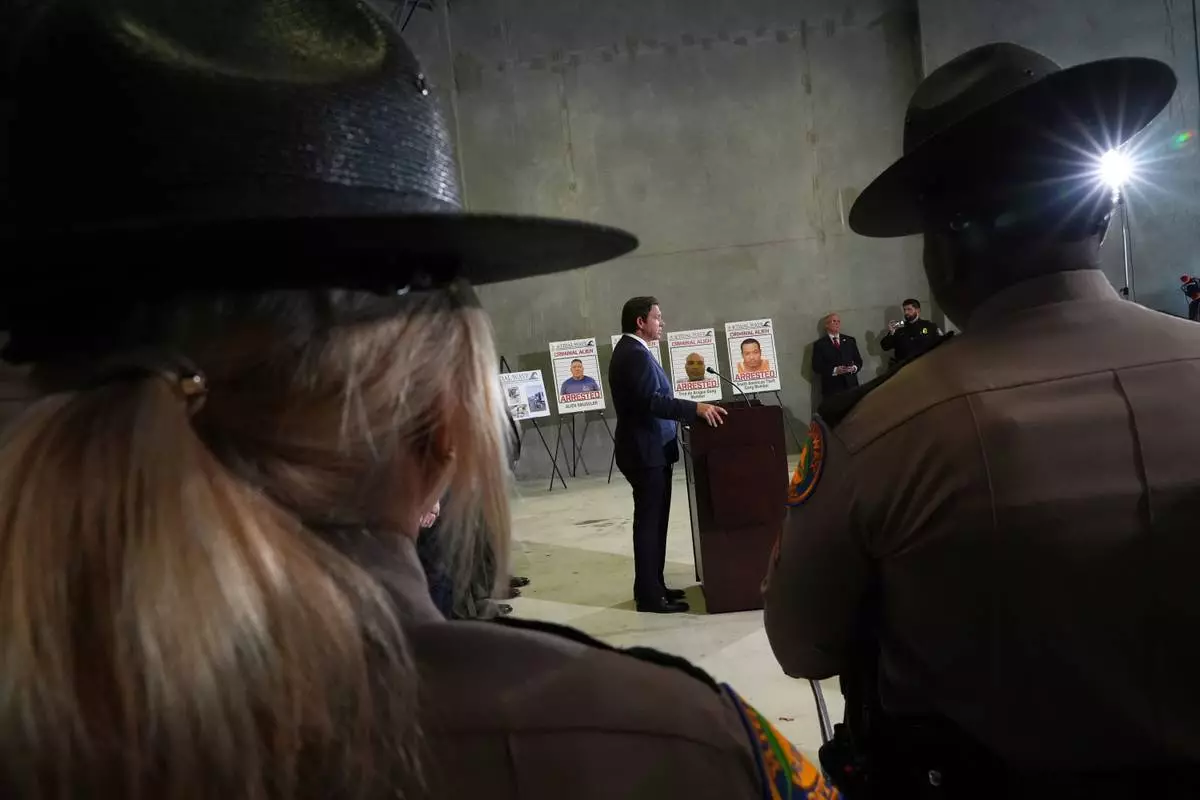
FILE - Florida Highway Patrol officers listen to Gov. Ron DeSantis speak during a press conference about a recent immigration enforcement operation, at the South Florida office of U.S. Immigration and Customs Enforcement and Enforcement and Removal Operations, May 1, 2025, in Miramar, Fla. (AP Photo/Rebecca Blackwell, File)
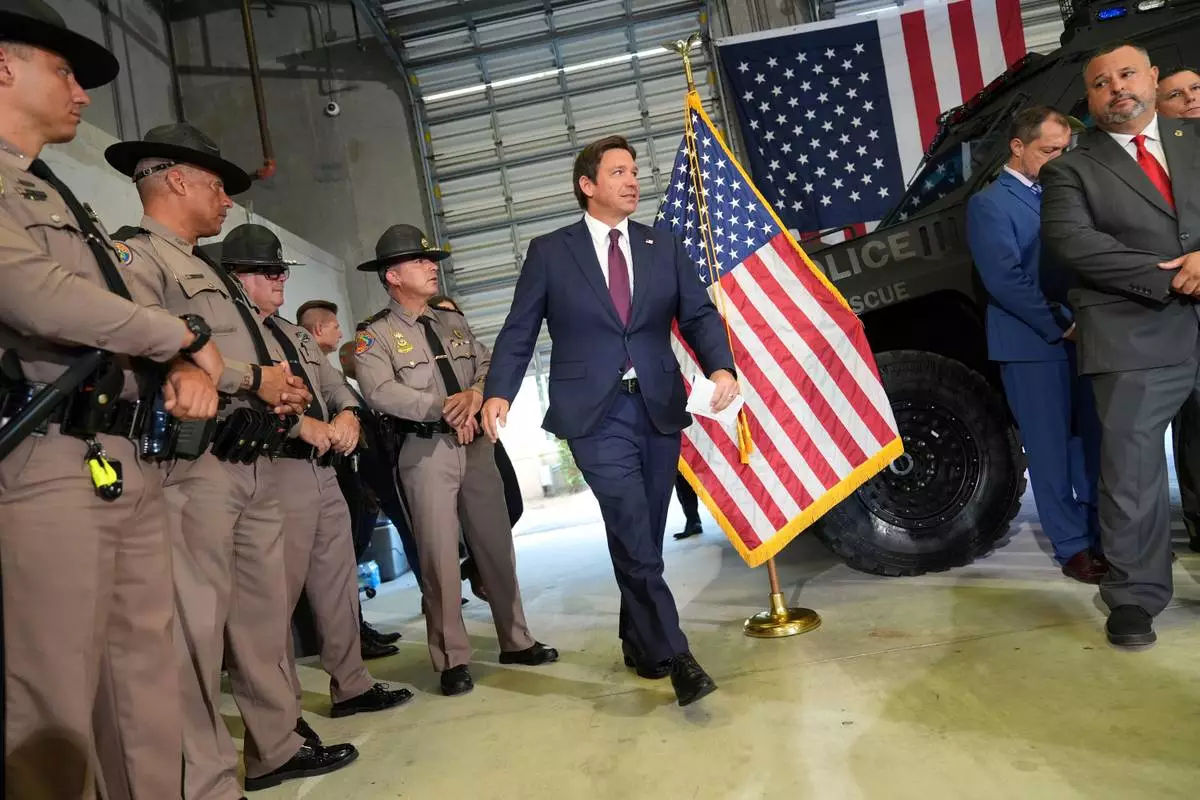
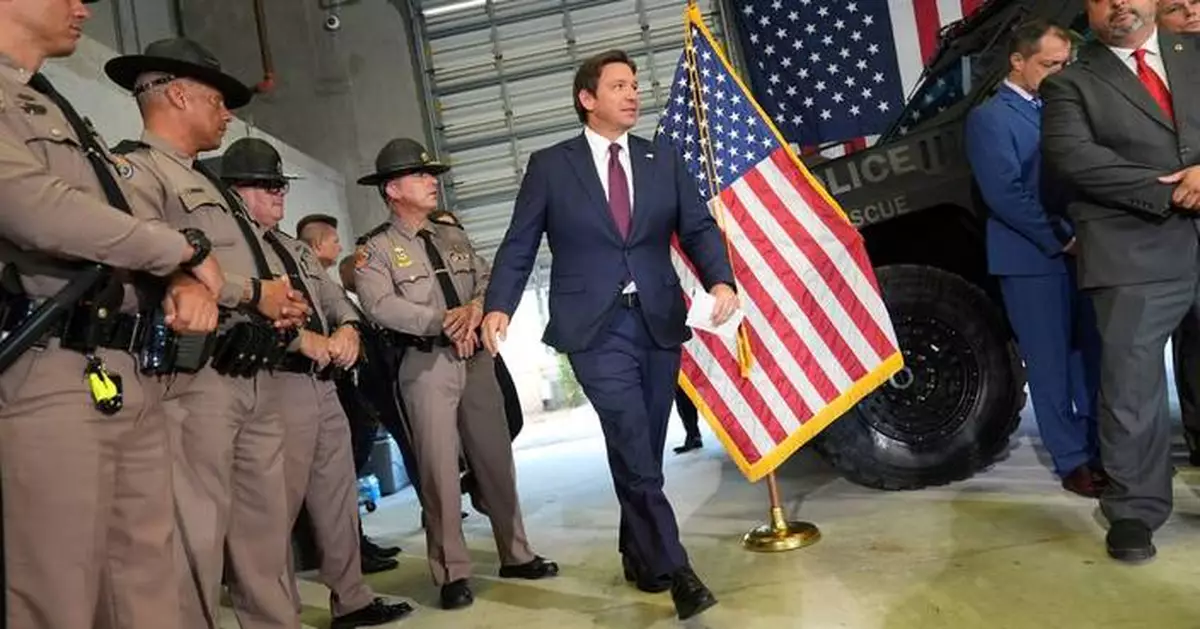
FILE - Florida Highway Patrol officers watch Gov. Ron DeSantis arrive at a press conference about a recent immigration enforcement operation, at the South Florida office of U.S. Immigration and Customs Enforcement and Enforcement and Removal Operations, May 1, 2025, in Miramar, Fla. (AP Photo/Rebecca Blackwell, File)