FRANKFURT, Germany (AP) — The European Central Bank on Thursday became the first major central bank to raise interest rates in response to the Iran war as policymakers around the world including new U.S. Federal Reserve Chair Kevin Warsh wrestle with how to confront the inflation fed by sharply higher oil prices.
The ECB’s rate-setting council raised its benchmark rate to 2.25% from 2%, where it had been for a year. The move comes ahead of rate-setting meetings next week at the Fed, the Bank of Japan, and the Bank of England.
Oil prices have risen sharply due to Iran choking off the flow of crude oil through the Strait of Hormuz, the sea passage for a fifth of the world’s oil and fuel products during normal times. Raising rates aims to dampen the consumer price inflation fed by higher costs for products made from crude such as gasoline, diesel fuel, cooking gas and heating oil.
International benchmark Bent crude was trading at around $93 per barrel on Thursday, up from around $73 on the eve of the war. That has helped push inflation to 3.2% in May in the 21 countries that use the euro currency, above the ECB’s target of 2%.
But ECB policymakers must also consider the impact of higher borrowing costs on an economy showing only mediocre growth. That has led analysts to think Thursday’s hike will be a one and done affair, aimed mainly at signaling to financial markets that the bank is determined not to get behind the curve if inflation spirals higher.
The bank's future decisions depend to a great extent on how long energy prices remain elevated and how high they go, ECB President Christine Lagarde said at a post-decision news conference. She said the bank was “well positioned to navigate the uncertainty caused by the war” and would “closely monitor the situation and follow a data-dependent and meeting-by-meeting approach.” She said the bank was “not pre-committing to a particular rate path.”
She said oil prices were expected to “lift inflation further over the summer” and that inflation was expected to remain “well above target” into the first half of next year. The Strait of Hormuz has been closed to most ship traffic for 103 days now.
Central banks in Australia and the Philippines have raises rates since the start of the war, and attention is focusing now on decisions in larger economies. For its part, the U.S. Federal Reserve is expected to keep its key interest rate unchanged when it meets next week with new chair Warsh, appointed earlier this year by President Donald Trump.
Warsh advocated for rate cuts last year and Trump repeatedly attacked Warsh’s predecessor, Jerome Powell, for not cutting borrowing costs deeply enough. Yet with inflation jumping to a three-year high as gas prices have spiked in the wake of the Iran war, even Trump and his officials have started to shift their focus more to a push to keep rates unchanged.
The Fed is likely to change the statement it issues after each meeting by removing language that had suggested that its next move would be a cut. That would open the door for a rate hike down the road. Many Fed officials have warned that if inflation doesn’t begin to cool soon, a rate hike may be necessary by the end of the year.
Raising benchmark rates influences what lenders charge throughout the economy, increasing the cost of borrowing money to buy things and thus dampening demand for goods. Higher central bank rates can send interest costs higher for home purchases, investment in new factories, and government borrowing.
The ECB may be able to get by with only one or two increases because the inflationary surge may be milder than feared, said Carsten Brzeski, global chief of macro at ING bank.
That is because consumers burned by the post-pandemic spike in inflation are in no mood to pay higher prices, leaving businesses little choice but to swallow higher energy costs: “The pass-through of higher energy and input prices to final consumption will be limited due to a lack of ability and willingness of consumers to actually pay for these higher prices,” he wrote in an emailed comment.
——
Rugaber reported from Washington.
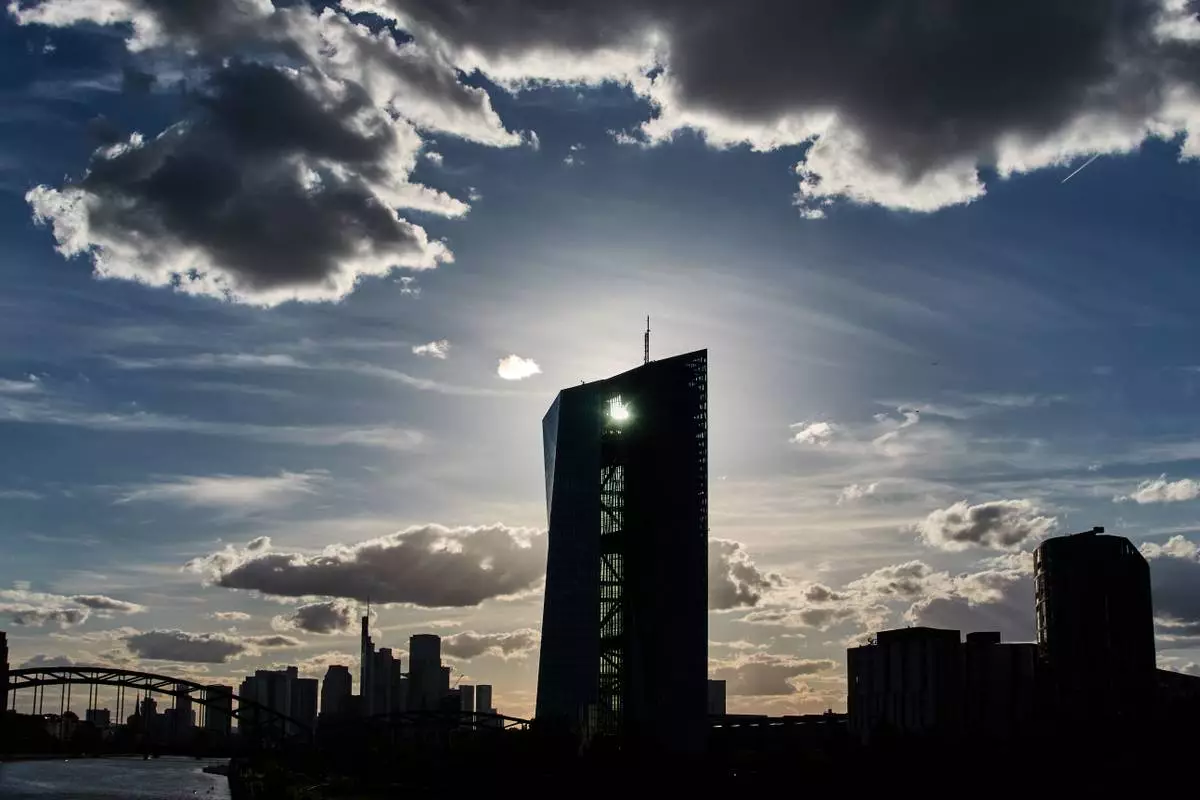
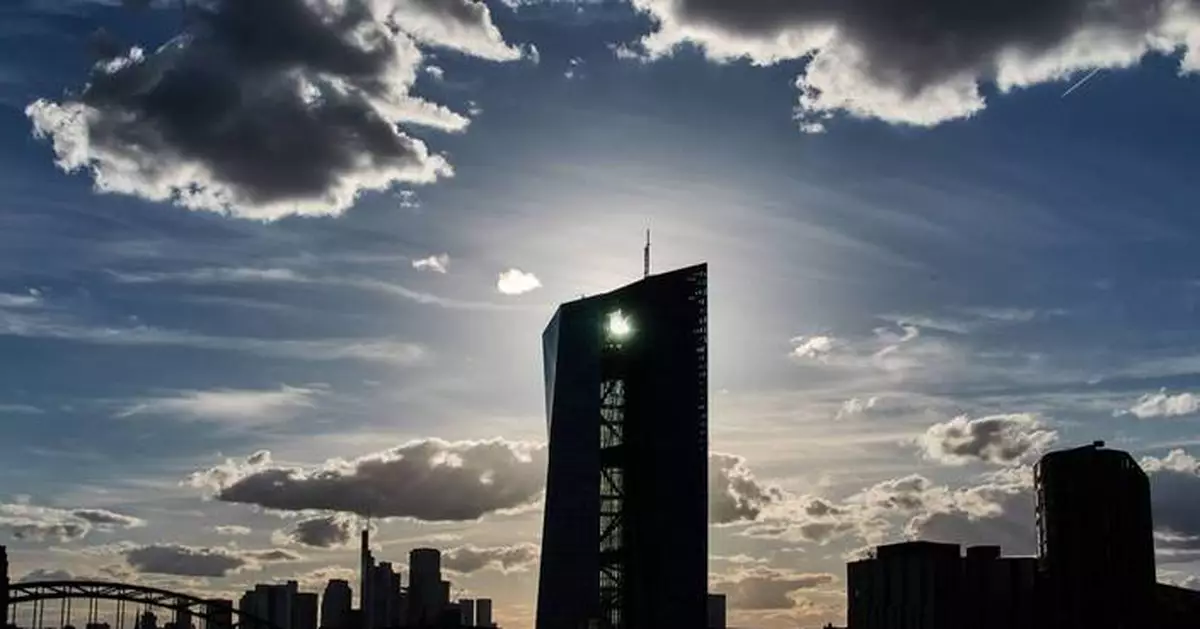
The European Bank is pictured in Frankfurt, Germany, Tuesday, June 9, 2026. (AP Photo/Michael Probst)
ARGUINEGUÍN, Spain (AP) — Pope Leo XIV traveled to a once-notorious epicenter of the European migration debate on Thursday, challenging countries to uphold migrants’ rights while shaming those leaders, including Christians, who turn them away with indifference.
Leo issued an impassioned plea to recognize the dignity of migrants from the port of Arguineguín, in the Canary Islands. In 2020, the port was dubbed “dock of shame” because of the squalid conditions migrants were forced to live in for months during a spike in arrivals.
“Human dignity has no passport and does not lose its value when crossing a border,” Leo said, with rescue ships docked behind him and a simple wooden cross made from a shipwrecked migrant boat nearby.
Leo is spending the final two days of his weeklong trip to Spain in the Canary Islands, a Spanish archipelago closer to Africa than the Iberian Peninsula and a key point of entry for migrants who make the perilous Atlantic crossing from West Africa.
He is fulfilling a wish of Pope Francis to visit the islands to commemorate the thousands of lives lost at sea.
With two migrants standing by him, Leo threw a bouquet of flowers into the sea. The gesture recalled one Francis made in 2013, at the start of his pontificate, when he visited another migration flashpoint in Lampedusa, Sicily and denounced the “globalization of indifference” that the world showed migrants.
The Canary Islands have long been a stepping stone for migrants trying to reach Europe from West Africa and Morocco. Some experts consider the Atlantic route they take to get here more deadly than the more well-known central Mediterranean smuggling route from Libya and Tunisia to Italy.
Migrant arrivals in the Canary Islands peaked in 2024 at nearly 47,000. Following pressure and deals between the European Union, Spain and the governments of several West African nations, arrivals have fallen dramatically, with just over 3,000 people landing there in the first five months of 2026.
Upon his arrival, Leo went straight to the port in Arguineguín, where in 2020 arrivals reached such numbers that migrants were forced to sleep on the dock in makeshift camps in the open air.
Many spent weeks just a blanket and no showers. Potential asylum seekers had no proper access to legal advice and some people were held for weeks, much longer than the three days that the law allowed. The ombudsman later forced the government to shutter the makeshift camp and relocate the migrants in hotels that had been emptied by COVID-19.
At the port on Thursday, Leo sat under a shaded platform while a fierce midday sun baked down on the migrants and aid workers. He heard testimonies from rescue workers, humanitarian workers and the personal story of a Nigerian victim of human trafficking. Nearby a banner, recalling the port's former nickname, rebaptized it “Dock of Hope.”
“Dear migrants, before saying anything else to you, I want to bow before your dignity,” Leo said to them, bowing his head slightly.
Addressing the Nigerian woman and other women who have been trafficked and forced into prostitution, Leo assured them: “If others have put a price on your body, know that God has never ceased to recognize your inestimable worth,” he said.
He urged countries of origin to create the security and economic conditions so people are not forced to flee, and for transit countries to protect migrants so they don’t fall prey to smugglers. And he appealed to the “conscience of Europe, which cannot claim to uphold human dignity while growing accustomed to the Mediterranean and the Atlantic becoming unmarked graves.”
In one of the most powerful speeches of his pontificate, dedicated entirely to migration, Leo listed the rights of migrants to flee or remain. But he didn't mention the right of nations to control their borders or limit asylum requests as he has done in the past. And significantly, he insisted that if one is Christian, one cannot ignore the plight of migrants.
“May history not accuse us of turning the pain of those who suffer into a common sight along our shores,” he said. “Today, here by the sea, every individual that arrives asks us what remains of our humanity. Sooner or later, it will be known whether we protected life or whether we yielded to indifference.”
Among the migrants waiting for Leo was Mame Amandou Neang, a 56-year-old who arrived in the Arguineguín port from Senegal earlier this year.
“This is a great honor,” said Neang. “We hope that if we see him, all our problems will stay behind us, we will forget our problems, because we have many things to forget for the moment.”
The International Organization of Migration’s Missing Migrants Project has recorded some 6,600 deaths on the Atlantic route from West Africa since it began keeping record in 2014. But it admits their estimate is a vast undercount due to the lack of information on the route and the phenomenon of “invisible shipwrecks.”
Since 2020, Spanish migrants rights group Walking Borders estimates more than 25,000 dead or missing trying to reach the Canary Islands.
Francis had made the plight of refugees a hallmark of his papacy, following the Gospel mandate to “welcome the stranger.”
Leo has followed suit, insisting especially on the dignity of migrants in his native United States amid the Trump administration’s crackdown and mass deportation program.
Next month, on July 4, the American pope will spend U.S. Independence Day on the island of Lampedusa, where Francis in 2013 first denounced the “globalization of indifference” the world shows migrants.
Winfield reported from Las Palmas de Gran Canaria, Spain. Brito contributed from Barcelona, Spain.
Associated Press religion coverage receives support through the AP’s collaboration with The Conversation US, with funding from Lilly Endowment Inc. The AP is solely responsible for this content.
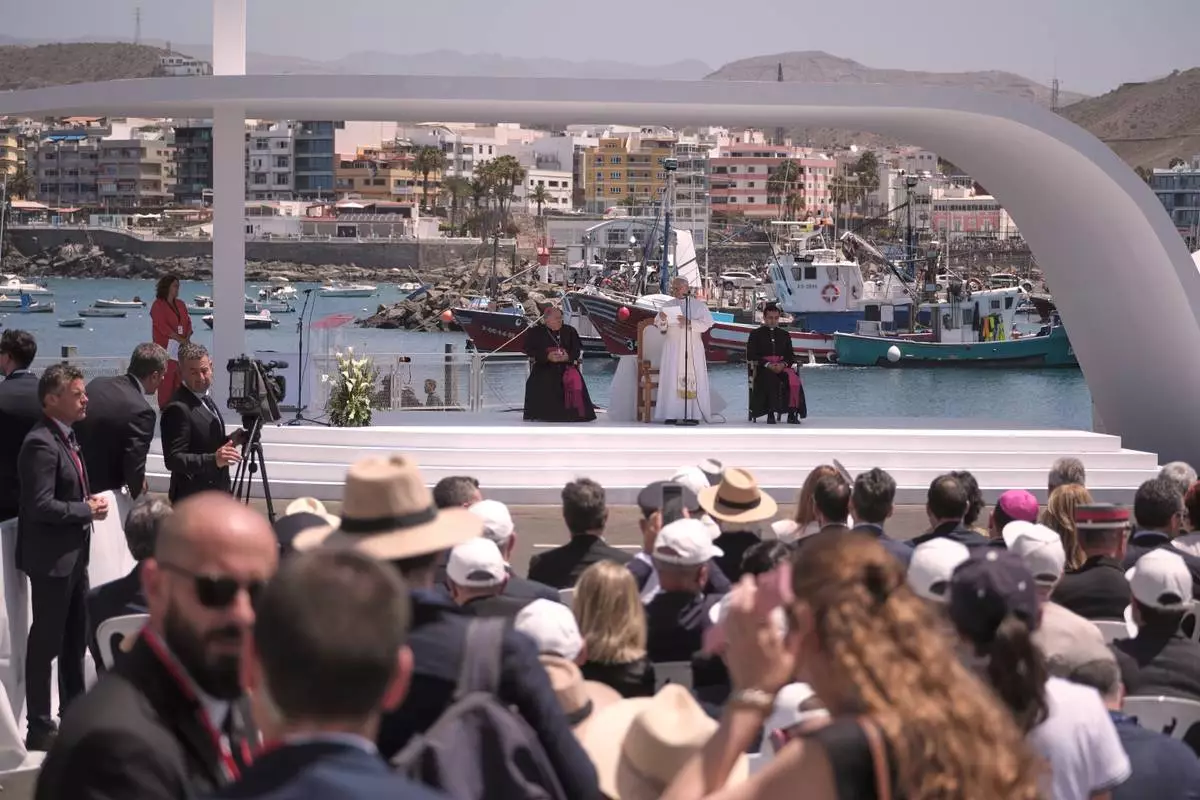
Pope Leo XIV attends a meeting with organizations working with migrants in Arguineguin in Las Palmas de Gran Canaria, Spain, Thursday, June 11, 2026.(AP Photo/Arturo Rodriguez)
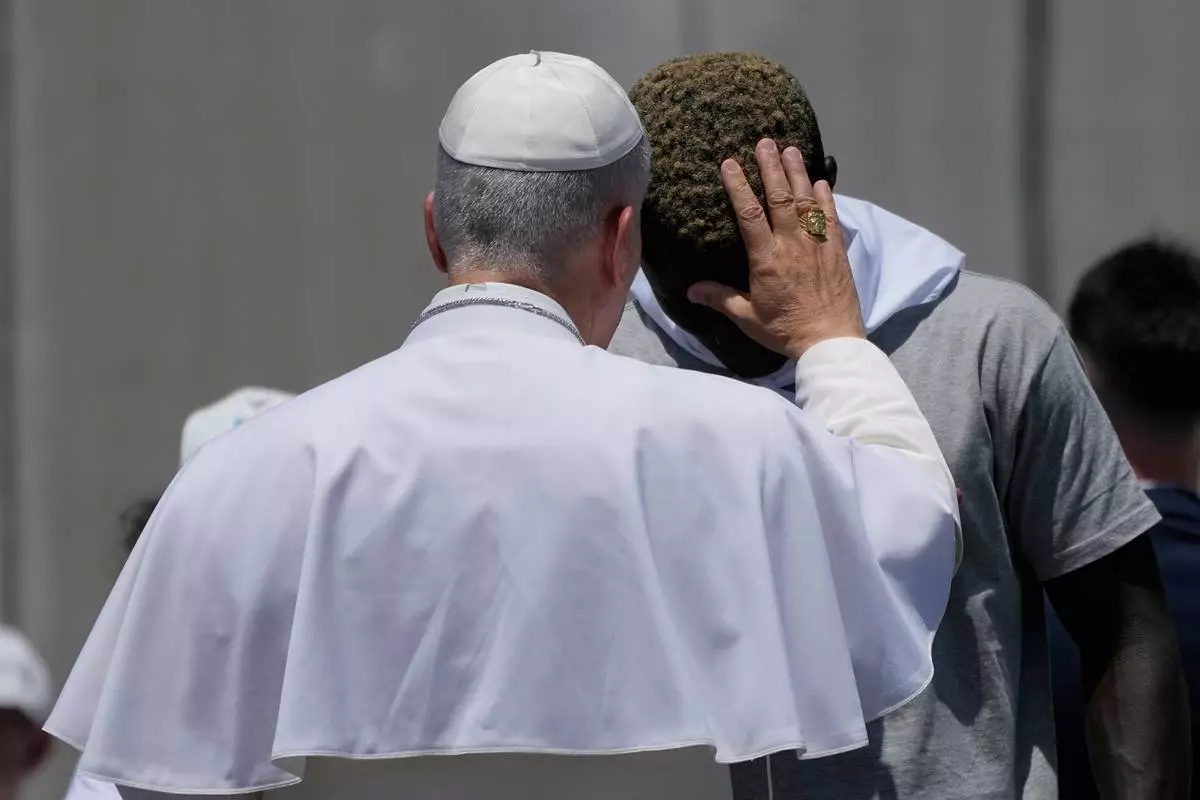
Pope Leo XIV blesses a migrant during a meeting with organisations working with migrants in Arguineguin at the Canary Islands, Spain, Thursday, June 11, 2026. (AP Photo/Alessandra Tarantino)
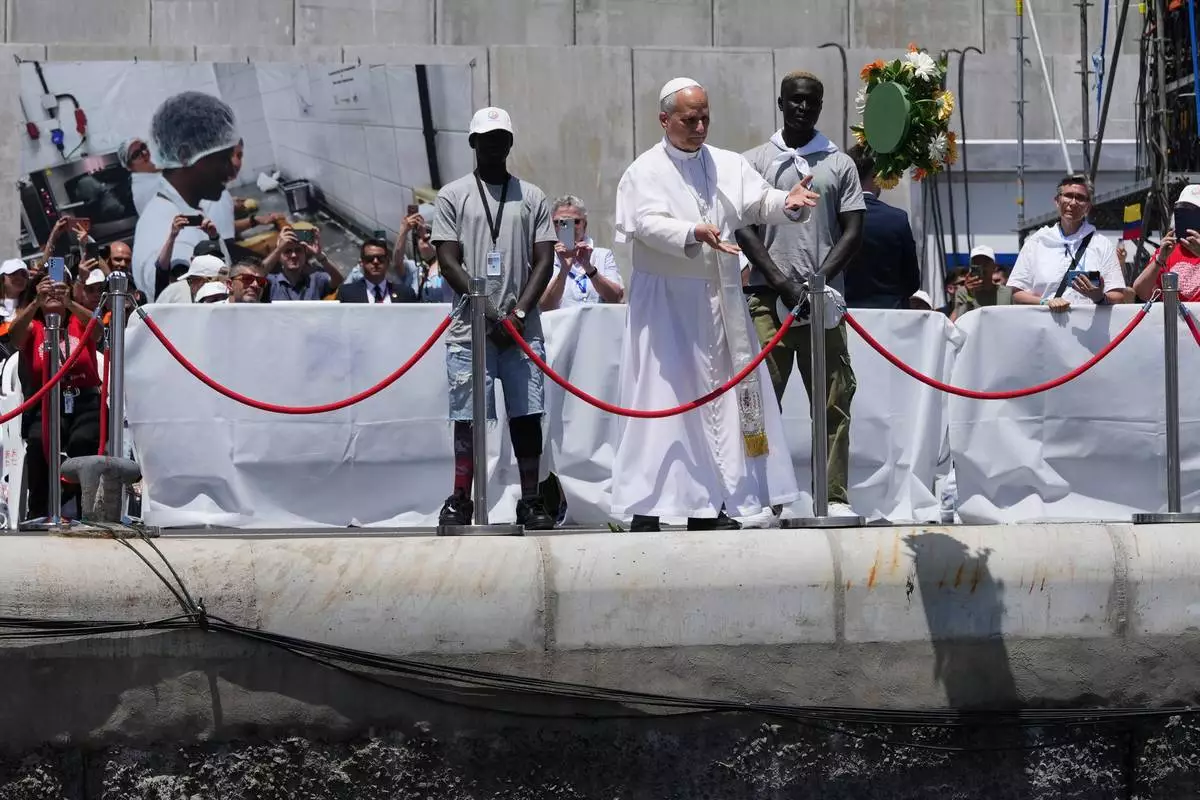
Pope Leo XIV throws a bouquet of flowers into the sea, flanked by migrants, during a meeting with organisations working with migrants in Arguineguin at the Canary Islands, Spain, Thursday, June 11, 2026. (AP Photo/Alessandra Tarantino)
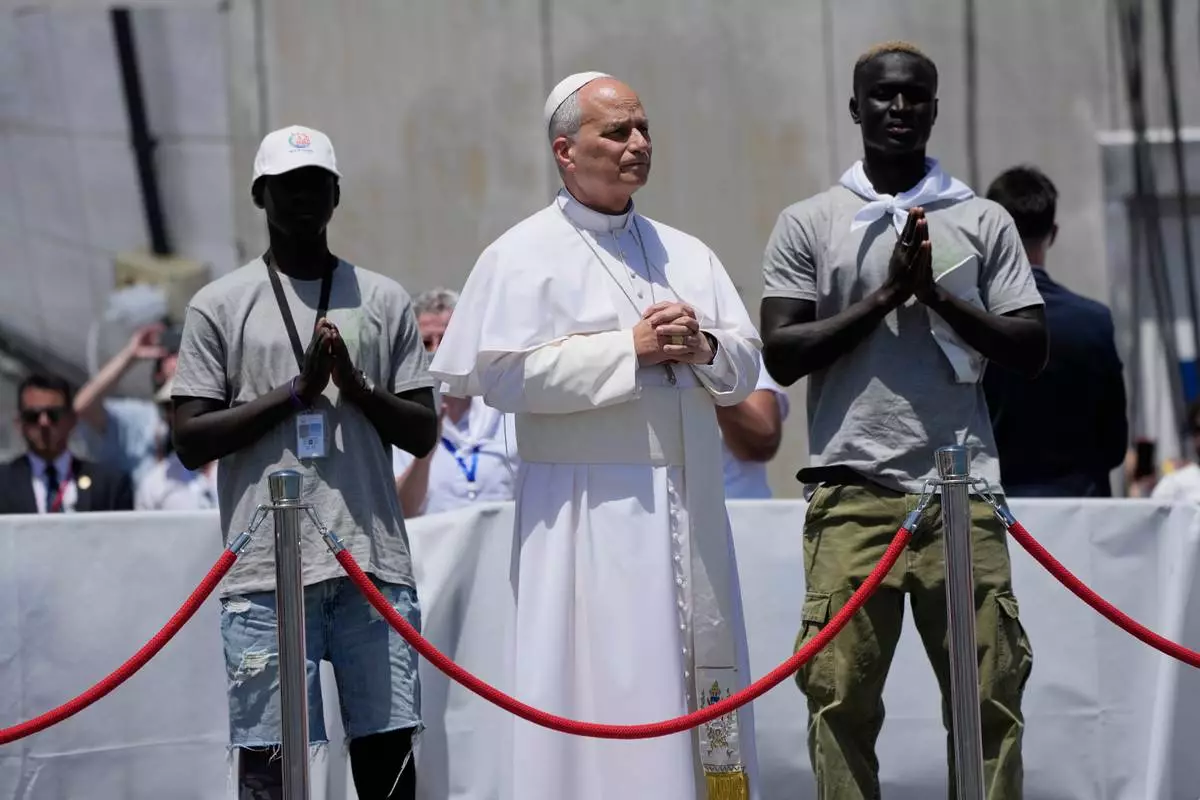
Pope Leo XIV attends a meeting with organisations working with migrants in Arguineguin at the Canary Islands, Spain, Thursday, June 11, 2026. (AP Photo/Alessandra Tarantino)
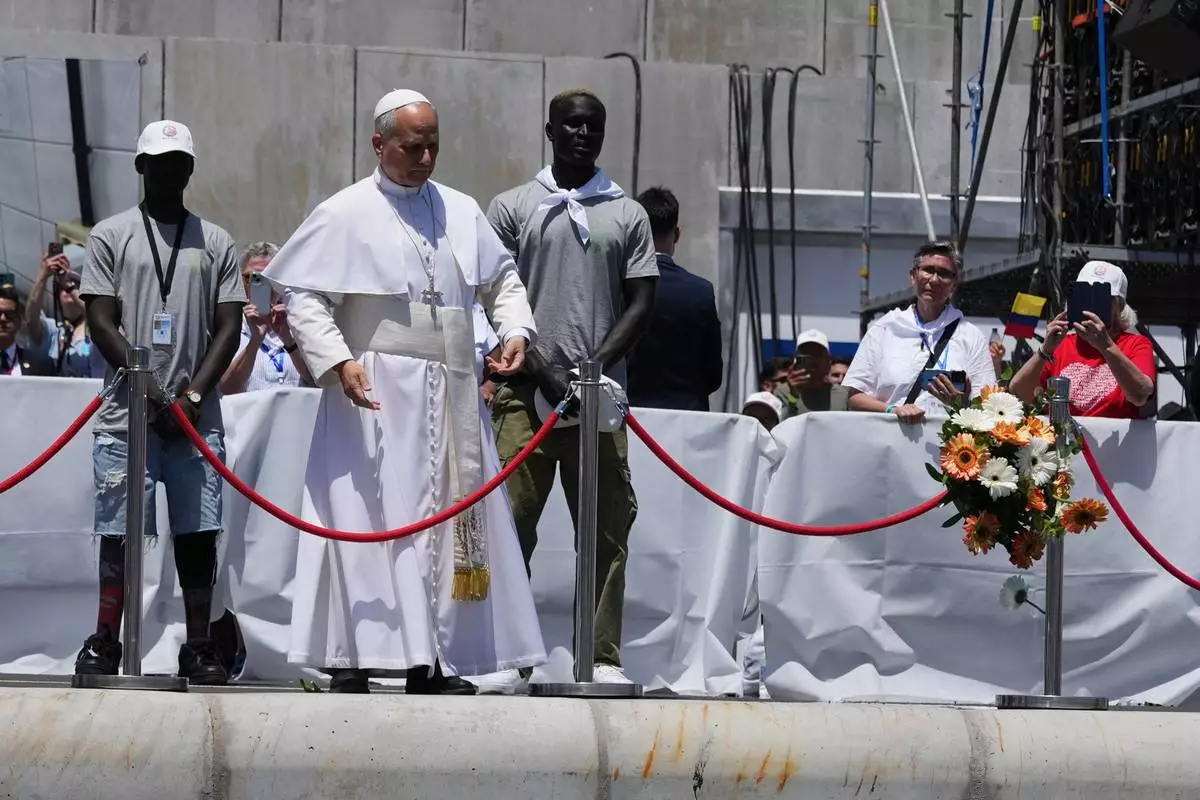
Pope Leo XIV throws a bouquet of flowers into the sea, flanked by migrants, during a meeting with organisations working with migrants in Arguineguin at the Canary Islands, Spain, Thursday, June 11, 2026. (AP Photo/Alessandra Tarantino)
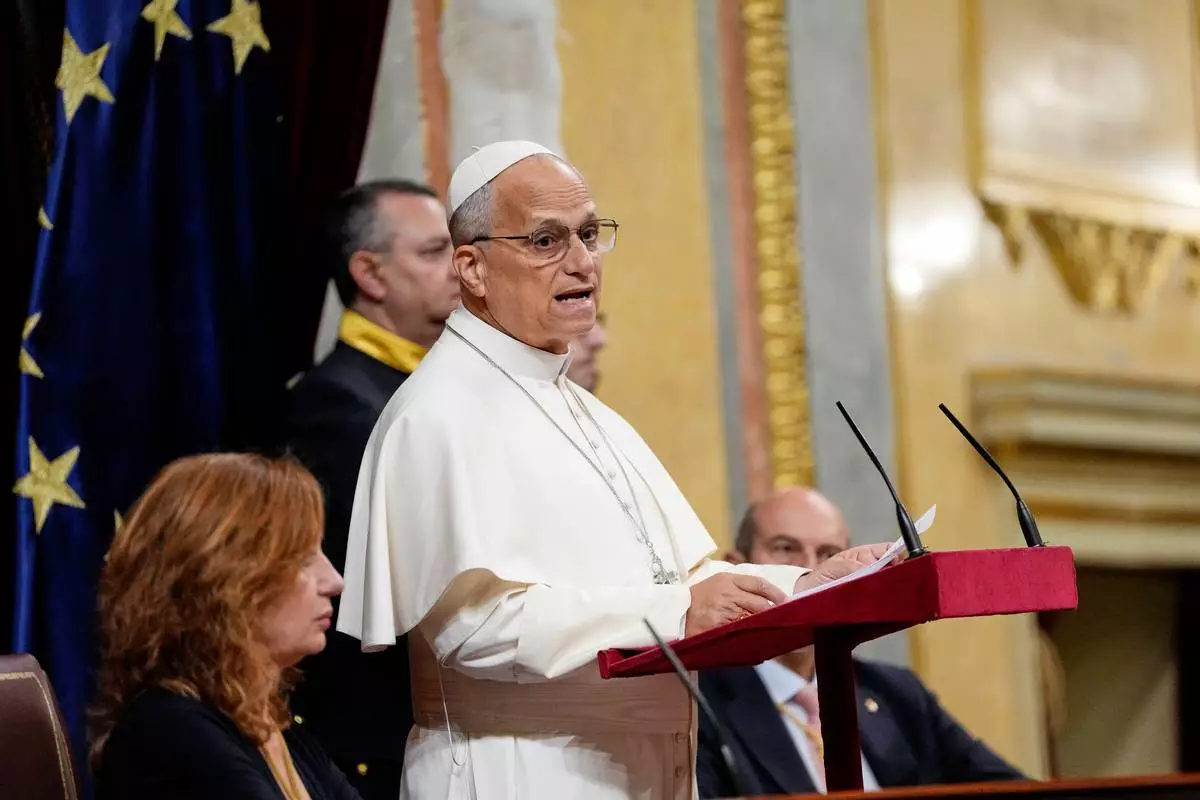
Pope Leo XIV delivers his speech as he meets with members of the Spanish Parliament at the Congress of Deputies, in Madrid, Monday, June 8, 2026. (AP Photo/Alessandra Tarantino)
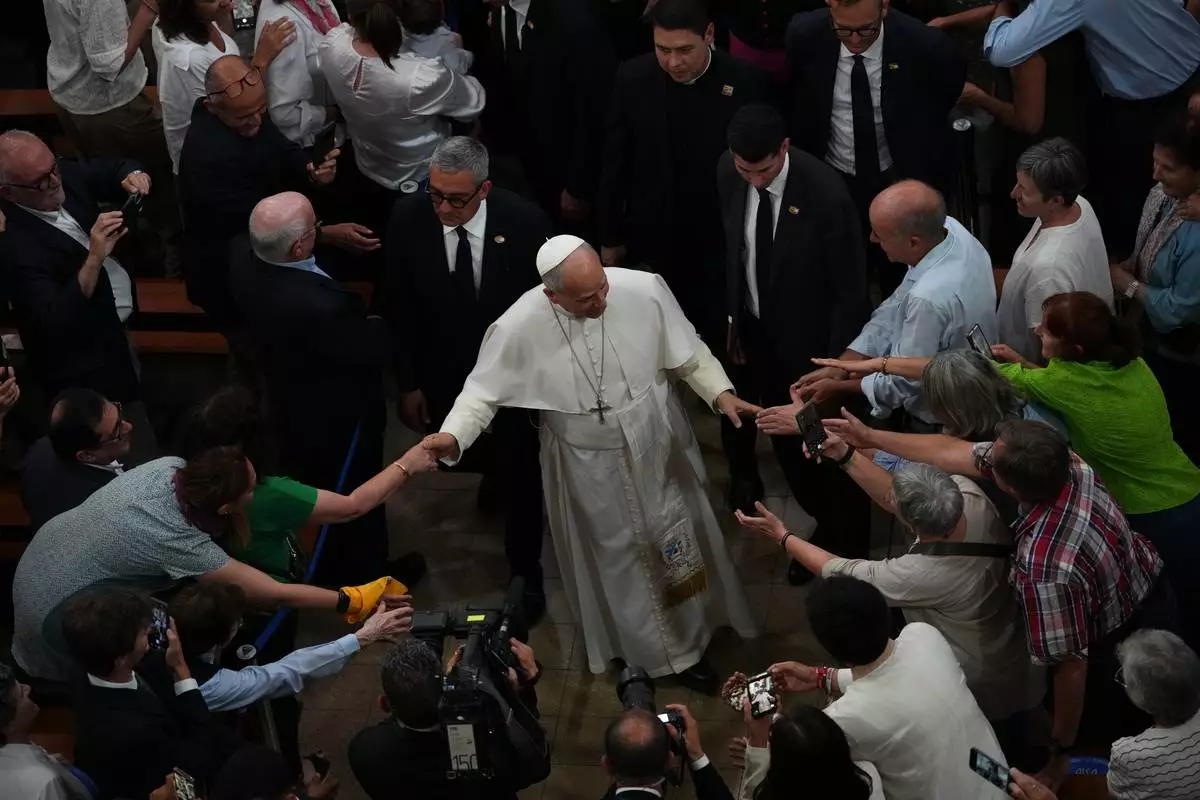
Pope Leo XIV leaves at the end of a meeting with faithful and members of the diocesan charity and welfare organizations in the Church of Sant Agusti in Barcelona, Spain, Wednesday, June 10, 2026 (AP Photo/Alessandra Tarantino)
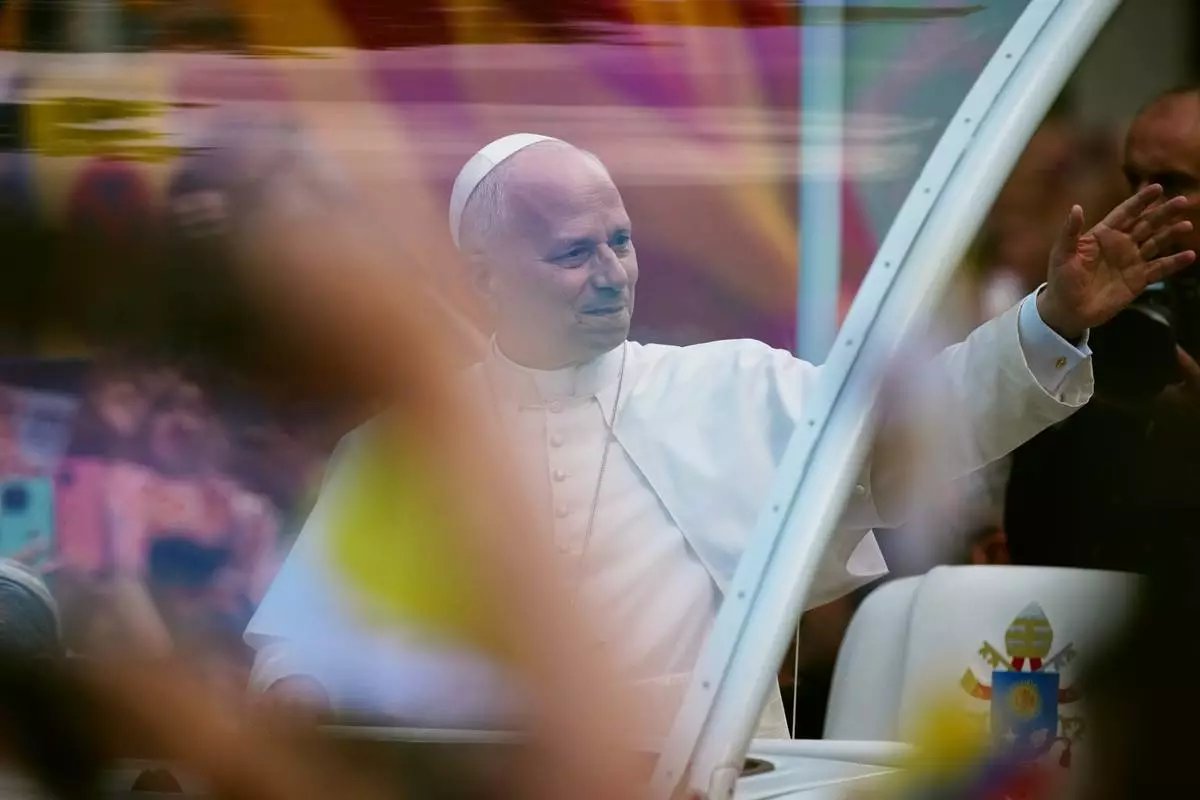
Pope Leo XIV waves as he arrives to celebrate Mass at the Basilica of the Sagrada Familia in Barcelona, Spain, Wednesday, June 10, 2026. (AP Photo/Joan Mateu Parra)