A grassroots football league in Shanghai, which brings together football lovers from around the world, fosters cross-cultural community connections and drives local economic growth through the sport.
TJ Lokomotiva Shanghai is one of the 32 teams in a football league that has been thriving for over two decades. Though players come from different cultures and all walks of life, they are united on the pitch by one universal language: football.
"I'm Ondrej from the Czech Republic. It's my honor to play mostly as a center-back for Lokomotiva. My side job is a lawyer in Shanghai," said Ondrej Zapletal, a player from Lokomotiva.
"I'm Sam, I'm from Beijing. I'm an entrepreneur," said Sam Xue, another player.
"My name is Pema Tashi, I come from Qinghai. I'm a director," said Pema Tashi, another player.
"My name is Isa, I'm from Turkmenistan. I'm coaching Lokomotiva U45," said Isayev Meylis, coach of Lokomotiva.
The league is supported by local sponsors, including restaurants, bars, and consumer brands that back individual teams. In return, players and supporters become loyal patrons, driving a self-sustaining economic cycle.
"I've been sponsoring the team for seven years. I love this team because this team is like a family. We have people from all around the world," said Nick Lin, a sponsor for Lokomotiva and the owner of a local bar.
"I've been with the team for over three years. I always look forward to playing football with my teammates and then grabbing a drink every weekend," said Seven Sun, another Lokomotiva sponsor and distributor for a Xizang-based mineral water company.
"Grassroots leagues are transforming China's sports industry. A new business model is shifting focus away from strictly professional sports. Now, community-based leisure sports are thriving, creating a much more diversified market. Their economic impact is profound. For Suchao, we found a one-yuan ticket can drive over seven yuan in related spending. Consumption is driven not by star power, but by emotional connection, supporting a neighbor, a colleague, or a friend," said Qiu Lijin, assistant professor of marketing at the School of Management of Fudan University.

Shanghai grassroots football league fosters cross-cultural exchanges, fuels local economy
Sticky rice dumpling producers in east China's Zhejiang Province are experimenting with new flavors and scaling up output ahead of the Dragon Boat Festival, a major holiday in China closely associated with the traditional food, known as zongzi.
More than one billion of these dumplings are produced each year in Zhejiang's Jiaxing City, which ranks first in the country in terms of zongzi output, output value, and sales revenue. Much of that production happens in preparation for the Dragon Boat Festival, which falls on June 19 this year.
Factories in the city have been buzzing since the beginning of peak season for zongzi production, which arrives in March every year. Zhejiang Qinglian Food Company has been receiving orders from all over the country since March and is currently operating at full capacity, with a peak daily output of nearly 200,000 zongzi.
"Our overall production capacity has increased by about 40 to 50 percent compared with the same period last year, and sales have grown proportionally. Market feedback has been very positive, with products selling across the country, particularly in the Shanghai and Hangzhou areas," said Guo Shali, general manager of the company's fresh zongzi business unit.
Wufangzhai, another leading zongzi company in Jiaxing, has been dedicating significant effort to new product development in recent years. Beyond traditional offerings like meat and red bean paste zongzi, the company has introduced innovative options such as eel and small fish zongzi, marketing them with a "low-fat and health-conscious" appeal.
"Our philosophy is that 'anything can be a zongzi filling. While eel is highly popular in Japan, China holds unique advantages across the entire eel supply chain. By combining these elements, we were able to create an eel zongzi that remains relatively affordable for consumers," said Li Yanfei, deputy general manager of Wufangzhai's international business department.
Stores around China are beginning to stock zongzi as consumers get ready to celebrate the holiday. In addition to brick-and-mortar sales, zongzi companies are investing heavily in e-commerce to expand their market reach, driven by improvements in freshness-preserving technology.
The zongzi’s connection to the Dragon Boat Festival is a tradition that goes back thousands of years. The holiday commemorates the life and death of Qu Yuan (340 BC-278 BC), who committed suicide by wading into the Miluo River in protest against the wrongful policies of the feudal dynasty in his times.
The local people raced their boats to find the beloved Qu in the river and threw balls of sticky rice into the river to keep the fish from eating his body. Since then, people have been celebrating the festival by holding dragon boat races and eating the traditional dumplings.
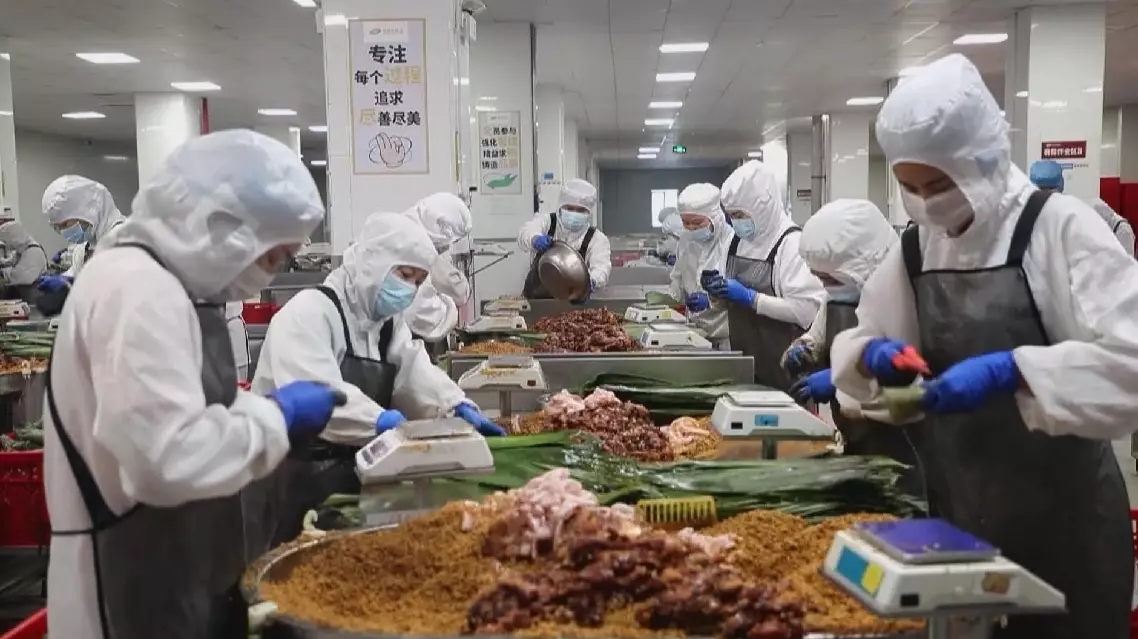
Chinese Zongzi companies pump up production ahead of Dragon Boat Festival