Taylor Hall was a No. 1 pick in the draft in 2010. He was the NHL's MVP in 2018.
Now, he is a Stanley Cup champion.
Click to Gallery

Carolina Hurricanes left wing Taylor Hall celebrates after a win over the Vegas Golden Knights in Game 6 of the NHL hockey Stanley Cup Final series, Sunday, June 14, 2026, in Las Vegas. (AP Photo/John Locher)
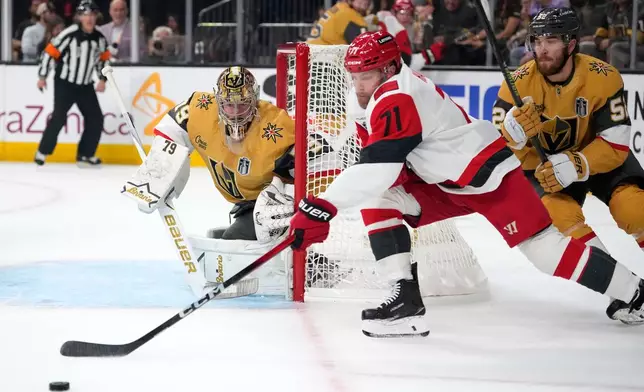
Carolina Hurricanes left wing Taylor Hall, center, attempts a wrap around as Vegas Golden Knights goaltender Carter Hart, left, and defenseman Dylan Coghlan defend during the first period in Game 3 of the NHL hockey Stanley Cup Final series Saturday, June 6, 2026, in Las Vegas. (AP Photo/John Locher)

Carolina Hurricanes left wing Taylor Hall shoots and scores during the first period in Game 6 of the NHL hockey Stanley Cup Final series against the Vegas Golden Knights, Sunday, June 14, 2026, in Las Vegas. (AP Photo/John Locher)

Carolina Hurricanes left wing Taylor Hall (71) celebrates after a goal by right wing Jackson Blake (53) during the second period in Game 6 of the NHL hockey Stanley Cup Final series against the Vegas Golden Knights, Sunday, June 14, 2026, in Las Vegas. (AP Photo/Candice Ward)

Carolina Hurricanes left wing Taylor Hall, center, celebrates his goal with teammates during the first period in Game 6 of the NHL hockey Stanley Cup Final series against the Vegas Golden Knights, Sunday, June 14, 2026, in Las Vegas. (AP Photo/John Locher)
“You never know. You never know what kind of turn your life’s going to take,” Hall said after hoisting the trophy. "It was heavy. It was heavy, unbalanced but amazing.”
No longer in the prime of his career, the 34-year-old Hall was one of the biggest reasons the Carolina Hurricanes won 16 of 19 games during this playoff run.
“He’s fast, he’s physical (and) he makes great plays with the puck,” defenseman Jaccob Slavin said. “He’s selling out to block shots. And so you need that. He’s really just been a complete player this whole playoffs.”
Hall took on a workmanlike role on a line alongside 23-year-old Logan Stankoven and 22-year-old Jackson Blake. That trio led the way through the first three rounds of the playoffs and in the final against Vegas. Hall was a force in every way — generating offense, hammering opponents and sacrificing himself on defense.
“Every line on our team has a physical aspect, and I think it falls on me to play like that,” Hall said. “Florida last year, there wasn’t a guy on their team that didn’t hit and didn’t make it really, really hard to be on the ice against them and you watch and learn.”
With Chicago, Hall played Carolina on Jan. 20, 2025, and liked what he saw in a hard-fought overtime loss.
“I got a first-hand glimpse of the intensity in which we play,” Hall said.
His agent had approached him about the Hurricanes' interest in him and a few days later he joined them as part of the same three-team trade that got them Mikko Rantanen. Initially, Hall was not in shape to play coach Rod Brind'Amour's brand of hockey.
But general manager Eric Tulsky liked what he saw in Hall.
“He brings a blend of speed, skill and heaviness that really fits for us,” Tulsy said. “He has the ability to get pucks into the zone, win pucks along the way and he has the vision and creativity and skill to get pucks to the middle and create scoring chances off it. We spend a lot of time in the offensive zone, and we need players like him who can not just win the battle along the wall but get it to premium ice and create those top-tier chances and he’s been able to do that for us.”
After starting in Edmonton and also playing for New Jersey, Arizona, Buffalo, Boston and Chicago, Carolina felt right.
“I’ve been kind of everywhere,” Hall said. “I got here and felt really at home within a couple days.”
He settled in the Raleigh area, and before the end of April signed a three-year extension worth just over $3 million annually. A lot went into it, including a bad experience as a free agent during the pandemic and being able to drive his dog to his offseason home.
“I was happy here, and I love the way we play and ultimately I saw this as a place that I think we could be here,” Hall said. “That’s what I envisioned, and everything else seemed like it made a lot of sense.”
Brind'Amour as a player was a grinder, a defense-first center who made a living out of stopping players like Hall. As a coach, he knew all about Hall's skill as a winger, his 93-point season in 2017-18 with New Jersey that got him the Hart Trophy and the kind of offensive talent the Hurricanes were getting.
The player who arrived was nothing like that.
“He didn’t bring any of that, ‘I’m an MVP’ and I’m going to do it this way.' It was, ‘What do I have to do?’” Brind'Amour said. “When he first got with us, he was playing like 12 minutes a night. It didn’t matter. It was whatever he has to do to win. That’s refreshing, and that’s good on him.”
Hall helped Carolina reach the 2025 Eastern Conference Final, then he and the team faltered against the defending-champion Panthers. That turned out to be an important lesson for a guy in his 30s thirsty for a title.
“I didn’t play well in that conference final at all, and I think just the way that Florida played and the way that I played, it was a learning experience for me even at 33,” Hall said. “It was just different way to play in the playoffs. There’s a way to play, and there’s a way that the really good teams do it. I took it over the summer and tried to just get better and better.”
Putting that into practice allowed Hall to set a record. His 18 seasons between getting drafted by Edmonton are the most before hoisting the Stanley Cup in league history for a No. 1 pick.
All because Hall made a conscious decision to fit exactly what the Hurricanes needed.
“It’s great for the role that we need him to play,” Slavin said. “I think he still has all the talent in the world, and you witness it night in and night out. He’s been great. And, yeah, has he adapted a little bit to how we play here? I think so. But that just speaks to the player that he is.”
AP NHL: https://apnews.com/hub/stanley-cup and https://apnews.com/hub/nhl
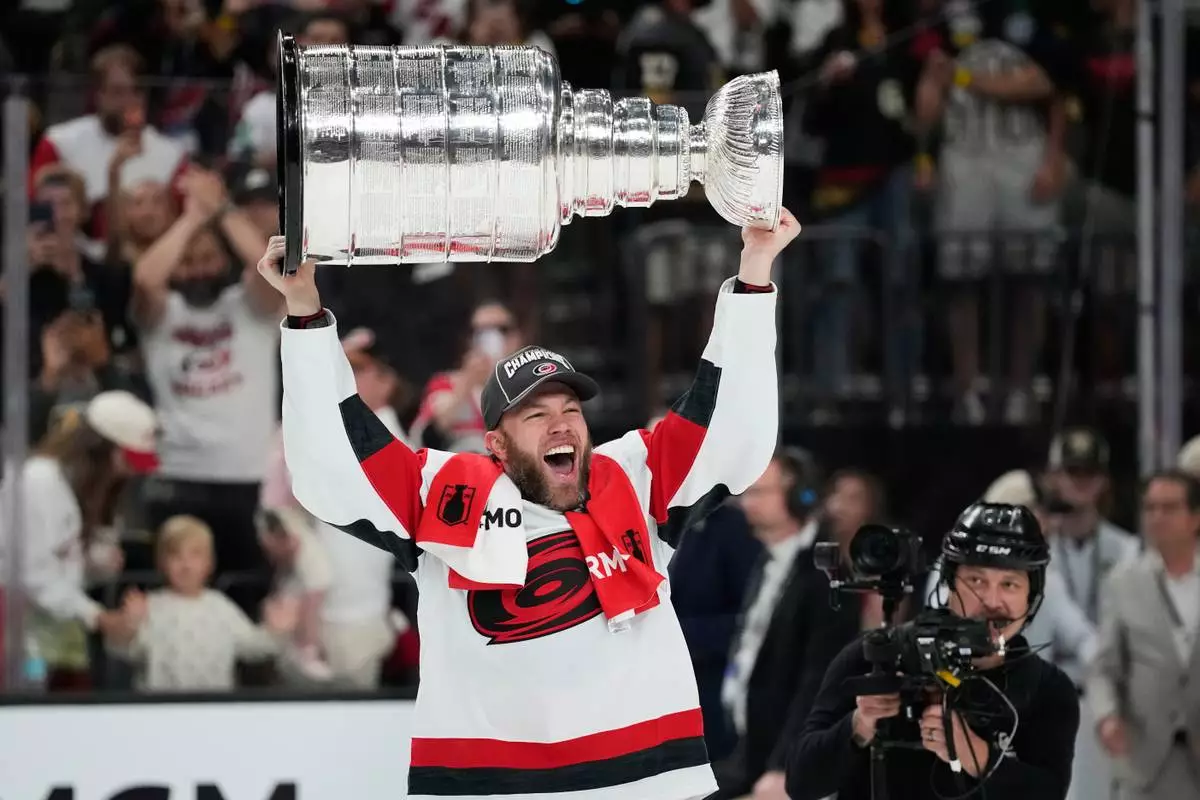
Carolina Hurricanes left wing Taylor Hall celebrates after a win over the Vegas Golden Knights in Game 6 of the NHL hockey Stanley Cup Final series, Sunday, June 14, 2026, in Las Vegas. (AP Photo/John Locher)
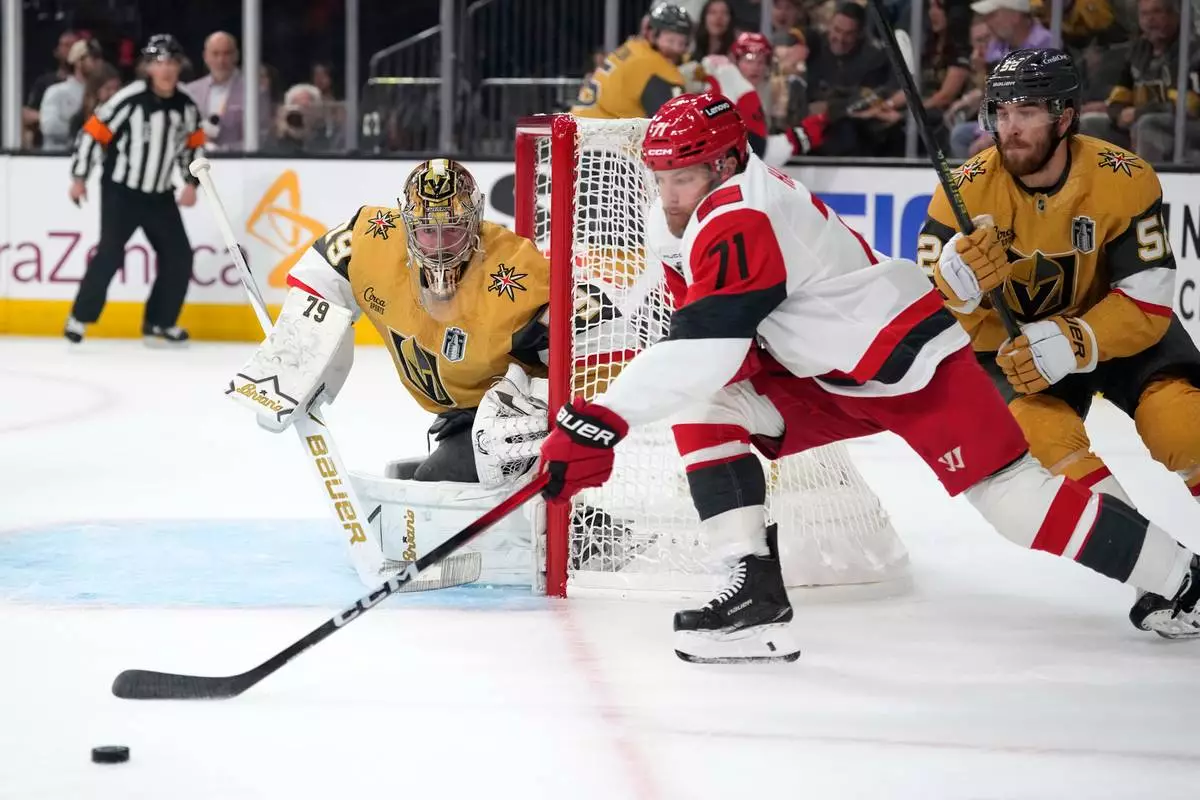
Carolina Hurricanes left wing Taylor Hall, center, attempts a wrap around as Vegas Golden Knights goaltender Carter Hart, left, and defenseman Dylan Coghlan defend during the first period in Game 3 of the NHL hockey Stanley Cup Final series Saturday, June 6, 2026, in Las Vegas. (AP Photo/John Locher)

Carolina Hurricanes left wing Taylor Hall shoots and scores during the first period in Game 6 of the NHL hockey Stanley Cup Final series against the Vegas Golden Knights, Sunday, June 14, 2026, in Las Vegas. (AP Photo/John Locher)
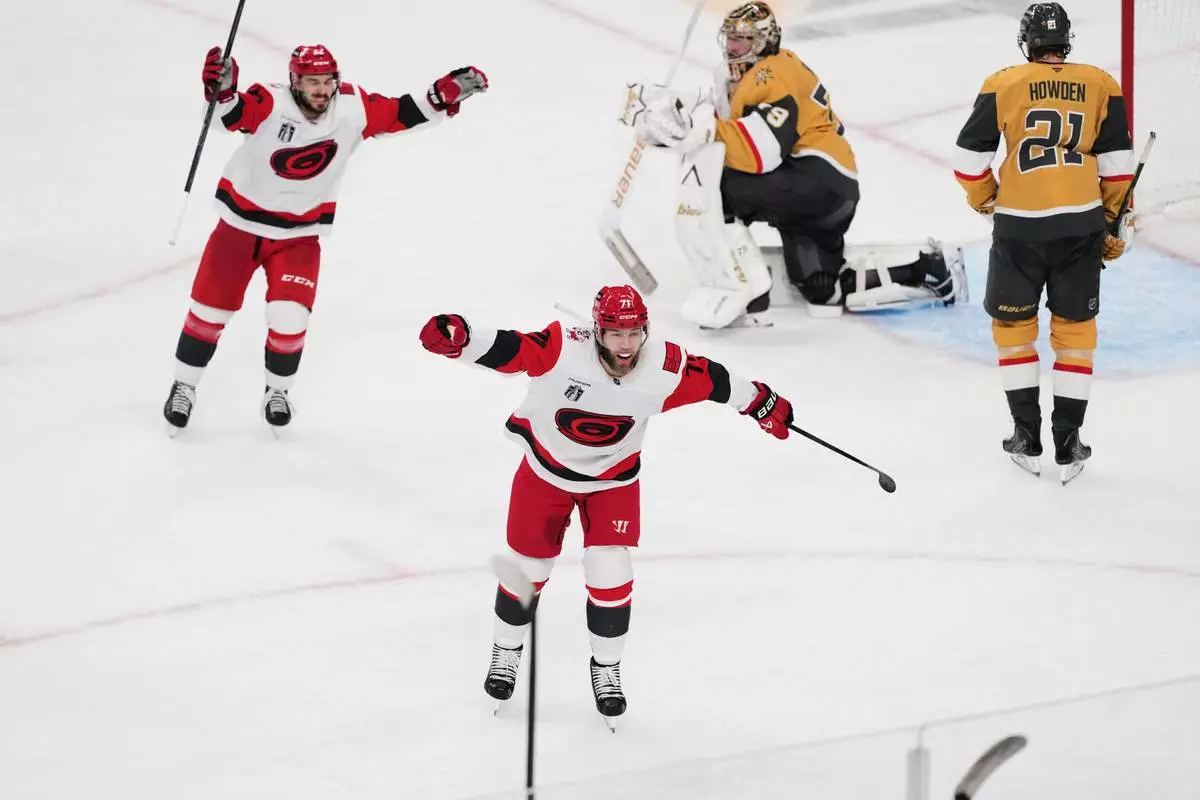
Carolina Hurricanes left wing Taylor Hall (71) celebrates after a goal by right wing Jackson Blake (53) during the second period in Game 6 of the NHL hockey Stanley Cup Final series against the Vegas Golden Knights, Sunday, June 14, 2026, in Las Vegas. (AP Photo/Candice Ward)
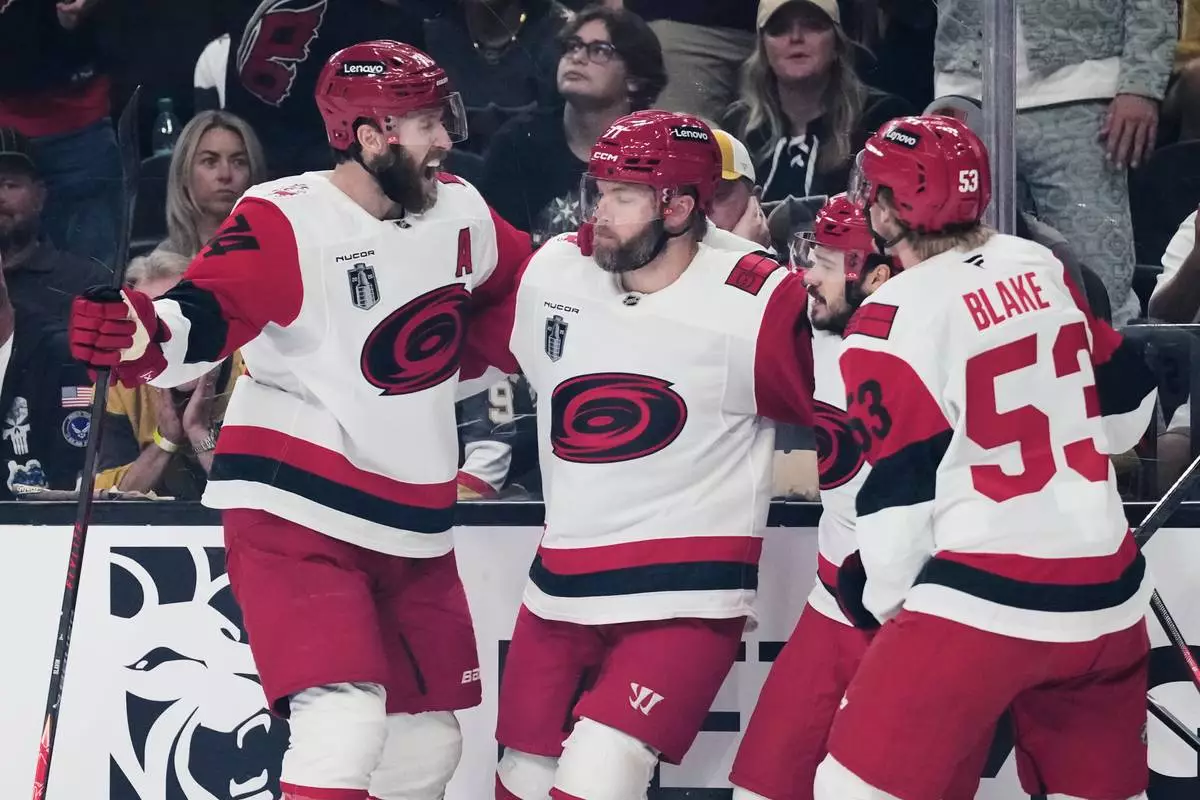
Carolina Hurricanes left wing Taylor Hall, center, celebrates his goal with teammates during the first period in Game 6 of the NHL hockey Stanley Cup Final series against the Vegas Golden Knights, Sunday, June 14, 2026, in Las Vegas. (AP Photo/John Locher)