A leading Japanese economist has warned that the Bank of Japan's anticipated interest rate hike will not address the country's fundamental economic problems, calling instead for structural reforms and stronger support for small and medium-sized enterprises.
The economist's comments come as the yen exchange rate continues to hover near 160 yen per U.S. dollar, with Japanese media and financial markets widely expecting the Bank of Japan to announce a rate hike at its monetary policy meeting on June 15 and 16.
"Japanese political and economic scholar Hamada Kazuyuki said: "The future trend of the Japanese economy is also affected by factors such as rising crude oil prices and inflation, and there are no signs of these problems being resolved anytime soon. If left unchecked, they will develop into a serious inflationary trend. This will not only affect enterprises but also the daily lives of ordinary people. Therefore, in order to curb these impacts, the Bank of Japan is taking countermeasures and adjusting toward the direction of raising interest rates. However, whether these measures can truly be effective still remains highly uncertain," he said.
He also noted that the operations of small and medium-sized enterprises in Japan continue to face pressure, and the overall recovery of the Japanese economy is filled with uncertainty. The Japanese government's model of relying on debt to rescue the market only addresses symptoms rather than root causes and cannot solve the fundamental problems of the Japanese economy, he added.
"More than 80 percent, or even 90 percent, of Japanese enterprises are small and medium-sized enterprises. Only a small number of large enterprises have gained profits from exchange rate fluctuations. The vast majority of small and medium-sized enterprises are already on the edge of life and death. Therefore, without more adequate support policies for small and medium-sized enterprises, it will be very difficult for the Japanese economy to achieve recovery or restoration. The current government is in a rather difficult situation. Originally, it said no supplementary budget was needed, but as the economy deteriorates, it has no choice but to rely on supplementary budgets and deficit financing to barely cope. But this is not a fundamental solution. Continuing down this path will only make Japan's situation further deteriorate. Therefore, if the government truly wants to improve the economy, it must cut waste within the existing fiscal scope and concentrate resources into truly effective areas. This is the necessary direction," he said.

Japanese economist warns rate hike inadequate, urges structural reform
Chinese stock markets dropped on Monday, as AI and tech stocks continued to see-saw, according to China Global Television Network (CGTN) market analyst Timothy Pope.
The benchmark Shanghai Composite Index closed down 0.59 percent at 3,882.01 points, with the Shenzhen Component Index, which has more exposure to the tech sector, closing 2.13 percent lower at 13,794.29 points.
Trading volumes on the two indices rose with around 2.01 trillion yuan (about 296.28 billion U.S. dollars) traded on Monday, up from 1.88 trillion yuan (about 280 billion U.S. dollars) last Friday.
Traditional sectors such as precious metals, coal mining, and insurance led the gains, while bio-tech stocks were among the top decliners.
The ChiNext Index, tracking China's Nasdaq-style board of growth enterprises, lost 3.21 percent to close at 3,431.89 points on Monday.
The STAR Composite Index, which tracks the performance of stocks on China's sci-tech innovation board, closed 3.10 percent lower on Monday at 1,896.16 points.
"The A-share markets seem locked in this cycle of rally and rout for those growth stocks, particularly in the AI and adjacent sectors. Today was very much on the rout side so, while the Shanghai Composite Index was down 0.6 percent, we saw the Shenzhen Component down more than 2 percent, the ChiNext board was down 3.2 percent and the STAR 50 down 3.1 percent. Those last three are more exposed to the tech rally than the Shanghai Composite. The big losers as I said were AI hardware companies - Shenzhen Gongjin Electronics was down 10 percent, Zhongji Innolight fell more than 7 percent. But they weren't alone because the other big winning sector of the last few weeks - biotech - was in retreat today as well. Investors were rotating into gold and coal stocks as well, and agricultural stocks extended the food security trade rally that we saw at the end of last week. There were a number of stocks across those sectors, all of those were hitting the upper limits of trade today," said Pope.
Pope said the rest of the week will be dominated by earnings reports from some of China’s biggest companies.
"The rest of the week is going to be mostly about earnings. The end-of-August filing deadline is fast approaching. Friday will be a really big day on the earnings calendar. We've got BYD, PetroChina, Shenhua Energy and a lot of big banks as well. Earnings that we are going to see for ICBC, China Merchants Bank and others will give us an insight into how much pressure the big banks are under with their margins. BYD is also going to be an interesting one in light of the government's anti-involution campaign and its efforts to avert a bit of a race to the bottom in the EV sector. And before we get there, there are Nvidia results in the US on Wednesday which will doubtless impact every stock in the AI space," he said.
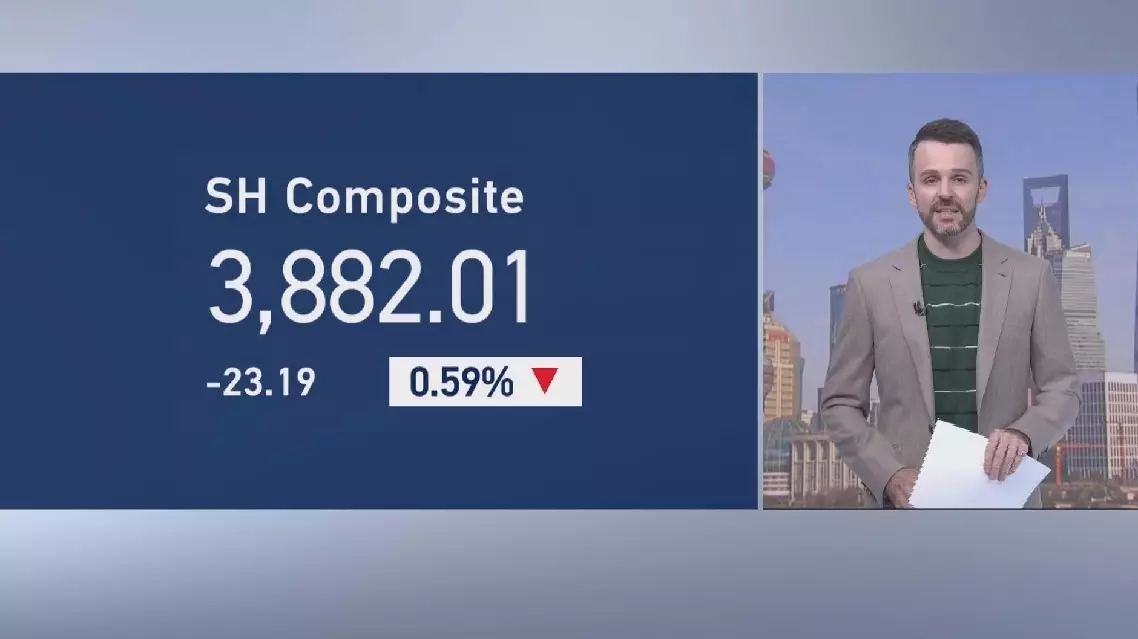
Chinese stock markets start week lower on AI volatility: analyst