Skip to Content Facebook Feature Image

Unilever Scales Digital Twins Across Global Manufacturing Network with Accenture

Business

Unilever Scales Digital Twins Across Global Manufacturing Network with Accenture
Business

Business

Unilever Scales Digital Twins Across Global Manufacturing Network with Accenture

2026-06-16 15:00 Last Updated At:15:10

NEW YORK & LONDON--(BUSINESS WIRE)--Jun 16, 2026--

Unilever (LON: ULVR) is partnering with Accenture (NYSE: ACN) to scale the use of AI-enabled digital twins across its global manufacturing network. The next-generation technology will help factories improve quality, boost efficiency and respond more quickly to consumer demand. The multi-year program marks a further step in Unilever’s journey to apply pioneering technology across its value chain as the company sets out to shape the future of the consumer goods industry.

This press release features multimedia. View the full release here: https://www.businesswire.com/news/home/20260616442266/en/

Digital twins are virtual models of factory equipment and production lines. They use live data from physical systems on the shop floor to monitor and predict how machines and processes perform.

By integrating digital twins with AI-enabled insights and agentic capabilities, Unilever is equipping manufacturing teams with advanced tools to identify issues sooner, simulate scenarios faster, and make smarter decisions across the production cycle.

Building on digital twins already in use, Unilever plans to expand adoption over the next 18 months by building more than 40 new digital twins, creating a scalable blueprint for global rollout.

“Scaling AI across our operations isn’t just a technological shift, it’s a commitment to superior products, sustainability and empowering our teams across our factories,” said Adam Raeburn-James, Global VP for Digital Business Operations, Unilever. “Through our partnership with Accenture to accelerate digital twins, we are turning innovation into measurable impact to create desirable brands for our 3.7 billion consumers worldwide.”

“Unilever has long been recognized for its supply chain excellence, and expanding the use of manufacturing digital twins reflects the company’s continued focus on both technology and people,” said Nicole van Det, CEO Accenture Netherlands and Nordics and global account lead for Unilever.

“Having invested early in AI, the company is setting the standard for pairing advanced tools with smart process design and disciplined execution on the shop floor. Together, we’re setting the benchmark for how industrial AI creates long-lasting value in the consumer goods sector.”

Accenture is supporting Unilever in deploying industrial AI capabilities that use advanced analytics and AI agents to predict maintenance needs, improve performance, and help teams act faster. As the system learns and employees gain confidence in its accuracy, it can progressively take on certain adjustments automatically, with human oversight.

Digital twins delivering impact across Unilever’s manufacturing network

Digital twins are already delivering tangible benefits across multiple Unilever sites:

Unilever's operational excellence, efficiency and sustainable growth across its supply chain have been recognized by the World Economic Forum’s Global Lighthouse Network, where Unilever holds the highest number of designations in the consumer goods sector.

Its manufacturing AI partnership with Accenture builds on previously announced efforts to scale next-generation technology across business operations, including identifying and testing new AI solutions through the AI Horizon3 Lab in Toronto, Canada.

About Unilever
Unilever is one of the world’s leading suppliers of Beauty & Wellbeing, Personal Care, Home Care and Foods products, with sales in over 190 countries and products used by 3.7 billion people every day. We have 96,000 employees and generated sales of €50.5 billion in 2025. For more information about Unilever and our brands, please visit www.unilever.com.

About Accenture
Accenture helps the world’s leading enterprises reinvent by building their digital core and unleashing the power of AI to create value at speed for organizations across industries. Our strategy is to be the reinvention partner of choice for our clients and lead in the safe, widespread adoption of AI, and to be the most client-focused, AI-enabled, great place to work in the world. We bring together the talent of our approximately 786,000 people with proprietary assets and platforms, deep process and industry expertise, and leading ecosystem relationships to deliver end-to-end solutions and measurable outcomes at scale. Through our Reinvention Services, we offer broad expertise across Cybersecurity, Digital Core, Finance, Industry and Enterprise, Song, Supply Chain and Engineering, and Talent, with advanced capabilities in AI and Data, Industry and Process, and Technology. We serve approximately 9,000 clients and generated approximately $70 billion in FY25 revenue. Visit us at accenture.com.

Accenture Forward-Looking Statement
Except for the historical information and discussions contained herein, statements in this news release may constitute forward-looking statements within the meaning of the Private Securities Litigation Reform Act of 1995. Words such as “may,” “will,” “should,” “likely,” “anticipates,” “aspires,” “expects,” “intends,” “plans,” “projects,” “believes,” “estimates,” “positioned,” “outlook,” “goal,” “target” and similar expressions are used to identify these forward-looking statements. These statements are not guarantees of future performance nor promises that goals or targets will be met, and involve a number of risks, uncertainties and other factors that are difficult to predict and could cause actual results to differ materially from those expressed or implied. These risks include, without limitation, that the collaboration might not achieve its anticipated benefits and risks and uncertainties related to the development and use of AI, including advanced AI, could harm our business, damage our reputation or give rise to legal or regulatory action, as well as the risks, uncertainties and other factors discussed under the “Risk Factors” heading in Accenture plc’s most recent Annual Report on Form 10-K and other documents filed with or furnished to the Securities and Exchange Commission. Statements in this news release speak only as of the date they were made, and Accenture undertakes no duty to update any forward-looking statements made in this news release or to conform such statements to actual results or changes in Accenture’s expectations.

Copyright © 2026 Accenture. All rights reserved. Accenture and its logo are registered trademarks of Accenture.

Unilever is partnering with Accenture to scale the use of AI-enabled digital twins across its global manufacturing network.


Unilever is partnering with Accenture to scale the use of AI-enabled digital twins across its global manufacturing network.
DUBAI, United Arab Emirates (AP) — Iran’s top diplomat said Tuesday that the deal ending the war with the United States would also require Israel to withdraw from Lebanon. But with Israel insisting it will keep forces in Lebanon, questions are growing about the still-unpublished agreement and whether disagreement over its terms could prolong the conflict.

Foreign Minister Abbas Araghchi said Israel’s continued occupation of southern Lebanon would violate the memorandum of understanding reached between the United States and Iran.

“The end of the war in Lebanon is an inseparable part of the complete end of the war,” Araghchi said in statements made to foreign diplomats in Tehran that were aired on Iranian state TV. “Without the withdrawal of Israeli forces from the territories they occupied during this war, the war has not fully come to an end.”

Araghchi said further Israeli attacks on Lebanon “will be considered by us a violation of the memorandum of understanding.”

The United States has not said whether Lebanon was part of the final agreement. But Araghchi's description clashes with statements made by Israeli officials about the deal to end the war that started with joint U.S.-Israeli airstrikes on Feb. 28.

Israel is not party to the agreement. Prime Minister Benjamin Netanyahu on Monday described it as President Donald Trump's decision, noting Israel had its own priorities and would remain in a buffer zone in Lebanon “as long as necessary.”

The ambiguity mirrored developments during past negotiations, including the temporary ceasefire brokered in April. That agreement did not pave the way to broader peace or the reopening of the Strait of Hormuz after the United States and Iran announced differing frameworks.

The discrepancy underscored how much of the agreement remains apparently unresolved ahead of a planned ceremonial signing Friday in Geneva.

The agreement is meant to provide a meaningful truce in a monthslong war that has killed thousands across the Middle East, including the top leaders of Iran’s theocracy, and raised the prices of fuel, food and other basic goods far beyond the region.

The unpublished agreement provides for the “immediate” opening of the Strait of Hormuz and lifting of the blockade, according to a senior U.S. official who spoke to reporters on condition of anonymity to discuss outlines of the agreement on Monday.

Brokered mainly by Pakistan, it starts with the simultaneous lifting of Iran’s closure of the strait and the U.S. blockade of Iran’s ports, according to Pakistani officials. The United States and Iran will then begin 60 days of negotiations over Iran’s nuclear program and the potential lifting of sanctions, Pakistani officials who helped broker the interim deal said, speaking on condition of anonymity about the unpublished text.

It also includes the possibility of releasing Iran’s frozen funds, sanctions relief and a $300 billion fund to help rebuild Iran if Tehran meets certain benchmarks, senior U.S. officials told reporters Monday.

Araghchi’s comments Tuesday appear to match the understanding of two regional officials with direct knowledge of the interim deal. The officials, speaking to The Associated Press on condition of anonymity to discuss the closed-door negotiations, said it would require Israel to leave nearly all the territory it occupies in Lebanon, minus a few hilltop points along the border seized earlier.

The officials say Iran insisted the accord include Lebanon in the last days of the negotiations. Regarding the timeline, the officials said the release of frozen Iranian assets are tied to Tehran implementing the deal. Gulf Arab states also have pledged to inject billions of dollars in Iran’s economy, they added.

Beyond Lebanon, there’s one more point of possible contention on Iran’s nuclear program. The interim deal begins a 60-day clock for talks over Tehran’s stockpile of highly enriched uranium.

Iran has agreed to discuss ways to possibly “dilute or remove” its stockpile, the officials said. However, it remains unclear whether Tehran would agree to that, particularly with hard-liners opposing to giving it up.

U.S. officials have not yet explained how they see the agreement addressing Iran’s nuclear program, including who will be in charge of verifying that Iran is in compliance and who will destroy or remove highly enriched uranium believed to be buried under nuclear sites that were badly damaged by U.S. strikes last summer.

Meanwhile, world leaders gathered in France for the first full day of the Group of Seven summit of major industrialized nations, where Iran was high on the agenda. Scheduled discussions include a work session focused on “ending crises and ensuring stability in the Middle East.” Leaders of Egypt, Qatar and the United Arab Emirates are to join the talks.

Trump has clashed with European leaders over not consulting them before going to war in Iran. Even so, leaders are expected to strike a measured tone as they seek ways to ease the economic fallout from rising oil prices caused by the blockade of the Strait of Hormuz.

Ahead of their meeting, the leaders of France, Germany, Italy and the United Kingdom issued a joint statement congratulating the United States, the Iranian government and the mediators on what they called a “diplomatic breakthrough.” Canada also signed the statement. The leaders said it was vital for detailed negotiations to take place and for the deal to be quickly implemented so the Strait of Hormuz can be reopened to tanker traffic.

People walk along Tajrish square in northern Tehran, Monday, June 15, 2026. (AP Photo/Vahid Salemi)

People walk along Tajrish square in northern Tehran, Monday, June 15, 2026. (AP Photo/Vahid Salemi)

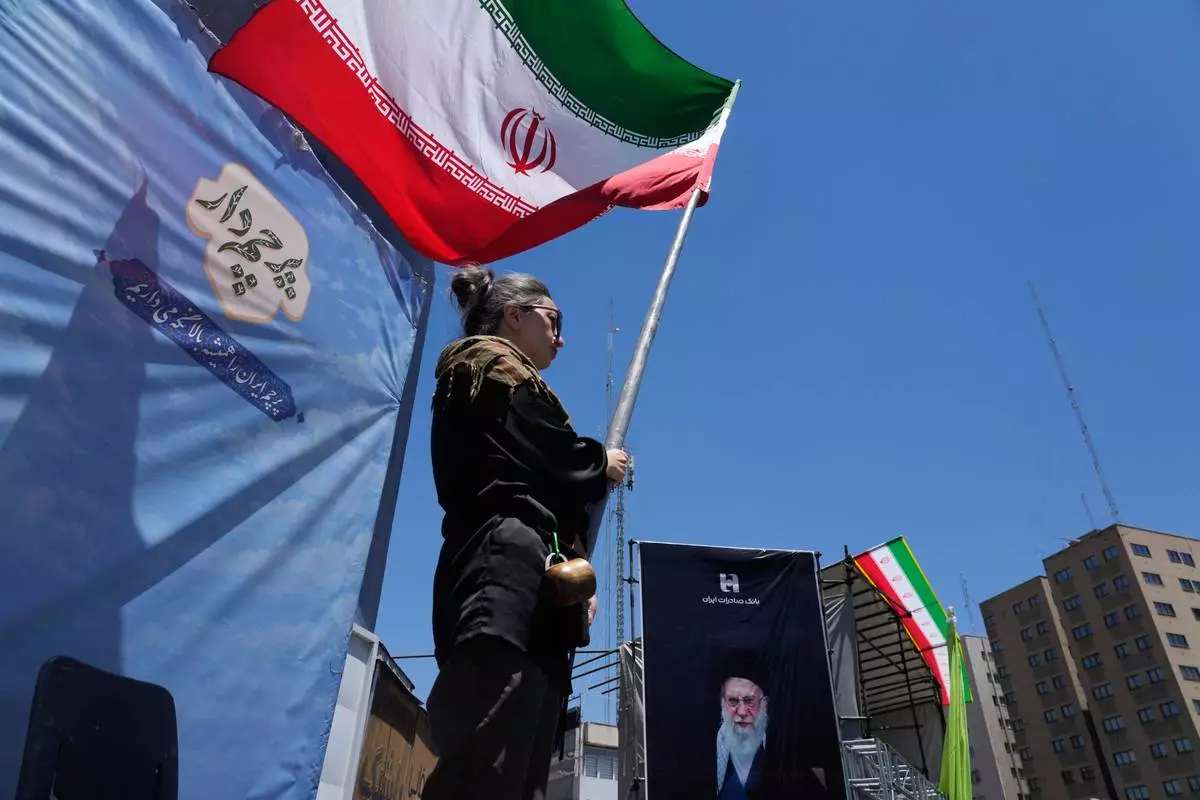
A woman waves an Iranian flag during a pro-government campaign as a portrait of the slain Supreme Leader Ayatollah Ali Khamenei, who was killed in U.S. and Israeli strikes on Feb. 28, is displayed at right, in downtown Tehran, Iran, Monday, June 15, 2026. (AP Photo/Vahid Salemi)

A woman waves an Iranian flag during a pro-government campaign as a portrait of the slain Supreme Leader Ayatollah Ali Khamenei, who was killed in U.S. and Israeli strikes on Feb. 28, is displayed at right, in downtown Tehran, Iran, Monday, June 15, 2026. (AP Photo/Vahid Salemi)

Recommended Articles