NEW YORK (AP) — Days before “Obsession” opened in theaters, its 26-year-old director, Curry Barker, made a bet with his manager and agent. They said if the movie opened above $20 million, they would all get tattoos.
“Obsession” fell just short. It debuted with $17 million. They were still thrilled. Barker made the horror film with just $750,000. It was enormously successful. But then something unexpected happened. The following weekend, “Obsession” easily cleared $20 million. And then it did again and again and almost a fourth time — an almost unheard-of staying power.
“It was just like: Holy cow. I didn’t think that was an option,” Barker says. “Now we’ve said if it hits $300 million, we’ll all get the tattoo. We had to make a new milestone. And I think we’ll reach it.”
Over the last month, “Obsession” has sent shock waves through Hollywood. Barker’s microbudget thriller has grossed $286 million worldwide, and it’s still going. On its fifth weekend in theaters, it was second only to Steven Spielberg’s “Disclosure Day,” with $19 million. In North America, it has outgrossed “Star Wars: The Mandalorian and Grogu.” It’s the biggest hit in the 24-year existence of Focus Features, which has had to postpone the video-on-demand release. It ranks among the most profitable movies ever made.
Barker, who built a following making sketches and short films on YouTube, is living out the dream of every aspiring filmmaker. Life, he granted in a recent interview, is different now.
“My day to day is pretty much the same. It’s just that when I go out in public, it’s a lot different,” he says, laughing. “I actually feel a little unsafe sometimes.”
That’s an ironic development for someone whose twist on an old Monkey Paw story has frightened moviegoers. In “Obsession,” Bear Bailey (Michael Johnston) wishes on an antique toy called a One Wish Willow that his crush, Nikki (Inde Navarrette), loved him. The spell — loosely inspired by an old “Simpsons” Halloween episode — works disturbingly well.
The astonishing success of “Obsession” has been hotly debated throughout the industry. Coupled with the A24 hit “Backrooms,” by 20-year-old Kane Parsons, it’s been a coming-out party for YouTube as a breeding ground for the next generation of filmmakers.
It’s also brought waves of Gen Z moviegoers — who already make up a promisingly robust percentage of frequent ticket buyers — into theaters. Summer has historically been dominated by legacy franchises, but “Obsession” may represent a sea change.
“If there’s a lesson from ‘Obsession,’ I think it’s about audiences,” says Peter Kujawski, chairman of Focus Features. “We have a generation that grew up online, approaches culture with enormous curiosity and playfulness, and is far less concerned with where a filmmaker comes from than whether the story connects. They’re engaged, incredibly film-literate and eager to champion new voices and original stories.”
Barker, who grew up in Mobile, Alabama, before moving to Los Angeles at 18, says he feels as though he’s writing for his generation. The response to “Obsession,” he says, taps into a collective need.
“I get it because I think we’re a little tired of being at home. Our generation is the COVID generation,” says Barker. “I was fortunate enough to have all four years of high school experience. My brother, Riley, lost two years of that. We’re sick of the phones.”
Barker wanted to be an actor before he wanted to be a filmmaker. And while his early exposure to “The Texas Chainsaw Massacre,” at age 11, helped set him on a horror path, he didn’t begin that way.
“I was a huge Harry Potter fan growing up. Huge. I was obsessed,” Barker says, smiling. “I had all the wands. I would dress up.”
Barker attended film school in Los Angeles for a year, where he met Cooper Tomlinson, a co-star and producer on “Obsession.” The two soon forged their own path, though, on YouTube and TikTok. Their comedy sketch series, “That’s a Bad Idea,” found a footing online.
Barker wrote and directed the 2023 short “The Chair,” which attracted the interest of Tea Shop Productions. Producer James Harris approached Barker about a feature of “The Chair,” but he instead wanted to make a film — “Obsession” — that drew on many of the same ideas. Meanwhile, Barker also made an $800 found-footage horror film, “Milk & Serial.” After failing to secure distribution, he simply uploaded to YouTube. It went viral and landed him an agent.
“Obsession” was selected to premiere at the Toronto International Film Festival last year, giving it an enviable platform. After a bidding war, Kujawski and Focus acquired it for $15 million.
“What stands out about Curry is that he isn’t working from an inherited playbook,” says Kujawski. “Whether you look at his earlier work or ‘Obsession,’ there’s a consistency of vision and a confidence in his storytelling that immediately sets him apart. He knows exactly what he wants to say while being absolutely committed to making every minute of his work as entertaining as possible, and he’s willing to take real risks in service of that vision.”
Barker’s swift but hard-earned rise has made him the poster boy for a new brand of filmmaker, one who has honed his craft as a digital creator and arrives with an established fan base. Jason Blum, the chief executive of Blumhouse Productions, has compared Barker and company to the 1970s wave of American auteurs, “making edgy movies that are connecting in theaters in a crazy way.”
“When you really step back, my journey is not really that different than Christopher Nolan or David Fincher or Steven Spielberg,” Barker says. “You can watch their early short films and see their work before they were given a chance. I think YouTube is just a path, a platform we can use now to show the industry what we’ve got.”
Now, Barker is one of the most in-demand filmmakers in Hollywood. He has already shot his next feature, “Anything But Ghosts,” starring Aaron Paul and Bryce Dallas Howard, for Blumhouse. Two months ago, A24 announced that he will write and direct a reboot of “The Texas Chainsaw Massacre.”
All the attention has taken some getting used to. Filmmakers like Ari Aster and Zach Cregger and even Spielberg have reached out to compliment Barker on his film.
“That’s when you start to feel this impostor syndrome of like: What? It’s not that good,” Barker says, laughing. “All I see when I watch ‘Obsession’ is the problems.”
An “Obsession” sequel is, naturally, a certainty. “A sequel isn’t hard for this movie,” grants Barker. He sketches out how new wishes by other characters on One Wish Willows could lead to entirely different stories, all revolving around some new vice: greed, fame, whatever.
But as much as it’s tempting to see “Obsession” as the product of Barker's own wish, it’s more like the opposite. In the film, Bear’s profound mistake is putting off confessing his feelings to Nikki, thinking there’s plenty of time to do it. (The movie immediately cuts to a dead cat.) Barker, on the other hand, had no timidity about realizing his dreams. He wanted to make movies, so he did.
“Anyone that asks what advice you have for young filmmakers, I always say the same thing,” says Barker. “I went to a film school for a year out in L.A. and I watched people paralyze themselves with the pressure of: I’ve told people I’m a director so now I have to direct something that has to be good. If it’s not good, everyone’s going to judge me. The result of that thinking is two years on one short film.”
“You can’t put too much pressure on an idea,” adds Barker. “You just got to make it.”

Curry Barker poses for a portrait in New York on Thursday, June 11, 2026. (Photo by Andy Kropa/Invision/AP)
DUBAI, United Arab Emirates (AP) — Iran’s top diplomat said Tuesday that the tentative deal to end the war with the United States would require Israel to withdraw from Lebanon — a condition Israel has already rejected and that could sink the agreement, leading to the resumption of all-out war.
The deal, which is between the U.S. and Iran, has not been made public, and officials have sometimes offered contradictory interpretations of what is in it. While Israel is not party to the agreement, it is part of the war after joining the U.S. in launching strikes on Iran on Feb. 28. Israel has also fought the Iran-backed Hezbollah militant group in Lebanon and seized large swaths of that country.
Iranian Foreign Minister Abbas Araghchi said Israel’s continued occupation of southern Lebanon would violate the deal.
“Without the withdrawal of Israeli forces from the territories they occupied during this war, the war has not fully come to an end,” Araghchi said.
A U.S. official, who spoke on condition of anonymity to discuss outlines of the agreement, has said the deal does not call for an Israeli withdrawal. And Israeli Prime Minister Benjamin Netanyahu said Monday that Israel would remain in Lebanon “as long as necessary.”
The negotiations to end the war have been plagued by such disagreements before, leading to a prolonged but uneasy ceasefire that has failed to develop into a permanent end to hostilities and has left the Strait of Hormuz, a crucial waterway for the world’s energy supplies, effectively shut.
In other developments, Switzerland’s foreign ministry said the signing ceremony for the deal will take place Friday at the Bürgenstock resort near the city of Luzern. Ministry officials said Tuesday that the location was proposed by Pakistani and Qatari mediators, along with the U.S. and Iran.
Pakistan has said the deal called for an end to military operations, including in Lebanon, as Iran long insisted. But Araghchi’s call for an Israeli withdrawal adds a new wrinkle.
It puts Israel into a dilemma as it tries to degrade Hezbollah’s military capabilities without undermining an agreement championed by its most important ally, the United States. Israel invaded southern Lebanon after Hezbollah fired missiles across the border during the first week of the war. Since then, it has expanded its military footprint to levels unseen in decades and struck targets deep inside Beirut.
Though Hezbollah has been weakened, it retains the ability to strike Israel, leaving open questions about the effectiveness of Israel’s campaign.
As of Tuesday evening, Netanyahu had not seen the memorandum of understanding between the U.S. and Iran, said a person familiar with the situation, who spoke on condition of anonymity to discuss closed-door details. Another person, who also spoke on condition of anonymity to discuss private conversations between Israel and the U.S., said Israeli officials have not asked U.S. negotiators for the memorandum.
Netanyahu’s office did not immediately respond to a request for comment from The Associated Press. The White House declined to comment on whether Netanyahu or Israeli officials have reviewed the agreement.
The Israeli ambassador to the U.S., Yechiel Leiter, told NPR that while Israel does not know the details of the deal, the apparent inclusion of Lebanon is “unnecessary and unhelpful.”
The extent of Israel’s strikes have at times opened a public fracture between its leaders and U.S. President Donald Trump, who told reporters Tuesday that he was “not happy with the way Israel has handled themselves with Lebanon and with Hezbollah.”
“It just goes on forever,” he said of Israel’s strategy. Israeli strikes in Lebanon have killed nearly 4,000 people, including hundreds of civilians, and displaced more than 1 million. “Israel’s fighting Hezbollah too long, and too many people are being killed,” Trump said.
Israel and the Lebanese government have entered into their own U.S.-mediated direct negotiations, of which Hezbollah was not a part. Those talks have yielded several announced ceasefires that were never implemented on the ground.
Lebanese officials initially tried to keep Lebanon separate from the U.S.-Iran negotiations, not wanting to be seen as beholden to Iran, but they have since welcomed the announcement that the deal to end the U.S.-Iran war would include a ceasefire in Lebanon.
Araghchi’s latest comments appear to match the understanding of two regional officials with direct knowledge of the interim deal. The officials, speaking to AP on condition of anonymity to discuss the closed-door negotiations, said it would require Israel to leave nearly all the territory it occupies in Lebanon, minus a few hilltop points along the border seized earlier.
The officials say Iran insisted the accord include Lebanon in the last days of the negotiations.
The U.N. peacekeeping force in Lebanon known as UNIFIL reported that Israel and Hezbollah are still exchanging fire but at a “significantly reduced level,” U.N. spokesperson Stephane Dujarric said Tuesday.
Lebanon is only one of several major questions hanging over the ceasefire ahead of the planned ceremonial signing.
The agreement is meant to provide a meaningful truce in a monthslong war that has killed thousands across the Middle East, including the top leaders of Iran’s theocracy, and raised the prices of fuel, food and other basic goods far beyond the region.
The agreement provides for the “immediate” opening of the Strait of Hormuz and the lifting of the American naval blockade of Iranian ports, according to a senior U.S. official who spoke to reporters Monday on condition of anonymity to discuss outlines of the agreement.
Pakistani officials who helped broker the agreement also described plans for the simultaneous lifting of Iran’s closure of the strait and the U.S. blockade.
The United States and Iran will then begin 60 days of negotiations over Iran’s nuclear program and the potential lifting of sanctions, Pakistani officials who helped broker the interim deal said, speaking on condition of anonymity about the unpublished text.
The pact also includes the possibility of releasing Iran’s frozen funds and a $300 billion fund to help rebuild Iran if Tehran meets certain benchmarks, senior U.S. officials told reporters Monday. Trump later said the United States would not “invest” funds in Iran.
Regarding the timeline, regional officials who spoke to AP about the deal said the release of frozen Iranian assets would be tied to Tehran implementing the deal. Gulf Arab states also have pledged to inject billions of dollars in Iran’s economy, they added, speaking on the condition of anonymity to discuss the negotiations.
U.S. officials have not yet explained how they see the agreement addressing Iran’s nuclear program, including who will be in charge of verifying that Iran is in compliance and who will destroy or remove highly enriched uranium believed to be buried under nuclear sites that were badly damaged by U.S. strikes last summer.
Iran has agreed to discuss ways to possibly “dilute or remove” the uranium, the regional officials said. However, it remains unclear whether Tehran would agree to that, particularly with hard-liners opposing to giving it up.
Trump said he’s open to sending the emerging agreement to the U.S. Congress for review.
Speaking on the sidelines of the Group of Seven summit in the French Alps, Trump said, “I like the idea, send it to Congress please.” He added, “I mean who wouldn’t approve it.”
Republicans on Capitol Hill say they want Trump to provide more information about the agreement, with some expressing skepticism that the deal can deter Iran from pursuing a nuclear weapon.

Tankers and cargo vessels are seen in the Gulf of Oman, along shipping routes linking the Strait of Hormuz and the Arabian Sea, Tuesday, June 16, 2026. (AP Photo)

Tankers and cargo vessels are seen in the Gulf of Oman, along shipping routes linking the Strait of Hormuz and the Arabian Sea, Tuesday, June 16, 2026. (AP Photo)
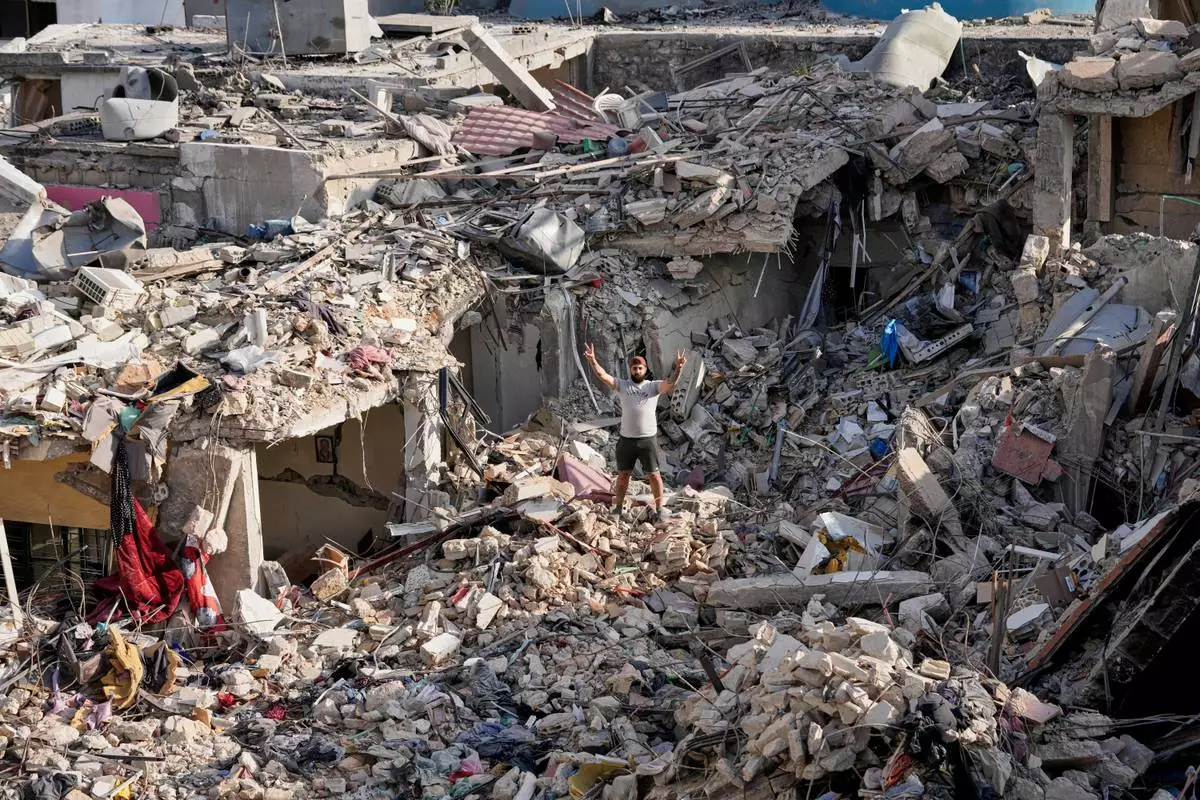
A man who returns to his village following the announcement of an initial ceasefire agreement between the United States and Iran, flashes victory sign as he stands on the rubble of his destroyed house in Nabatiyeh town, southern Lebanon, Tuesday, June 16, 2026. (AP Photo/Hussein Malla)

People walk along Tajrish square in northern Tehran, Monday, June 15, 2026. (AP Photo/Vahid Salemi)
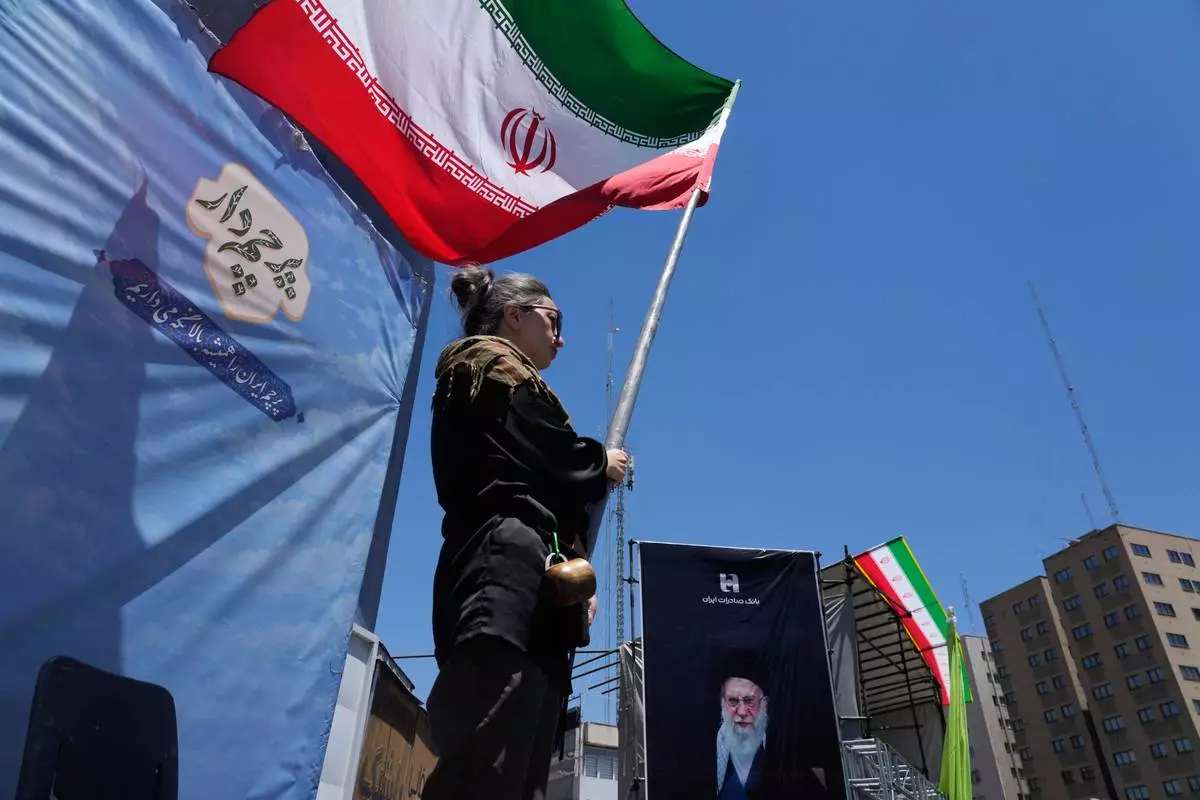
A woman waves an Iranian flag during a pro-government campaign as a portrait of the slain Supreme Leader Ayatollah Ali Khamenei, who was killed in U.S. and Israeli strikes on Feb. 28, is displayed at right, in downtown Tehran, Iran, Monday, June 15, 2026. (AP Photo/Vahid Salemi)