NEW YORK (AP) — The NHL said Thursday it completed a review of Mike Babcock’s tenure in Columbus, cleared him to coach the Edmonton Oilers if they opt to hire him.
The league launched an investigation at the request of the NHL Players’ Association in light of the Edmonton Oilers’ interest in hiring Babcock. The league in a statement said even in the least favorable light, there was no basis to restrict Babcock’s employment.
It was not immediately clear if or when the Oilers would name Babcock coach. They have been looking for a replacement since firing Kris Knoblauch following a first-round playoff exit that came after back-to-back trips to the Stanley Cup Final.
Babcock, 63, has not coached in the NHL since 2019, when he was fired by Toronto 23 games into his fifth season in charge. The Blue Jackets hired him on July 1, 2023, and Babcock resigned in September after his requests for personal photos from players in an attempt to get to know them drew criticism as an invasion of privacy.
A statement from the NHLPA called the allegations very concerning and said, "Moving forward, we expect that Mr. Babcock will uphold the high standards required of NHL head coaches.”
The NHL dropped its planned investigation at the time because Babcock stepped down. It got underway this week after the final ended
Babcock coached Detroit to the Stanley Cup in 2008 and has made two other trips to the final, along with guiding Canada to Olympic gold medals in 2010 and ’14.
AP NHL: https://apnews.com/NHL

FILE - Toronto Maple Leafs head coach Mike Babcock directs his team against the Colorado Avalanche in the third period of an NHL hockey game, Feb. 12, 2019, in Denver. (AP Photo/David Zalubowski, File)

FILE - Toronto Maple Leafs head coach Mike Babcock during the third period of an NHL hockey game against the Detroit Red Wings, Oct. 12, 2019, in Detroit. (AP Photo/Duane Burleson, File)
LONDON (AP) — A massive ancient oak tree linked to the legend of Robin Hood may have been loved to death.
The 1,200-year-old Major Oak in Sherwood Forest is believed to have died after it didn’t sprout leaves this spring, the Royal Society for the Protection of Birds said Thursday.
Visitors over the past two centuries who viewed the tree's gnarled limbs and sprawling canopy in Nottingham compressed the soil, making it difficult for rain to reach its roots, the conservation group said.
The forest has been under threat for years and the tree had been rumored to have died in the past — only to have the group confirm it was still alive.
That is no longer the case.
“The tree’s failure to produce leaves this year is heartbreaking for everyone,” Hollie Drake of the RSPB said in a statement announcing the death.
The tree is said to have sheltered Robin Hood, the legendary 13th-century bandit who stole from the rich and gave to the poor and took refuge in the forest when being pursued by the sheriff of Nottingham.
It got its name after being mentioned in a book on oaks by Major Hayman Rooke in 1790 that led to the first wave of fans who flocked to the forest.
It's impossible to say what killed the tree, but the footprints of millions contributed to its downfall, along with intervention to shore up its massive limbs using cables and poles. Climate change that has brought heat waves and drought was also blamed.
Tree experts found the root system strangled and starved.
“Ancient trees like the Major Oak are the ‘conservation white rhinos of the U.K.’ but their decline is far less visible,” said Ed Pyne, of the Woodland Trust. “Saving them is vital to the health of the world we live in and yet most disappear quietly, without the recognition or care given to the Major Oak.”
In addition to its place in folklore, the forest is known for Sherwood oaks that floated the ships of Vice Admiral Horatio Nelson’s Royal Navy in the late 18th and early 19th centuries and as timbers in the roof of St. Paul’s Cathedral in London.
The Major Oak was spared from the saw and has been protected by a fence since the 1970s.
“The Major Oak will continue to stand at the heart of Sherwood as a natural monument for visitors to come and see, living on in the legend of Robin Hood and continuing to provide as much support to the forest’s ecosystem in death as in life,” Drake said.
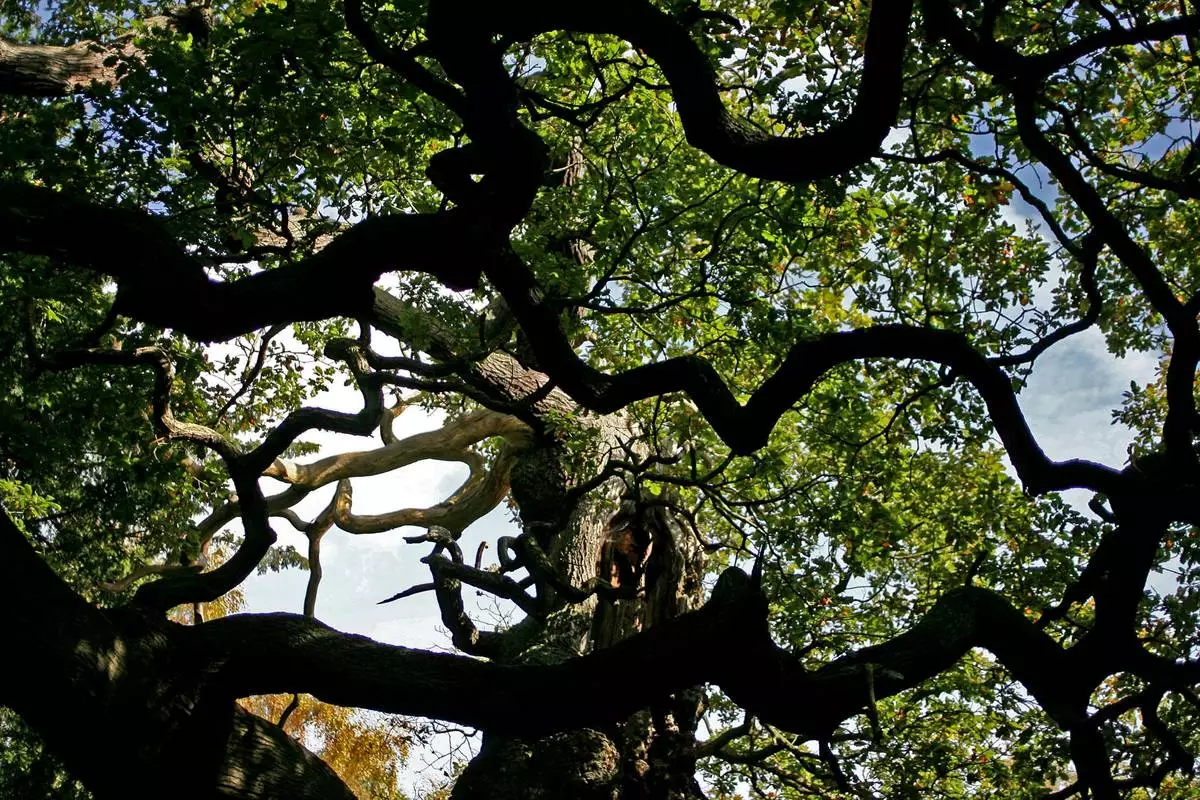
FILE - A 1,200-year-old Major Oak tree, where Robin Hood allegedly used as a hide out, stands in Sherwood Forest near Nottinghamshire, England, on Oct. 19, 2007. (AP Photo/Simon Dawson, File)

FILE - A 1,200-year-old Major Oak tree, where Robin Hood allegedly used as a hide out, stands in Sherwood Forest near Nottinghamshire, England, on Oct. 19, 2007. (AP Photo/Simon Dawson, File)