WASHINGTON (AP) — Janeese Lewis George, who pledged to aggressively stand up to federal intervention into Washington, D.C.'s affairs, won Tuesday's Democratic primary for mayor, setting up a potential showdown with the Trump administration over its moves to challenge the city’s limited autonomy.
In an overwhelmingly Democratic city, Lewis George is likely to take the top spot in November's general election, replacing moderate Muriel Bowser, who decided not to run again after three terms.
Lewis George joins Robert White Jr., who won the Democratic primary for the district's delegate to Congress, as the top local officials who likely will contend with the federal government's intentions for the city. They each campaigned on a promise to take a harder line than their predecessors against the Trump administration's moves on the district, including its deployment of the National Guard on an ongoing, open-ended mission meant to fight crime.
Speaking at a news conference Thursday, Lewis George said she hoped she could work together with the administration “as every mayor has had to work with any president of the United States, no matter their party.”
But, she said, she would oppose actions that threaten the city's residents.
"We are not going to be able to stand up for our autonomy and fight for D.C. statehood ultimately, by just complying in advance,” Lewis George said. “I have also been very clear that I will work with anyone including the president for the best interest of D.C. residents.”
Washington has limited autonomy and federal leaders retain significant control over local affairs, including approval of the budget and laws passed by the D.C. Council.
President Donald Trump further encroached on that autonomy last year when he briefly federalized the city's police force and deployed an ongoing law enforcement surge that included the National Guard. Trump’s efforts to downsize the federal government also roiled the capital region, costing thousands of people their jobs. He has also been reshaping the city by renovating storied landmarks and putting his name or image on buildings.
Lewis George, a self-described democratic socialist and a member of the D.C. Council, has already come under fire from Trump, who last week threatened to place the city under federal control if she won.
“Maybe we’d take back Washington, run it on the federal basis,” he said.
Her main opponent, former D.C. Council member Kenyan McDuffie, conceded the race Thursday and said he had contacted Lewis George to congratulate her.
“While the final certification process will continue, it is clear that the voters have chosen a different path,” he said in a statement. He wished Lewis George luck in the general election and called on his supporters to continue working.
Lewis George, 38 and a third generation Washingtonian, has vowed to overrule an executive order by the city’s police chief permitting local law enforcement to cooperate with Immigration and Customs Enforcement agents. Lewis George argued the order “hurt the trust of our community.”
Lewis George also vowed to use any levers available to her through the city’s home rule compact to resist what she called authoritarian infringements on the district’s local governance.
“We have legal tools we can use to fight back,” she told The Associated Press in an interview before the vote. “And we know that when we have gone to court, we’ve won.”
Bowser found herself walking a fine line between staying in Trump’s good graces and responding to the concerns of constituents, many of whom said she didn’t push back hard enough on Trump’s actions. Eleanor Holmes Norton, the 18-term, 89-year-old delegate to Congress, meanwhile, faced mounting concern from critics who said she wasn't forcefully pushing back on the Trump administration's moves against the city.
Lewis George has also made affordability a top priority and her platform has included issues like rent support as well as ending below minimum wage pay for tipped employees and controlling high utility rates.
Tuesday’s primary marked the first time in a generation that D.C. residents voted for a new mayor and delegate in the same election. It was also the city’s first election using ranked choice voting.

FILE - The D.C. Council member Janeese Lewis George, speaks during the D.C. Council hearing on the Fiscal Year 2027 budget at the Wilson Building, City Hall, June 9, 2026, in Washington. (AP Photo/Jose Luis Magana, File)

D.C. Council member Janeese Lewis George speaks to the crowd after winning D.C. Mayor primary election during an election night party at the Howard Theatre Tuesday, June 16, 2026, in Washington. (AP Photo/Jose Luis Magana)
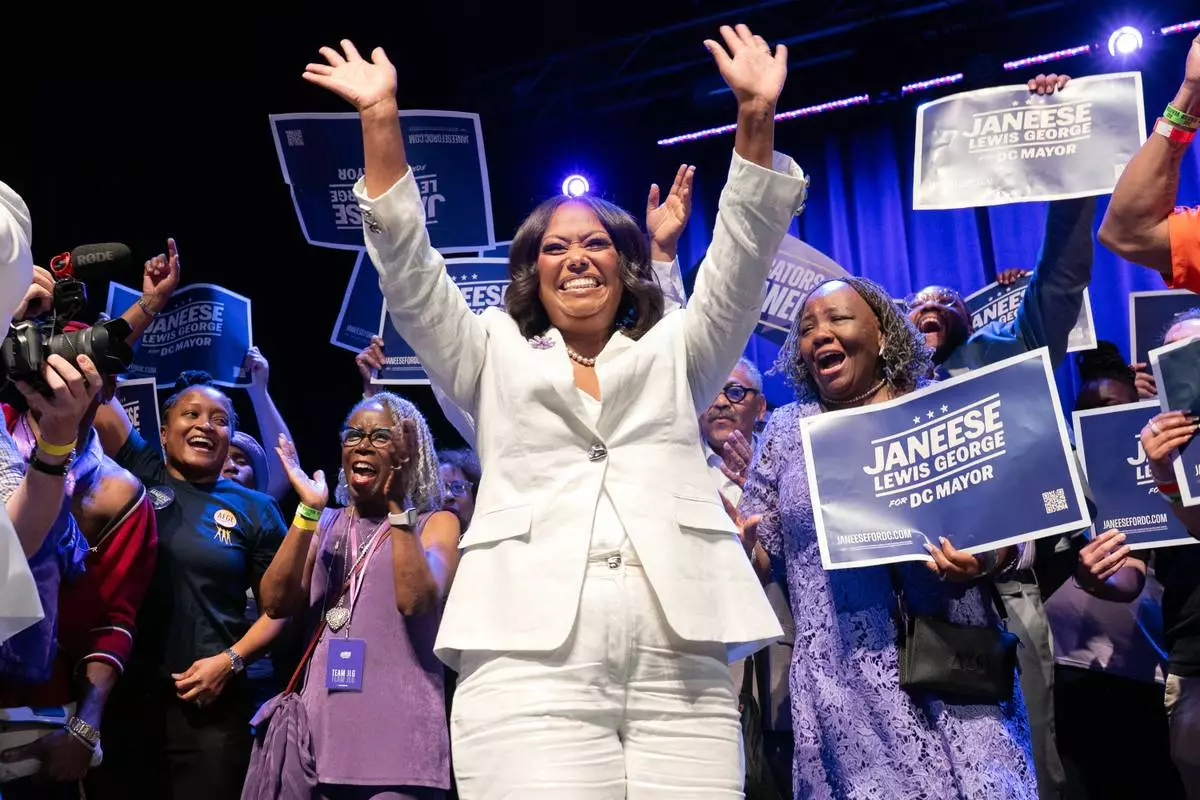
D.C. Council member Janeese Lewis George waves to the crowd as she celebrates after winning D.C. Mayor primary election during an election night party at the Howard Theatre Tuesday, June 16, 2026, in Washington. (AP Photo/Jose Luis Magana)
NEW YORK (AP) — U.S. gas prices fell to just below $4 a gallon on average Thursday, bringing some relief to drivers who have seen soaring costs amid Washington's war with Iran
But filling up is still more expensive than it was before the conflict began.
According to motor club AAA, a gallon of regular gasoline is now averaging at $3.999. It's the first time since March that prices have been that low. And the drop aligns with easing crude oil costs overall, with some optimism about an initial agreement between the U.S. and Iran to end their war.
Still, American drivers are collectively paying about $1 more per gallon than they were before the U.S. joined Israel to attack Iran in February — and prices are 25% higher than they were at this time last year. That's caused many households to tighten their budgets in other areas, or rethink where they want to spend their money more broadly.
Research has shown that short-term swings in the cost of gas leads consumers to adjust both their driving and wider spending — with some even pulling back on core necessities like groceries when prices at the pump get high, notes Dylan Brewer, an assistant professor in Georgia Tech’s School of Economics.
If costs continue to cool in the coming weeks, he said, more people may be able to “loosen their belts a little bit.” Cheaper fuel will also be welcome by businesses that rely on gas and diesel to transport their goods. But it could take a few months for that to trickle through the supply chain, Brewer adds.
And gas isn't the only thing that's gotten more expensive over the course of the war. Groceries, airline tickets and even condoms and shoes cost more amid global supply chain disruptions. Even if oil and other core necessities — like fertilizer — begin flowing from the Middle East again, experts warn the sticker shock will likely outlast the fighting.
“Product prices across the United States are projected to keep climbing for the rest of 2026," Pat Penfield, a professor of supply chain practice at Syracuse University, said on Thursday.
Penfield pointed to depleted inventories and ongoing supply chain consequences spanning from the war — noting that farmers, for example, already had to pay higher costs for fertilizer and other supplies in the spring that will “ripple through to increased food prices by autumn.” And at the gas pump, he noted that limited refinery capacity in the U.S. “remains a significant bottleneck” toward bringing down prices further.
Steep fuel costs have already pushed U.S. inflation to its highest level in three years. And many consumers are still filling their tanks for much more than $4 a gallon.
That price is a national average, with costs varying between states due to factors like proximity to supply and differing tax rates. In California on Thursday, prices averaged about $5.64 for a gallon of regular gas, per AAA, followed by $5.57 in Hawaii. Meanwhile, prices in Indiana and Texas sat at about $3.40 and $3.49 a gallon, respectively.
Recent relief for fuel prices arrived with cooling costs for crude oil — the main ingredient in gasoline.
Brent crude, the international standard, sat under $80 per barrel Thursday. And U.S. benchmark crude tumbled to below $76 per barrel. That's still a little higher than the roughly $70 price tag before the war, but far below the $100-plus price from just a few weeks ago.
Prices fell overnight after President Donald Trump signed an agreement with Iran. The tenuous agreement calls for Tehran to dilute its stockpile of highly enriched uranium and waives U.S.-backed sanctions on the country — immediately allowing Iran to sell its oil freely in a significant concession from Washington.
Major ship owners have also begun moving vessels through the key Strait of Hormuz since the memorandum of understanding was signed Wednesday, according to maritime data from Lloyd’s List Intelligence, although some reported that only more limited side routes were open. And U.S. Vice President JD Vance said Thursday that the Navy has lifted its own blockade to allow some transit to and from Iranian ports.
Still, it could take weeks or months for traffic to return to prewar levels. Before the war, the strait carried a fifth of the world’s crude oil. And Gulf oil producers that throttled back production will need time to get the oil moving again.
Some ship captains may take their time to determine if the passage is safe. The agreement between the U.S. and Iran calls for a permanent end to hostilities and starts a 60-day negotiating clock to reach a final deal on the future of Iran’s nuclear program, though Trump left the door open to resume attacks.
Refineries also typically pay for crude oil a month or more in advance, so even after oil prices drop, they won’t immediately be processing cheaper products. Energy shocks have been even starker in places that rely more heavily on imports from the Middle East — notably countries across Asia and Africa.
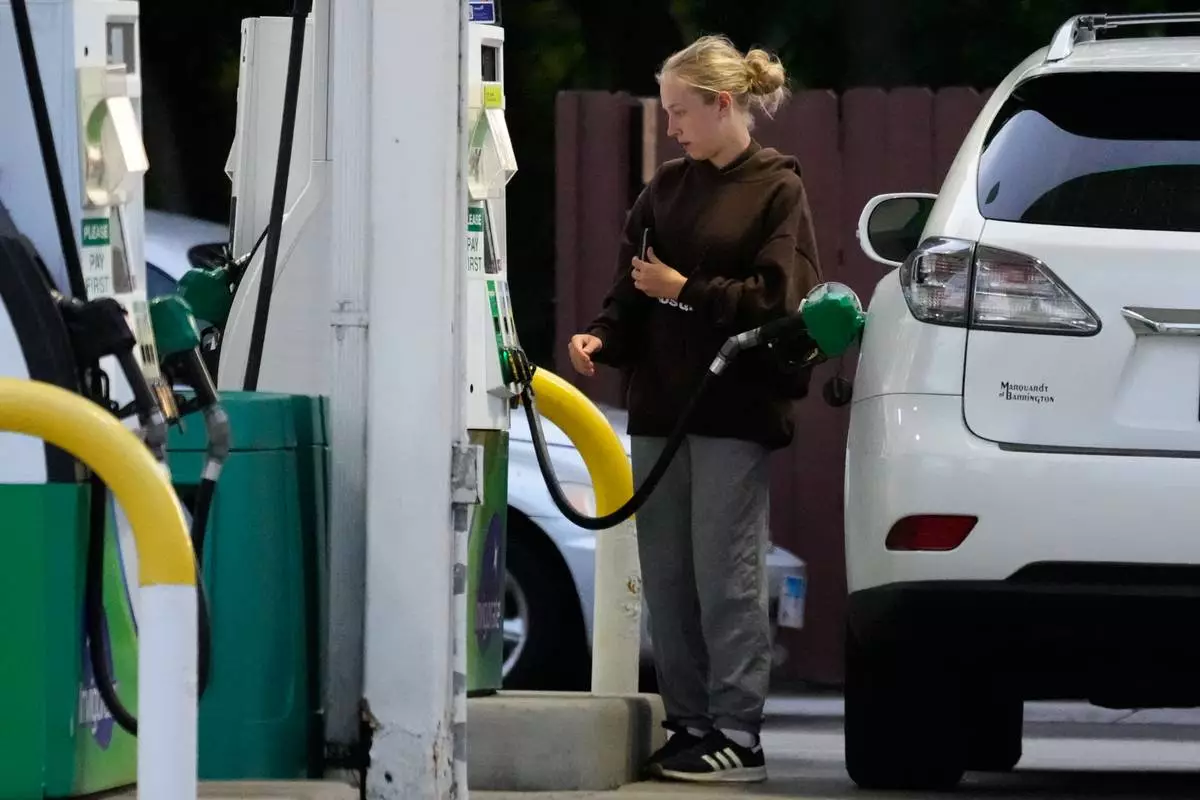
Customer checks gas price before she fills up her vehicle's tank at a gas station in Lincolnshire, Ill., Monday, June 8, 2026. (AP Photo/Nam Y. Huh)
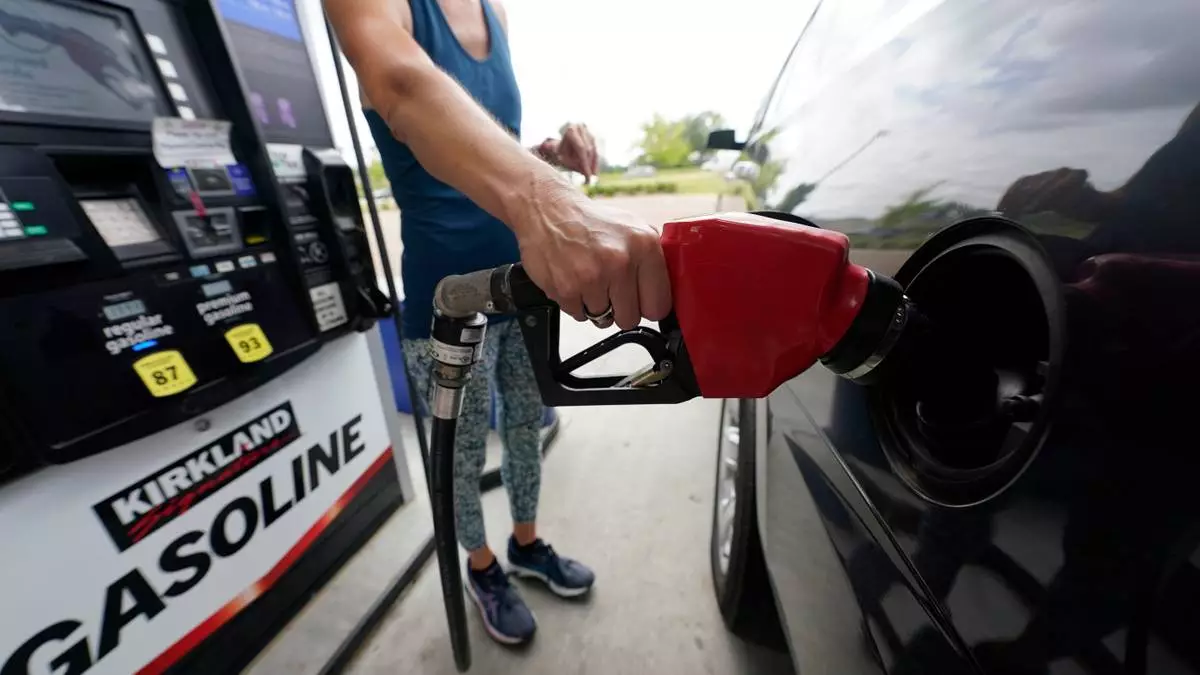
FILE - A customer readies to pump gas at this Ridgeland, Miss., Costco, Tuesday, May 24, 2022. s. (AP Photo/Rogelio V. Solis, File)