JUBA, South Sudan (AP) — A Vietnamese national deported to South Sudan by the Trump administration under its controversial third-country deportation program was repatriated to Vietnam on Friday after spending more than a year in detention.
South Sudan’s Ministry of Foreign Affairs announced the repatriation of 44-year-old Tuan Phan at a press briefing on Friday.
“We are grateful that while in our custody Mr. Phan was very disciplined, joyful, and importantly, he remained healthy,” said spokesperson Agok Anyar.
Phan and seven other men were sent to Africa in May 2025, rerouted first to a U.S. military base in Djibouti after a federal judge blocked their deportation to South Sudan midflight, citing procedural irregularities. They arrived in Juba, South Sudan’s capital, aboard a military aircraft in July 2025 after a Supreme Court ruling greenlit their removal.
The eight men all have criminal convictions in the U.S. but had served their prison sentences when they were taken into custody last year.
At least seven African countries have agreed to accept deportees who are not their own citizens as part of arrangements with the U.S., which in exchange has agreed to pay millions of dollars to those governments.
More than 180 people have been sent to those countries, according to the monitoring initiative Third Country Deportation Watch.
The choice of South Sudan as a receiving nation was particularly controversial given its exceptionally poor human rights record, high levels of corruption and growing political instability. Armed conflict displaced more than half a million people in 2025, according to the United Nations.
Phan is the second person in the group to be repatriated after Jesus Munõz-Gutierrez was flown to Mexico in September. Dian Peter Domach, the only South Sudanese national in the group, was released upon his arrival, officials said. The remaining men are from Cuba, Myanmar, and Laos.
Phan moved to the U.S. as a child in 1991, court documents show. In 2000, shortly after turning eighteen, he received a 25-year prison sentence after he shot and killed someone during a gang altercation. His removal from the U.S. was ordered in 2009, and he was taken into custody by Immigration and Customs Enforcement immediately after completing his sentence in March 2025.
In Juba, the deportees were held in a gated house under supervision by armed guards, according to a U.S. Senate report. A congressional aide who visited Juba last year was the first person other than a South Sudanese official to visit the men, the report says.
Michael Bochenek, a senior counsel for Human Rights Watch, said that the lack of visits means “there’s been no independent check on people’s treatment and conditions of confinement and raises serious questions about South Sudan’s compliance with human rights norms and essential safeguards against abuses in detention.”
While the details of deals made between the U.S. and other governments to accept deportees have been made public, the conditions of the South Sudan arrangement remain murky.
State Department documents made public show that South Sudan made requests to the U.S. after agreeing to accept the men, including sanctions relief for a former top official and support with the prosecution of a prominent opposition leader.
It is unclear what South Sudan's government was paid or what it received in return.

Vietnamese national Tuan Phan speaks during a news conference before departing Juba International Airport in Juba, South Sudan, Friday, June 19, 2026. (AP Photo/Deng Machol)

Vietnamese national Tuan Phan speaks during a news conference before departing Juba International Airport in Juba, South Sudan, Friday, June 19, 2026. (AP Photo/Deng Machol)
WASHINGTON (AP) — Most Americans continue to disapprove of how President Donald Trump is handling Iran, while his overall presidential approval holds steady, according to a new AP-NORC poll that was conducted as he suggested a deal with Iran had been reached.
The poll points to just how unpopular the war, which began Feb. 28, has been with Americans even as the Republican president turned abruptly from threatening Iran to reopening negotiations. Support for his handling of the war remains lopsidedly partisan. About two-thirds, 65%, of U.S. adults disapprove of how Trump is handling issues with Iran. But while the vast majority of Democrats and independents view Trump’s actions negatively, only 28% of Republicans are unhappy.
Americans’ views on how the president is handling Iran are roughly in line with his overall job approval, which stands at 37%, unchanged from an Associated Press-NORC Center for Public Affairs Research poll conducted in May.
The new survey was conducted June 11-17, just after Trump called off threats to escalate the war with Iran. The poll was fielded as Trump announced a deal with Iran and authorized an end to the U.S. naval blockade in the Strait of Hormuz, concluding just before the deal was signed Wednesday.
Approval of Trump’s actions on Iran has been low over the past few months. But in interviews, some Republicans also weren’t pleased with the outcome of this week’s agreement, which gives Iran an immediate benefit, allowing it to sell its oil freely again.
The deal also reopens the strait without tolls for two months, restarts talks between the U.S. and Iran over Tehran’s nuclear program and calls for Tehran to dilute its stockpile of highly enriched uranium.
David Farrington, a 79-year-old Republican-leaning independent in Fort Worth, Texas, “doesn’t have any love lost” for Iran, but he’s frustrated the agreement focused on the strait and didn’t deliver more on the country’s nuclear weapons program.
“Any agreement regarding the strait is hardly what I would consider a recognizable concession on the part of Iran,” Farrington said. “So, I consider that some fluff that attempts to make this agreement look better when it’s not.”
Only about one-third of U.S. adults approve of how Trump is handling Iran in the new poll, in line with May.
Donald McBride, a 28-year-old independent in Plano, Texas, is frustrated that Trump has not maintained his campaign promise to keep America out of foreign wars. McBride voted for Trump but he opposed going to war with Iran.
“I would like the war to end,” he said. “The original objective of the war was to end the Iranian regime, and that’s just not possible. I don’t really know why we’d continue fighting.”
The poll suggests most Americans want action in Iran to wrap up. Even with an agreement on the horizon, 53% of U.S. adults said American military action against Iran had “gone too far,” only a slight decline from 59% in March.
About 4 in 10 Republicans, though, said in the latest poll that action has been “about right,” and 37% said it had not gone far enough.
Joan Jones, a 64-year-old independent in northwest Florida, believes the United States’ actions in Iran have been necessary to address the threat Iran posed.
“Those attacks are ultimately to protect us from nuclear attacks,” Jones said. “I think we have to go through that … and eliminate that worry so we don’t have that hovering over us.”
About one-third, 34%, of U.S. adults approve of how Trump is handling Israel.
Tensions have been rising between Israeli Prime Minister Benjamin Netanyahu and Trump as the president criticizes recent Israeli attacks in Lebanon, which jeopardized negotiations between Washington and Tehran.
James Huffman, a 69-year-old Republican in Medway, Ohio, thinks Trump is taking the wrong strategy when it comes to Netanyahu.
“Netanyahu is not going to do everything Trump wants. He’s going to do what he wants,” Huffman said. “I just don’t think it’s effective.”
About one-third of U.S. adults approve of Trump’s approach to the economy. That’s in line with last month, and continues a challenging stretch for Trump on the issue.
Jones, the Florida independent, is more optimistic than most. She said she can hardly leave the house some hours without getting stuck in the traffic of tourists headed to the beach on vacation. She also spots lines around the block for Starbucks, McDonalds and Chick-fil-A in her community — all signs to her that the economy is doing well overall.
“I think President Trump’s policies are contributing to a better economy,” Jones said.
Other Republicans are more skeptical, a troubling sign for a president who prides himself on his business acumen. Only 69% of Republicans approve of how he’s handling the economy, slightly lower than the 78% who approve of how he’s handling the presidency overall.
Patricia Bailey, a 42-year-old Republican in Parkersburg, West Virginia, sees an economy where prices have gotten out of control. “I just said the other night, ordering pizza is for rich people,” she said. Bailey voted for Trump but added, “He’s kind of let me down a little bit.”
Even if high prices preceded Trump, Bailey doesn’t think he’s lived up to his pledge to improve the economy.
“I think he got so distracted with the war that he forgot some old promises,” she said.
The AP-NORC poll of 3,040 adults was conducted June 11-17 using a sample drawn from NORC’s probability-based AmeriSpeak Panel, which is designed to be representative of the U.S. population. The margin of sampling error for adults overall is plus or minus 2.8 percentage points.

Barber Wissam Srour, 41, right, searches for belongings in the rubble of his barbershop, damaged in an Israeli strike, in the southern port city of Tyre, Lebanon, Friday, June 19, 2026. (AP Photo/Hassan Ammar)

A small motorboat passes anchored vessels in the Strait of Hormuz off Bandar Abbas, Iran, Wednesday, June 17, 2026.(Amirhosein Khorgooi/ISNA via AP)
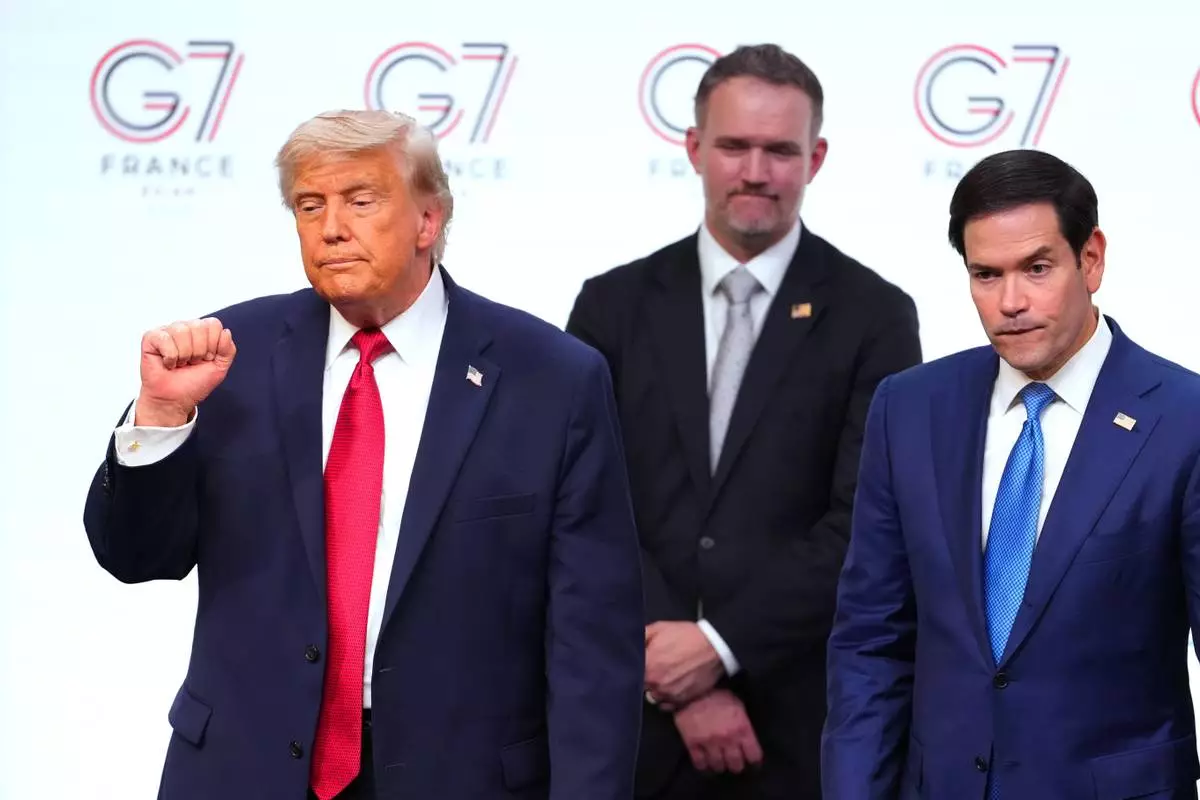
U.S. President Donald Trump, left, leaves the stage with, from right, United States Secretary of State Marco Rubio and U.S Trade Representative Jamieson Greer after a media conference at the end of the G7 summit in Evian-les-Bains, France, Wednesday, June 17, 2026. (AP Photo/Vadim Ghirda)
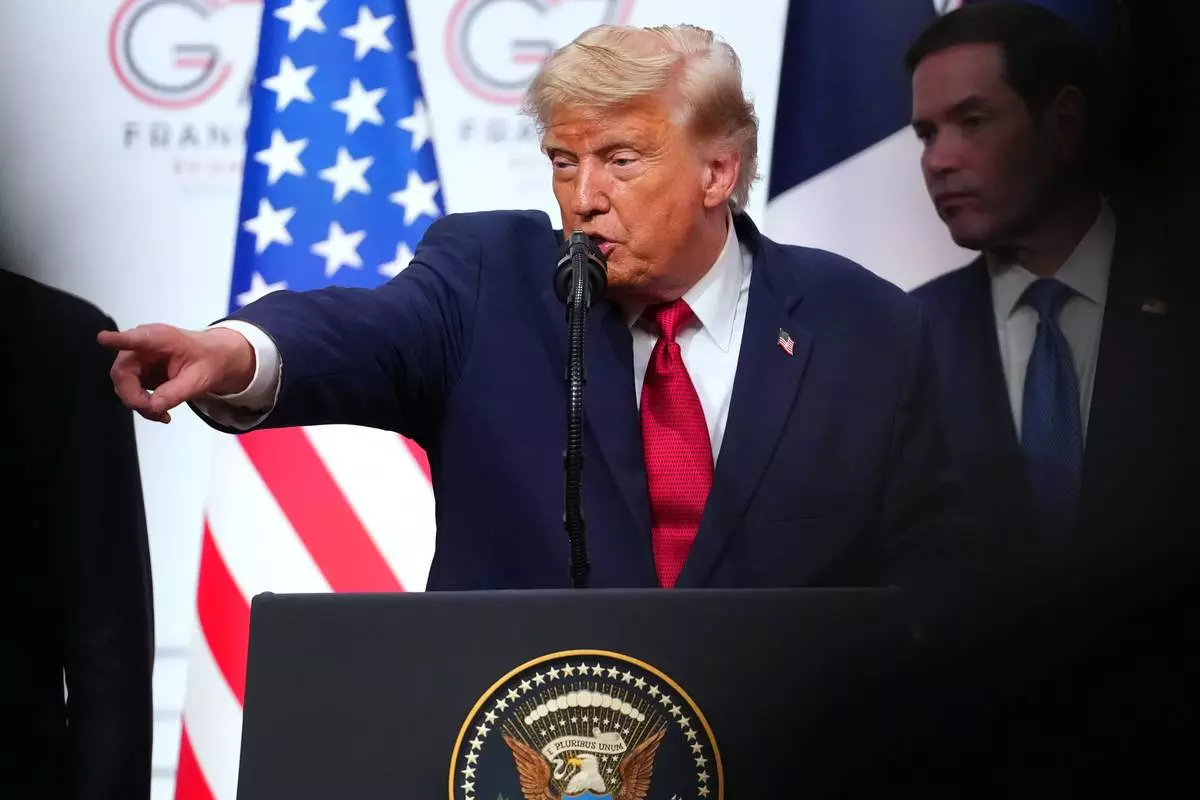
U.S. President Donald Trump, center, takes questions during a media conference at the end of the G7 summit in Evian-les-Bains, France, Wednesday, June 17, 2026. (AP Photo/Vadim Ghirda)