Chinese Premier Li Qiang held talks with visiting Prime Minister of the People's Republic of Bangladesh Tarique Rahman in Beijing on Thursday.
Noting that China and Bangladesh are traditional neighbors with close ties, Li said that President Xi Jinping is scheduled to meet Mr. Prime Minister Rahman to map out new plans for advancing bilateral relations.
He stressed China's firm support for Bangladesh in pursuing a development path suited to its national conditions and for the new Bangladeshi government in carrying out its administrative duties.
China stands ready to work with Bangladesh to uphold the policy of good neighborliness and friendship, consolidate strategic mutual trust, expand practical cooperation, thus promoting continuous new and greater development of bilateral relations, and delivering more benefits to the people of the two countries, he said. Li highlighted China's readiness to advance high-quality Belt and Road cooperation, steadily push forward the implementation of landmark projects in ports and water conservancy, and enhance cooperation in such sectors as trade, industrial and supply chains, and finance, thereby promoting common development and prosperity of the two countries.
China is willing to import more quality products from Bangladesh, support capable Chinese enterprises in investing there, and expand cooperation in emerging sectors such as new energy, digital economy and artificial intelligence, Li said, calling on the Bangladeshi side to continue to create a favorable environment for Chinese businesses.
The Chinese premier also called for enhanced cooperation in healthcare, education, youth and culture to improve people's sense of fulfillment.
As fellow developing countries, China is ready to closely coordinate and cooperate with Bangladesh in multilateral affairs, safeguard common interests, pursue greater strength through unity among developing countries, and make greater contributions to the shared development of the Global South, Li said. Rahman reaffirmed Bangladesh's commitment to the one-China principle and expressed the hope for closer high-level exchanges.
He said Bangladesh looks forward to deepening cooperation with China in economy, trade, and people-to-people exchanges under the framework of the Belt and Road Initiative.
Rahman underscored his country's firm support for the post-war international order based on the Cairo Declaration, the Potsdam Proclamation and the UN Charter, and voiced backing for the vision of a community with a shared future for humanity and China-proposed four major global initiatives.
He said Bangladesh is delighted to strengthen multilateral communication and cooperation with China to promote regional and global peace, stability and development.
After talks, Li and Rahman jointly witnessed the signing of multiple cooperation documents.
Prior to the talks, Li held a welcome ceremony for Rahman.
At the invitation of Li, Rahman is on an official visit to China from Wednesday to Friday.
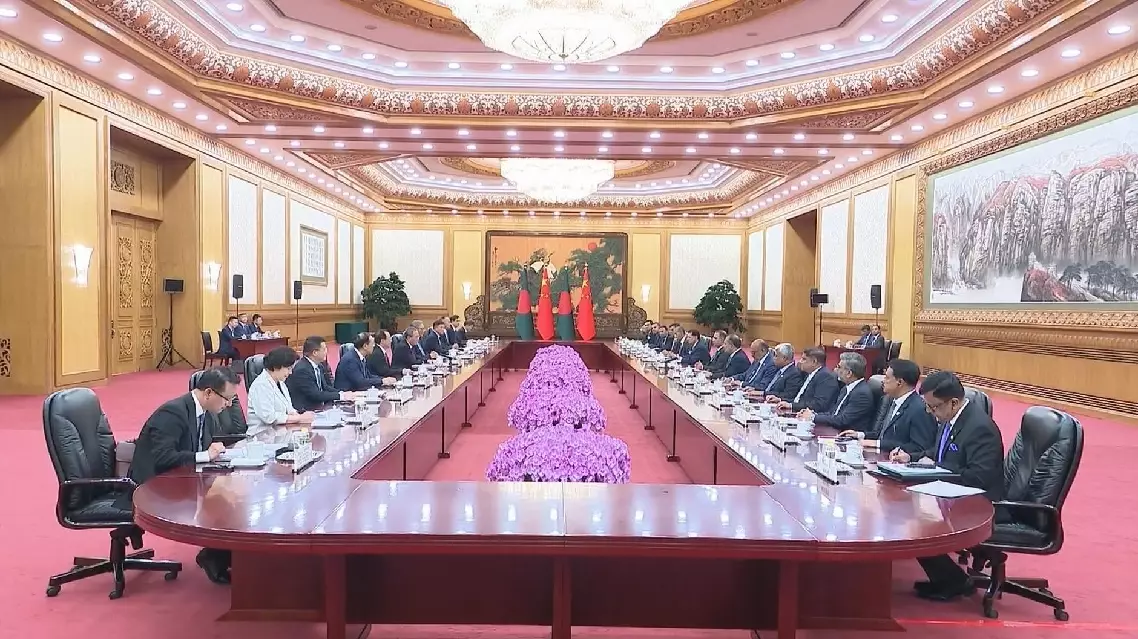
Chinese premier holds talks with Bangladeshi PM