Panicked residents in Venezuela's capital Caracas spent the night outdoors as two powerful earthquakes jolted the country in quick succession on Wednesday evening, which has left at least 164 people dead and 971 others injured.
Venezuela's acting President Delcy Rodriguez said Thursday that the coastal state of La Guaira in northern Venezuela was the hardest hit, describing it as a "disaster zone," where dozens of buildings had completely collapsed.
She also said the earthquake had triggered about 30 aftershocks, noting that the government is currently coordinating resources nationwide to strengthen rescue efforts in the hardest-hit areas and has called on the private sector to help procure rescue equipment and supplies.
The U.S. Geological Survey reported a magnitude 7.1 quake at 2204 GMT on Wednesday, followed just one minute later by an even stronger magnitude 7.5 tremor. Both struck near the coastal town of Moron, about 160 km west of Caracas.
The quakes were shallow with a depth of 10 km, which could intensify their destructive impact.
Rescue operations are underway as the country has declared a state of emergency following the strong earthquakes.
The Venezuelan government said all school activities nationwide have been suspended until further notice due to the severe damage caused by the twin earthquakes.
All nonessential activities have also been suspended for the rest of the week.
The quakes were among the strongest to strike Venezuela in more than a century and could be felt throughout the region. Tremors were significantly far-reaching, triggering building evacuations in Brazilian cities, roughly 1,700 kilometers away from Caracas.

Panicked Venezuelans sleep outdoors as death toll from powerful earthquakes rises to 164
Chinese Foreign Minister Wang Yi met with Austrian Federal Minister for European and International Affairs Beate Meinl-Reisinger in Beijing on Thursday.
Noting that China-Austria bilateral ties have maintained sound and steady development on the whole over the past 55 years since the establishment of diplomatic relations, Wang, also a member of the Political Bureau of the Communist Party of China Central Committee, said that the most valuable experience guiding bilateral ties lies in mutual respect and equality. He added that the most effective approach is openness, inclusiveness as well as mutual benefit and win-win outcomes.
The China-Austria friendly strategic partnership fully proves that countries varying in size, social system and civilization can forge sound friendship and partnerships, said Wang.
Wang said China congratulates Austria on its election as a non-permanent member of the United Nations (UN) Security Council and China stands ready to step up communication and coordination with Austria to jointly uphold the authority of the UN.
Wang said China and Europe are partners instead of rivals, and China's development represents opportunities for Europe rather than a challenge. China appreciates Austria's rational and pragmatic China policy and hopes Austria will continue to play a constructive role in advancing China-Europe ties, he added.
Meinl-Reisinger said that Austria attaches great importance to developing bilateral ties with China, remains committed to the one-China policy, and stands ready to take the 55th anniversary of bilateral diplomatic ties as an opportunity to step up strategic dialogue with China and expand all-round cooperation covering trade, investment and green development.
Austria is prepared to support candid China-Europe dialogue to advance the sound and steady growth of China-Europe ties, she added.
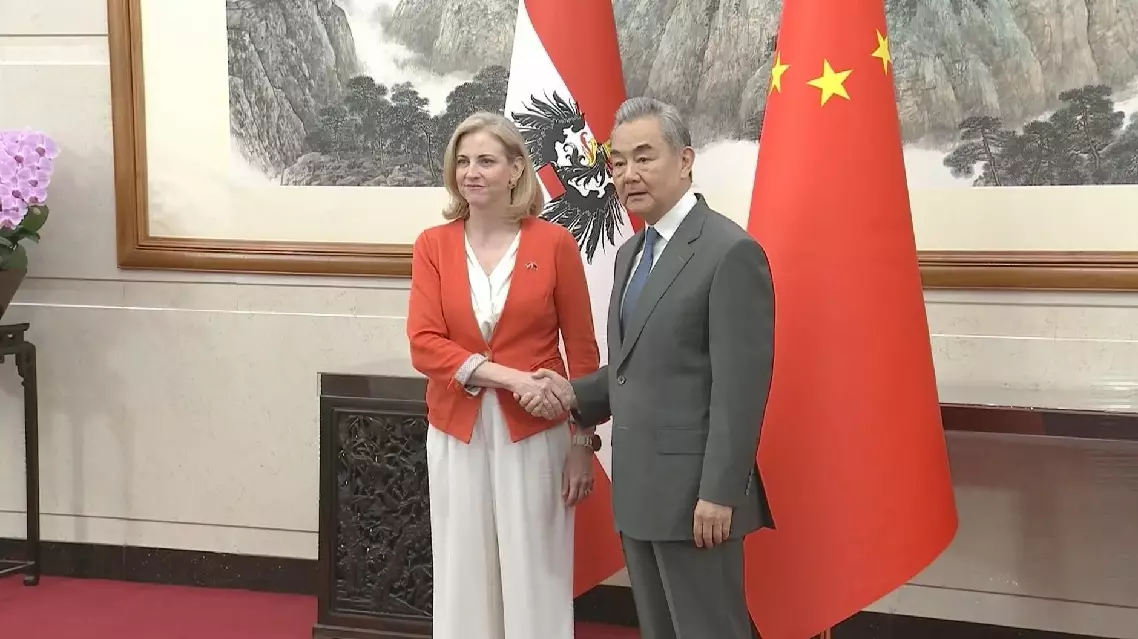
Chinese FM meets Austrian counterpart