MOUNTAIN VIEW, Calif.--(BUSINESS WIRE)--Jun 26, 2026--
Unseen Reality, the spatial computing company building mixed reality glasses for everyday use, unveiled URXR One, its first product, at Augmented World Expo (AWE) 2026.
This press release features multimedia. View the full release here: https://www.businesswire.com/news/home/20260626644048/en/
Today's XR devices often force a tradeoff: lightweight glasses that mainly mirror a screen, or powerful mixed reality headsets that are too bulky for everyday wear. URXR One is designed to close that gap, bringing immersive spatial screens, room-aware interaction, and video see-through mixed reality into a 93g glasses form factor.
"Spatial computing has lived inside headsets too long. We're putting it on a face you'd actually want to keep wearing," said Edward Zhou, Founder and CEO of Unseen Reality. "Every design decision starts with one question: can someone forget they're wearing this? At AWE, people felt the answer for the first time."
URXR One lets users turn any room into a private screen space. They can open a large virtual display for movies, extend a laptop into a multi-screen workspace, or place apps around the room and keep them anchored in space. When they want a simpler experience, URXR One can also work as a screen that follows their view.
Unlike traditional headsets that fully isolate users from their surroundings, URXR One uses ultra-low-latency video see-through under 10ms, allowing people to stay aware of the room around them while interacting with digital content. Users can move, resize, and arrange windows with natural hand gestures, without reaching for a controller.
URXR One combines dual high-resolution Micro-OLED displays, 2.5K per eye, and a wide 90-degree field of view to deliver sharp, immersive visuals in a compact wearable design. The glasses support both responsive head-tracked viewing and 6DoF spatial anchoring, enabling screens and apps to remain fixed in the physical environment, powered by a leading-edge custom Spatial Processing Unit (SPU) that handles all spatial computing on-chip.
"For AI to truly perceive and interact with the physical world, it needs a new kind of eyes. That conviction led us to Unseen Reality," said Xiaoxian Kong, angel investor in Unseen Reality. "This team has produced a full spatial sensing architecture that challenges what even the largest hardware companies have shipped."
Kong is an early investor of frontier hardware, including Diagen Biotechnology and brain-computer interface company BrainCo.
Availability
URXR One will begin shipping in fall 2026. Pricing and ordering details will be announced ahead of launch. For updates, visit unseen-reality.com.
About Unseen Reality
Unseen Reality is a spatial computing company on a mission to make everyday spatial intelligence a reality. Based in Silicon Valley, the company designs URXR One, lightweight spatial display glasses that deliver full-stack spatial computing in 93 grams. For more information, visit unseen-reality.com.

Unseen Reality URXR
MEXICO CITY (AP) — A father holds the hand of his daughter dressed as a fairy. A 24-year-old man in a pilot uniform stares proudly at the camera. A family embraces on a soccer field.
They are among the images posted by relatives within Venezuela and abroad desperately searching for their missing loved ones following two powerful, back-to-back earthquakes on Wednesday evening.
Hundreds have been killed and thousands injured. The number of casualties is expected to climb after the 7.2- and 7.5-magnitude quakes that caused widespread damage and were among the strongest to strike Venezuela in more than a century.
With communication patchy, social media and online registries have become a crucial tool for many Venezuelans seeking information and resources beyond sparse government statistics. Independent online registries documenting up to 40,000 people missing far surpass the official government account.
While some rushed to search beneath the rubble of collapsed buildings, others created digital flyers on WhatsApp, Facebook and X with their relatives’ details.
Among them was Vanesa Marcano, 31, who posted photos from Madrid of her uncle and aunt, who live in La Guaira state, north of the capital Caracas, which suffered some of the heaviest damage and casualties.
Marcano posted the images in the hopes that they were only unreachable due to damaged communication lines. Her uncle’s daughter and his 7-year-old grandson were visiting from the United States and also are missing.
“It’s a feeling of impotence and uncertainty,” Marcano said by phone. “I know you must stay calm and focus on the actions you can take. But it’s very easy to fall into despair.”
Jhoyser Concalves, a Venezuelan from the northern coastal city of Catia La Mar, was talking to his partner and her daughter just minutes before the shaking. It was the last he heard from them.
When the earthquake stopped, Concalves ran out of his house to their apartment building, where they lived on the sixth floor. There was only debris and people desperately trying to rescue neighbors from the rubble.
Concalves posted a flyer reading “MISSING” on X and Facebook in a desperate attempt to find them.
“They are pulling people out of the building alive. So I still have hope that they are in there alive,” he said.
The search was complicated by the country's restrictions on social media and messaging platforms.
On Thursday, the U.N. human rights mission in Venezuela issued a statement calling on the government to lift local restrictions on social media and saying timely access to reliable information can save lives.
Sites including X and messaging app Signal were blocked in August 2024 by then-President Nicolás Maduro in an attempt to suppress communication among those who rejected his claim of victory in the presidential election. Former Vice President Delcy Rodríguez became the acting president in January after the U.S. captured and removed Maduro from power.
Shortly after the U.N.’s request Thursday, Venezuelans in the country were able to access X.
Outside the country, such sites have become even more important for many of the 8 million people who have migrated from Venezuela in recent years and were unable to check on their loved ones.
Elibel Tovar's 70-year-old father moved to Brazil more than 20 years ago but was in La Guaira for business. Félix Ramón Tovar Hernández was planning to travel Friday to Chile for his first reunion with his son in more than a decade. But Tovar, 38, said he hasn't heard from his father.
“I feel powerless because I don’t know how this is affecting him: the shock, the decisions he’s having to make, whether he is physically okay, or even whether he is still alive,” said Tovar, who registered his father on the website for the missing.
“Being in Chile makes it very difficult to get information, and everything we see feels confusing,” he said via WhatsApp.
In Madrid, Marcano said she was trying to stay calm for the sake of her 1-year-old daughter.
“You keep hoping someone will organize a fundraiser or some kind of initiative where you can help,” Marcano said. “But the truth is, from far away, there is very little you can do.”
Hughes reported from Rio de Janeiro.
Follow AP’s coverage of Latin America and the Caribbean at https://apnews.com/hub/latin-america
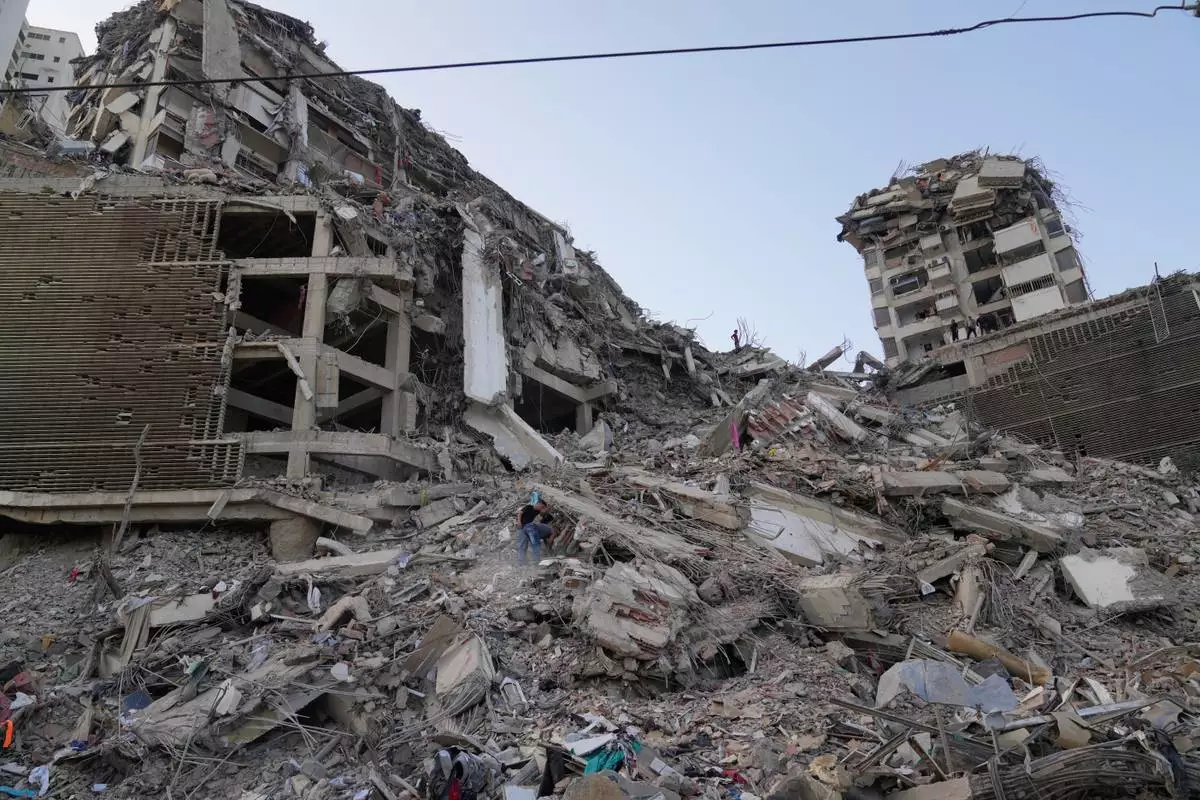
Residents search through the rubble two days after an earthquake struck La Guaira, Venezuela, Friday, June 26, 2026. (AP Photo/Ariana Cubillos)
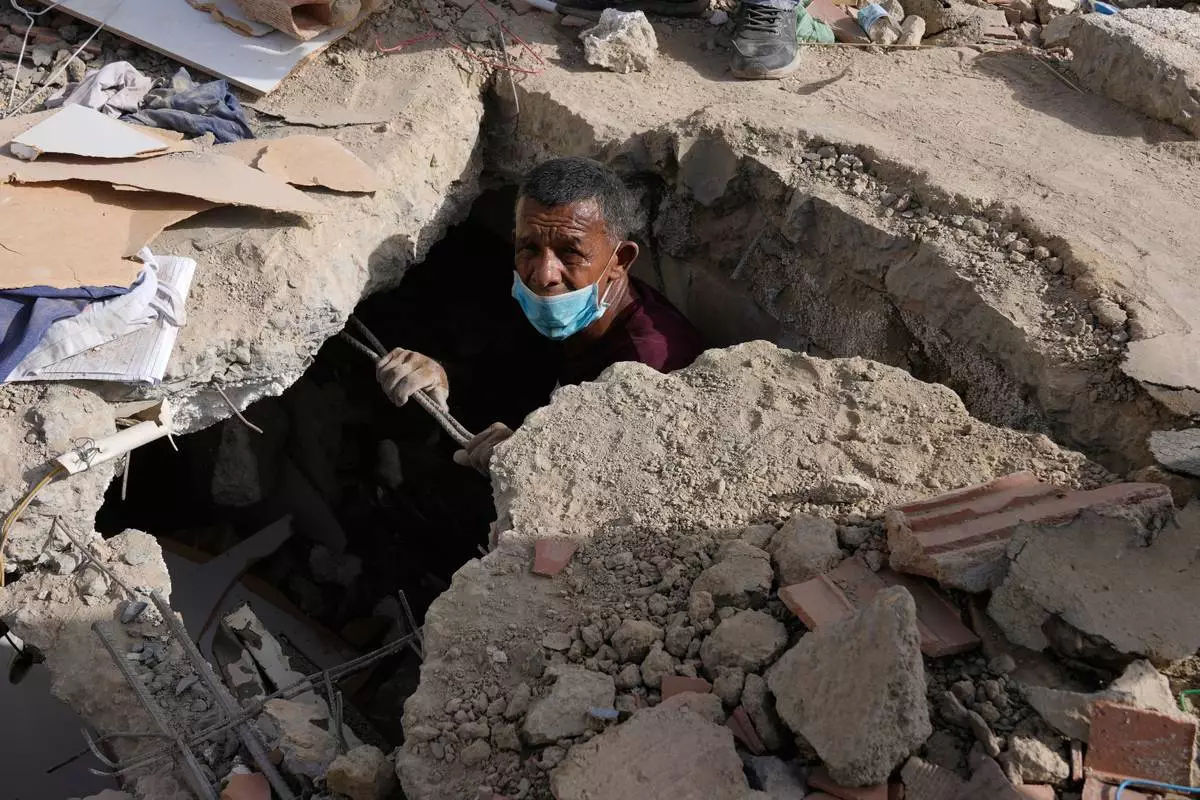
Franklin Fuentes searches for missing relatives in the collapsed building where they lived two days after earthquakes struck La Guaira, Venezuela, Friday, June 26, 2026. (AP Photo/Ariana Cubillos)
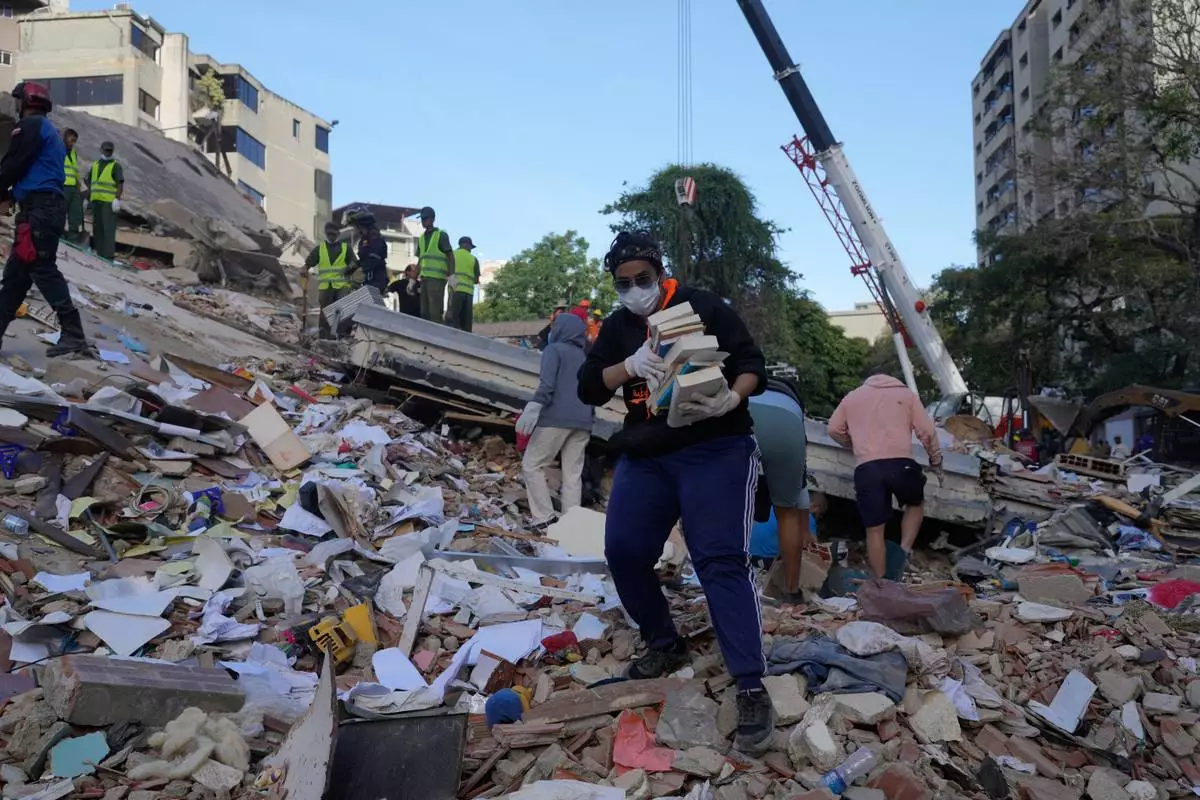
Residents search through the rubble of a building that collapsed in an earthquake in Caracas, Venezuela, Thursday, June 25, 2026. (AP Photo/Ariana Cubillos)
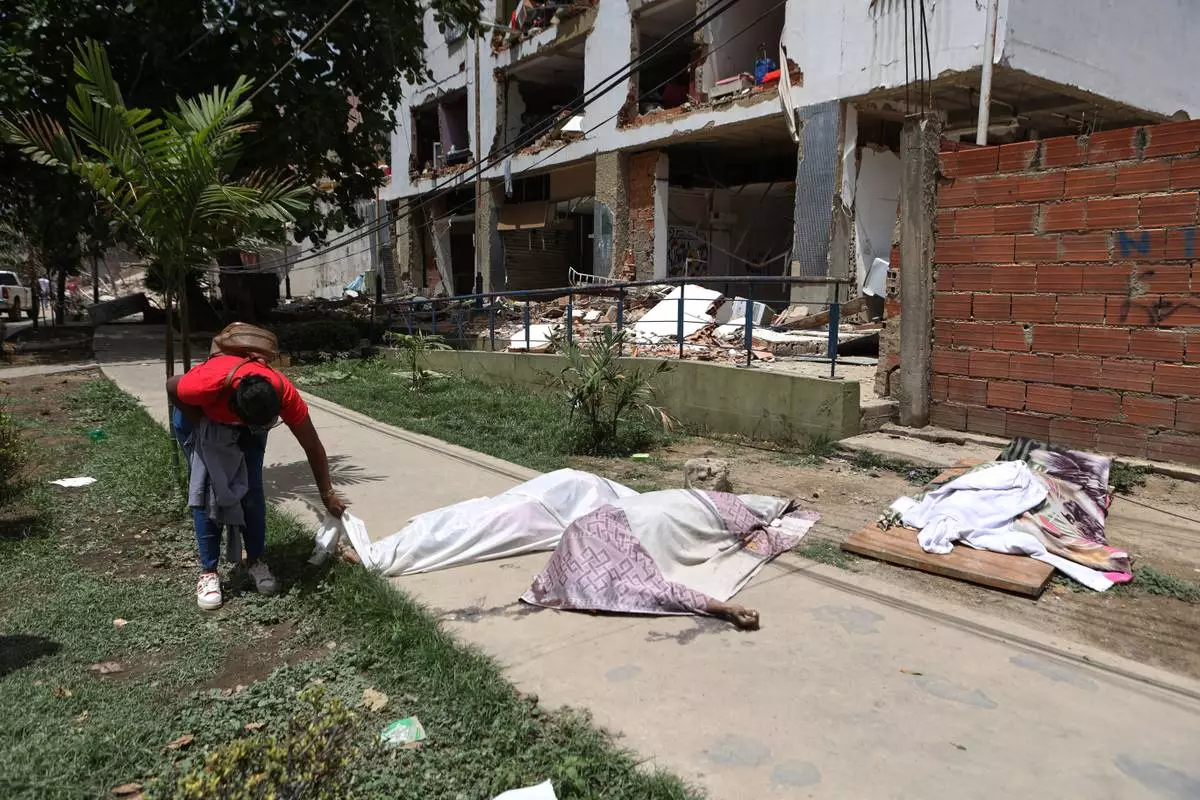
A man looks at covered bodies in front of a damaged building the day after earthquakes and several aftershocks struck La Guaira, Venezuela, Thursday, June 25, 2026. (AP Photo/Pedro Mattey)
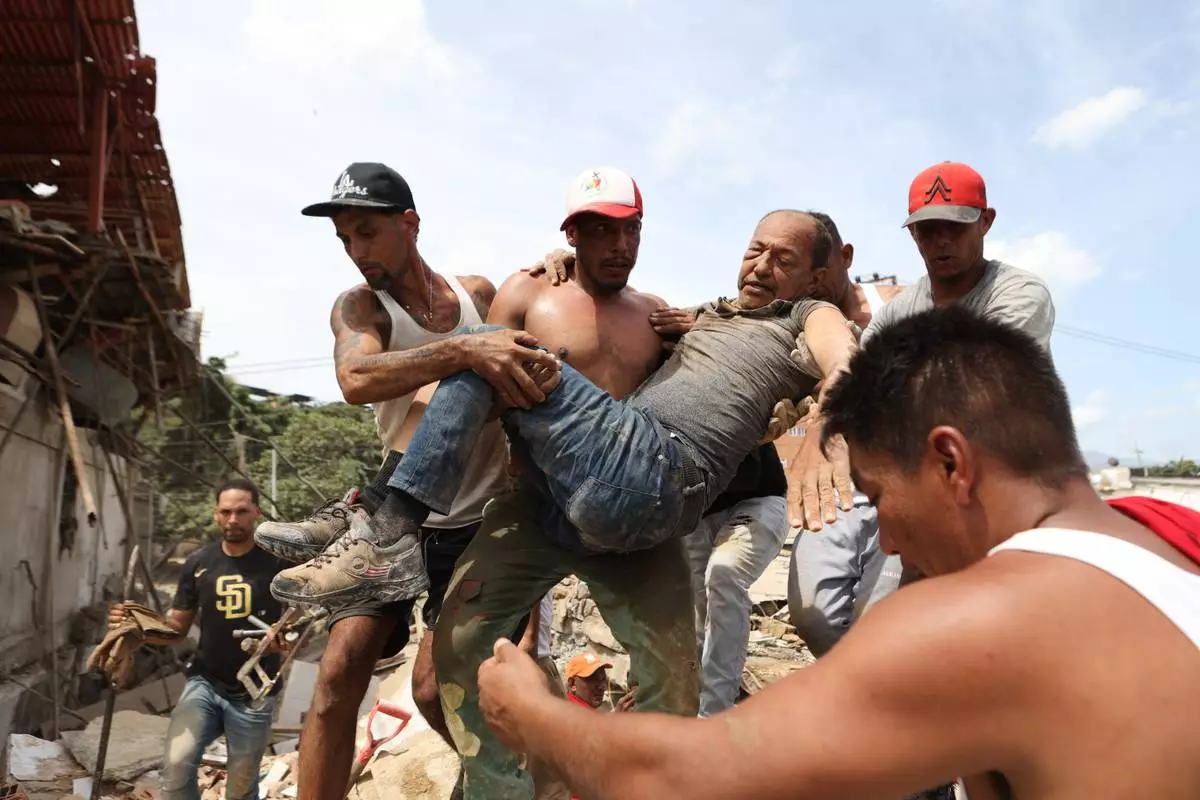
Neighbors carry a man rescued from the rubble of a collapsed building the day after earthquakes struck La Guaira, Venezuela, Thursday, June 25, 2026. (AP Photo/Pedro Mattey)
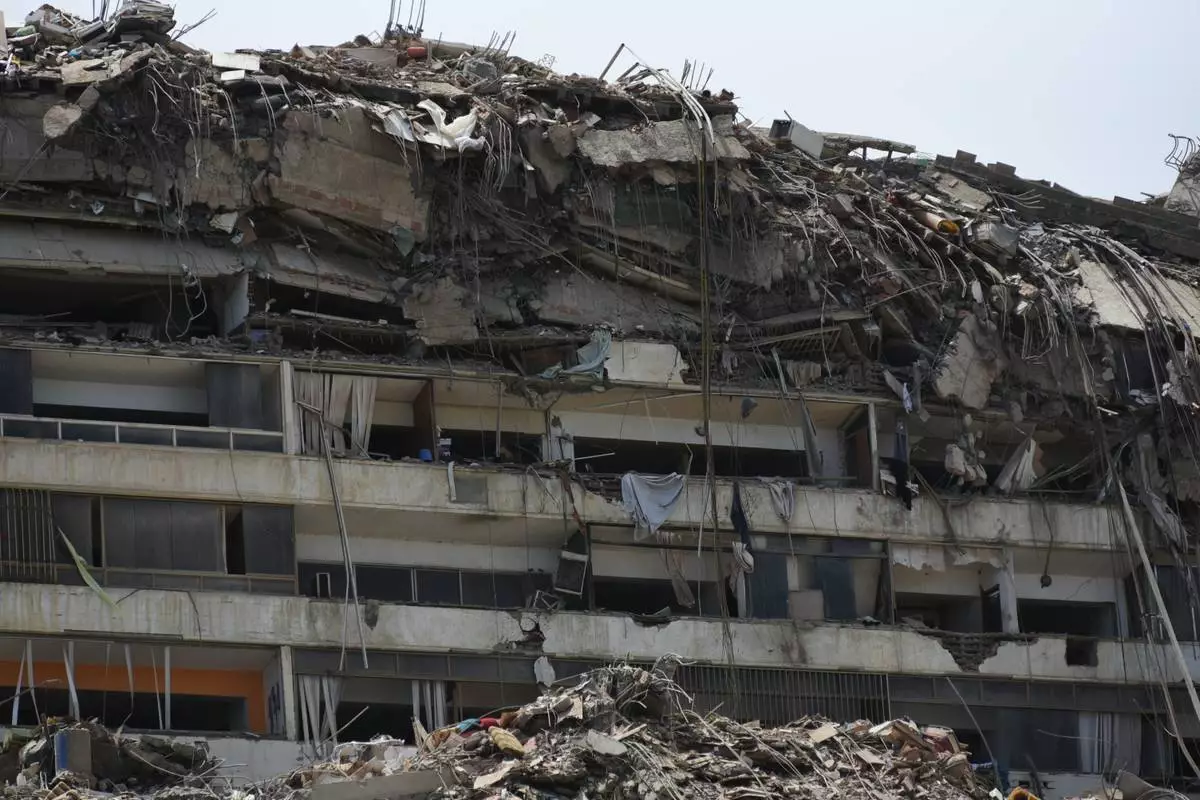
Damaged buildings stand in Catia La Mar, Venezuela, a day after an earthquake and several aftershocks struck the city, Thursday, June 25, 2026. (AP Photo/Jonathan Lanza)
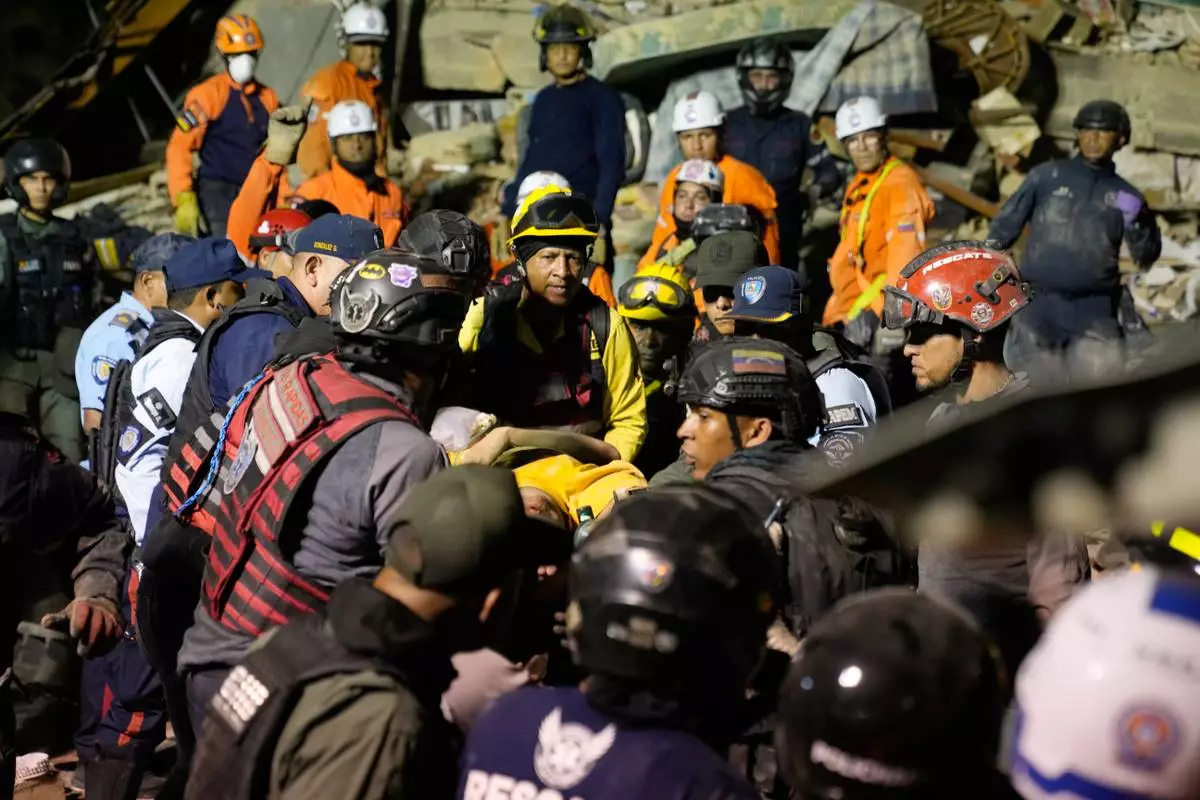
Rescue workers search through the rubble of a collapsed building after earthquake in Caracas, Venezuela, Wednesday, June 24, 2026. (AP Photo/Ariana Cubillos)