The Shenzhou-23 spacecraft crew have carried out diverse scientific experiments on the orbiting Tiangong space station over the past week.
The three taikonauts, Zhu Yangzhu, Zhang Zhiyuan and Lai Ka-ying, who arrived at the space station on May 25, have conducted experiments of space medicine, electroencephalogram (EEG), human-robot interaction and microgravity physics.
Using ultrasound diagnostic devices, the trio assisted each other to perform ultrasonic scans of the neck, wrist, abdomen and other body parts.
The data obtained will support multiple research projects, including pan-vascular blood flow spectroscopy, spatio-temporal evolution mapping of blood flow, and sensitive muscle group remodeling.
They interacted with a robot to conduct touch-interaction tests. The collected data will be used to optimize motion behavior planning methods for in-orbit robots in follow-up missions.
Using EEG acquisition equipment, the three taikonauts carried out several experimental tests such as visual-motor processing and behavioral response to lighting.
In microgravity physical sciences, the crew installed multiple experiment modules and units and performed sample cleaning and replacement in the experimental cavity of the containerless materials cabinet.
In terms of health management, the crew used a TCM four-diagnosis instrument to collect relevant data, providing a basis for researchers to implement long-term health monitoring of taikonauts on orbit.
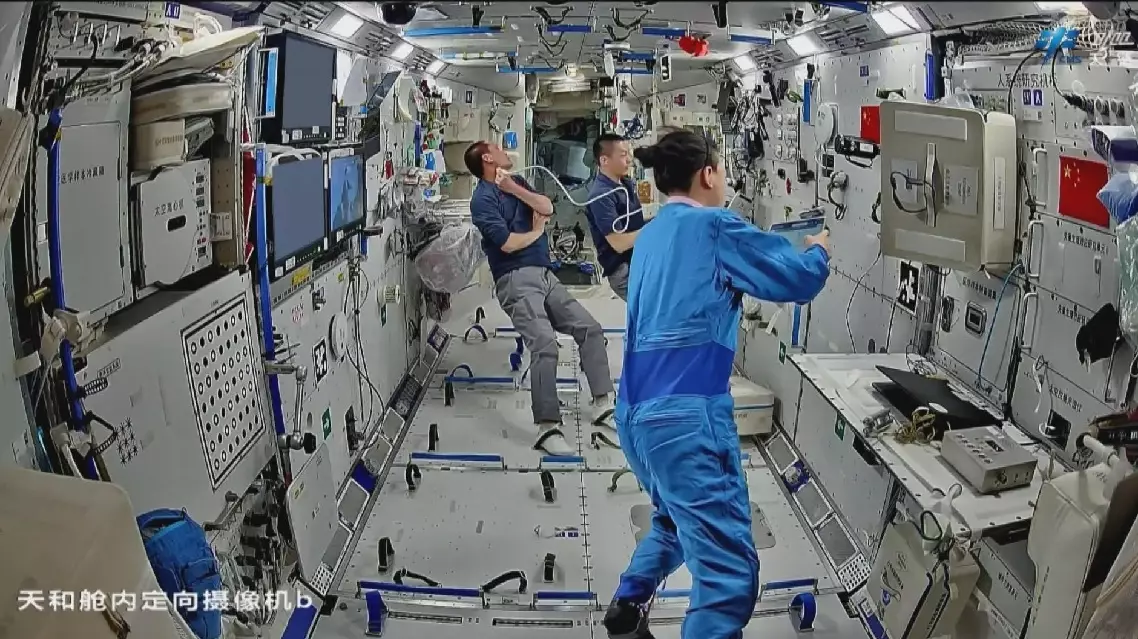
Shenzhou-23 crew performs diverse experiments in space station