Political leaders, scholars and policy experts from around the world have highlighted the Communist Party of China (CPC)’s role in driving China’s development and contributing to global growth.
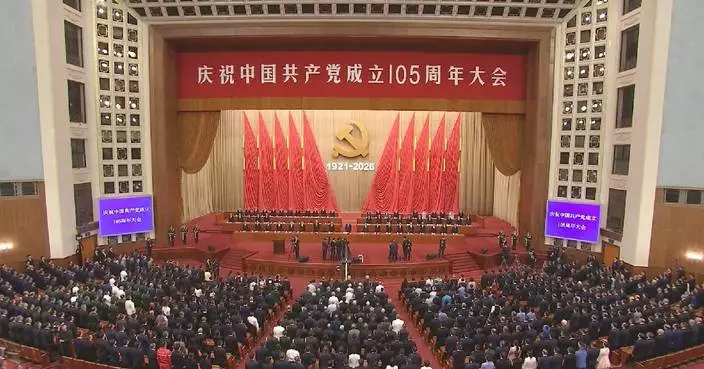
Since its founding 105 years ago, the Communist Party of China (CPC) has been at the forefront of China's transformation, leading the country to become one of the world's foremost economic powers.
Now with more than 101 million members, the CPC is steering the country on a new journey toward modernization by building on decades of development.
"Communist Party of China is a well-respected party. One of the things that the CPC has been able to do is to align their policy trust and development of China between the Party and the government. It makes the Party very relevant. It's one of the most relevant and strongest parties in the world," said Joseph Tegbe, director-general of the Nigeria-China Strategic Partnership.
"The Chinese government has been promoting and working hand-in-hand with the people of China to promote economic development of China, and we’ve seen advancement in artificial intelligent and renewable energy, and we’ve seen also the electric SUVs, that have been used everywhere in the world, in addition to several advancement in different sectors. How do we see this? Here we admire this advancement in a very short period of time and the successes that China has been celebrating," said Sheikha Dr. Alanoud Ebraheem Al-Sabah, an expert on China-Kuwait relations.
"You would see greater economic development, and I think you would see China continue on its pathway for having greater prosperity, not only internally in the country, but I think it’s also something that, as China actually achieves greater progress and prosperity internally, it also translates to benefit the wider international community," said Steven Wright, director of the Leadership Knowledgebase of Qatar Leadership Centre.
"China has provided immense support for global development. Its vision of a shared future for humanity, its advocacy of a fairer form of multilateralism, and the network of Global South partnerships it helps to lead with other nations through BRICS serve as important pillars for a counter-hegemonic struggle against European and U.S. imperialism, which continues to drive aggressive policies around the world. China represents a form of soft power and a source of support for a better international order—one based on more equal relations among nations, mutual respect, and the principle of national self-determination," said Walter Sorrentino, secretary of the Communist Party of Brazil.
"Most important Chinese invention. Yes, we know about gunpowder, we know about ink, we know about paper, we know about the compass. But in my opinion, the most important is governance. The contribution of China will not only cover Ecuador, will cover all of Latin America. These have helped a lot of people out of poverty," said Hector Villagran Cepeda, former Minister for Public Works and Transport of Ecuador.

Global observers highlight CPC's role in driving China's development