Driven by a belief that technology should improve people's lives, Chinese entrepreneur and educator Zhang Zhengtao has spent years transforming robotics research into practical innovations, from dexterous industrial robots to a humanoid robot band that has captured public attention.
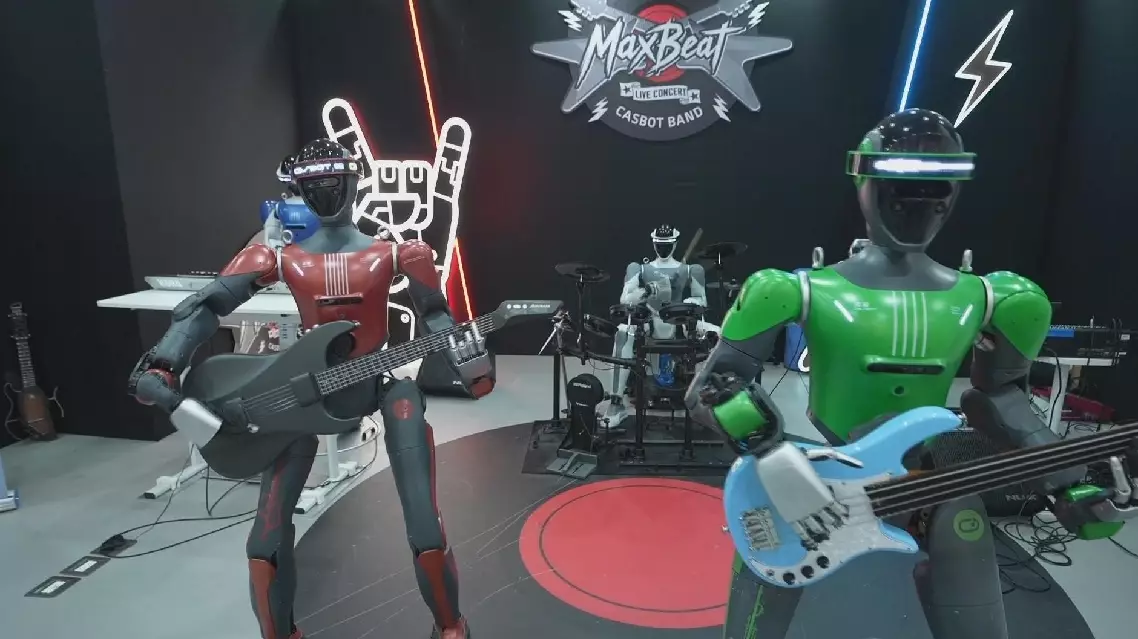
The robot band has become one of Zhongke Huiling Robotics' most recognizable creations, drawing widespread attention online. Behind the performance is years of research in dexterous manipulation, motion control and embodied AI.
The robot band has a full line-up, including drums, keyboard, lead guitar and bass. Its performance may look effortless, but developing robots capable of playing together required overcoming a series of technical hurdles.
"Getting robots to play together is much harder than it looks. Each robot needs highly dexterous hands to play instruments with human-like precision. Then all four robots have to stay synchronized within milliseconds. And finally, they need natural movement and stage presence, like real musicians. Bringing together robotics, AI, and performance required us to solve many technical challenges, but we're proud of the result," said Zhang. For Zhang, however, the robot band is only one demonstration of a much broader vision. A robotics researcher by training, he founded Zhongke Huiling Robotics in 2023 to transform years of scientific research into practical technologies capable of solving real-world industrial challenges.
"My PhD research at the Chinese Academy of Sciences focused on humanoid robots playing table tennis. I've always wanted to take robotics out of the lab and into real-world applications. That's why I founded this company in 2023, focusing on embodied AI and industrial robotics that can perceive, learn, and interact with the physical world," he said.
Today, those technologies are already being deployed in manufacturing, where robots are taking on complex tasks that have traditionally depended on skilled human labor.
One example is footwear manufacturing, where robots equipped with the company's dexterous hands are learning to perform delicate assembly work by observing human operators.
"In shoe production, many assembly tasks involve soft, flexible materials that are difficult to standardize. Traditionally, workers perform these tasks by hand. Our robots learn these operations by observing human demonstrations. They capture movement, force, and visual information, then replicate those actions. This is exactly the kind of unstructured tasks where embodied AI can make a significant impact," Zhang said.
Beyond entrepreneurship, Zhang is also committed to cultivating the next generation of robotics researchers. He helped establish the Beijing Key Laboratory of Industrial Embodied Robotics, where he serves as director and doctoral supervisor. The laboratory brings together more than 120 faculty members, researchers and graduate students to conduct research on embodied robotics and AI-driven robotic intelligence while promoting the deployment of advanced technologies in industry.
As both a researcher and educator, Zhang said cultivating talent begins with encouraging students to solve practical problems while maintaining world-class academic standards.
"First and foremost, we want students to tackle real-world problems. Problems that are challenging, meaningful, and capable of advancing productivity and society. At the same time, we hope they develop strong research skills, publish influential work at leading international conferences and journals, and engage with the global academic community. Ultimately, we want graduates who combine scientific thinking with practical engineering ability. Many of our students have gone on to make valuable contributions across academia, industry, and society," he said.
He added that technological innovation and talent cultivation ultimately serve the same goal of contributing to national development while improving people's daily lives. As a Party member, he said that mission continues to guide both his research and entrepreneurship.
"As grassroots researchers and Party members, our goal is to use technology to serve the country's development and improve people's lives. Our vision is to build robots that can perceive, learn, and think more like humans. But ultimately, technology should serve humanity. Whether it's performing dangerous tasks in hazardous environments or assisting people in daily life and industry, we want AI and embodied robotics to make work safer, more productive, and more meaningful. That belief is at the heart of our team and drives everything we do," Zhang said.
Chinese entrepreneur advances embodied AI to serve industry, everyday life