Shanghai on Friday launched its celebrations for China's National Maritime Day 2026 with a variety of public events to promote maritime culture and highlight Shanghai's rising status as a leading international shipping hub.
China celebrated its 22nd National Maritime Day on Saturday, which also marks the country's observance of World Maritime Day.
The public events in Shanghai include ship open houses, cultural and creative fairs, and special postal exhibitions, bringing maritime culture closer to communities across the city.
Relevant shipping indices showed Shanghai has risen to second place among 43 cities in global shipping competitiveness, underscoring its growing role as a leading international maritime center.
As part of the celebrations, three vessels, including the maritime patrol ship Haixun 01 and the pilot vessel Hugangyin 6, docked at the Shanghai Port international cruise terminal and opened to the public.
The open-house event attracted large numbers of visitors, who boarded the vessels to observe maritime patrol operations, port pilotage services, and sightseeing cruises up close.
Visitors also learned about navigation technologies and gained firsthand insight into the daily lives of seafarers.
"I am here because I wanted to see China's own ships. It was my first time learning that a vessel can be equipped with small devices on both sides to help maintain its balance. I found it quite impressive," said Wu Xiaoting, a visitor.

Activities launched in Shanghai to mark National Maritime Day
More than 10,000 pages of ancient palm-leaf manuscripts, preserved for nearly a millennium at the Potala Palace in southwest China's Xizang Autonomous Region, are being digitally scanned and cataloged as part of a major preservation initiative.
Palm-leaf manuscripts, known as Beiyejing in Mandarin, mainly consist of Buddhist scriptures, while also encompassing ancient records of drama, medicine, astronomy and more.
"The uniqueness of the palm-leaf manuscripts lies in two attributes. One is the scarcity of the material. The other is the content recorded on that material. Most of Xizang's palm-leaf manuscripts relate to Buddhist scripture. But there's also non-Buddhist content, for example, dramas, poems, medicine, astronomy and calendar calculation. They've been around for ages. They're irreplaceable cultural relics with great and multifaceted value. The mass influx of palm-leaf manuscripts probably began in the mid-8th century and continued through to the 17th century. That's nearly 1,000 years. In terms of content, the Potala Palace collection contains some truly unique manuscripts. For example, nowhere else are these new discoveries in Buddhist logic classics to be seen, such as certain parts of the Madhyamaka Sutras and Hetuvidya Scriptures. They may not have been translated in Kangyur and Tengyur. Such manuscripts are invaluable for interpreting these texts," said Dorje Phuntsok, director of the Cultural Relics Research Office under the Potala Palace Management Office.
Xizang is home to many important palm-leaf manuscripts. Most of those preserved at the Potala Palace remain intact and feature a fairly complete, uniform binding style, including numerous significant classical works.
Today, the Potala Palace's Palm-Leaf Manuscript Research Center has carried out comprehensive surveys, cataloging, digital scanning and condition assessments of tens of thousands of pages, aiming to safeguard this cultural treasure that bears witness to ethnic exchange, interaction and integration.
"The palm-leaf manuscripts, ever since the Potala Palace was rebuilt in the 17th century, have had a special storage area just for them. Following the standards and rules of the time, they were given their own scripture boards and boxes, and even cloth to wrap them in. So, they have a fairly complete, uniform binding style. Look at Potala Palace's palm-leaf manuscripts. Some are over 1,000 years old and others, a few hundred. Most are well preserved and in pretty good condition," said Dorje Phuntsok.
"The Potala Palace's Palm-Leaf Manuscript Research Center focuses on two main tasks. First, the collection has been counted page by page - that's over 10,000 pages of palm-leaf manuscripts. It does a full check, records the details and lists them. Second, it checks for damage to the manuscripts, look at their storage conditions, and is launching a major preservation campaign. So far, we've done some initial digitization. We've scanned over 200 manuscripts digitally, covering thousands of pages. Next, we'll use these digital copies to interpret the texts and do other things like that. This way, we don't have to handle the originals. It's a way of protecting them," he said.
Dorje Phuntsok said research on the palm-leaf manuscripts is of great significance given their cultural value.
"The research on the Potala Palace's palm-leaf manuscripts has considerable potential. Whether it's their value as relics or in view of their relevance today, I think the Potala Palace's palm-leaf manuscripts are a remarkable treasure. Studying them will be a long, hard road. Actually, if I had to sum it up in one sentence, they're a symbol of ethnic exchange, interaction and integration. They're messages from China's various civilizations," he said.
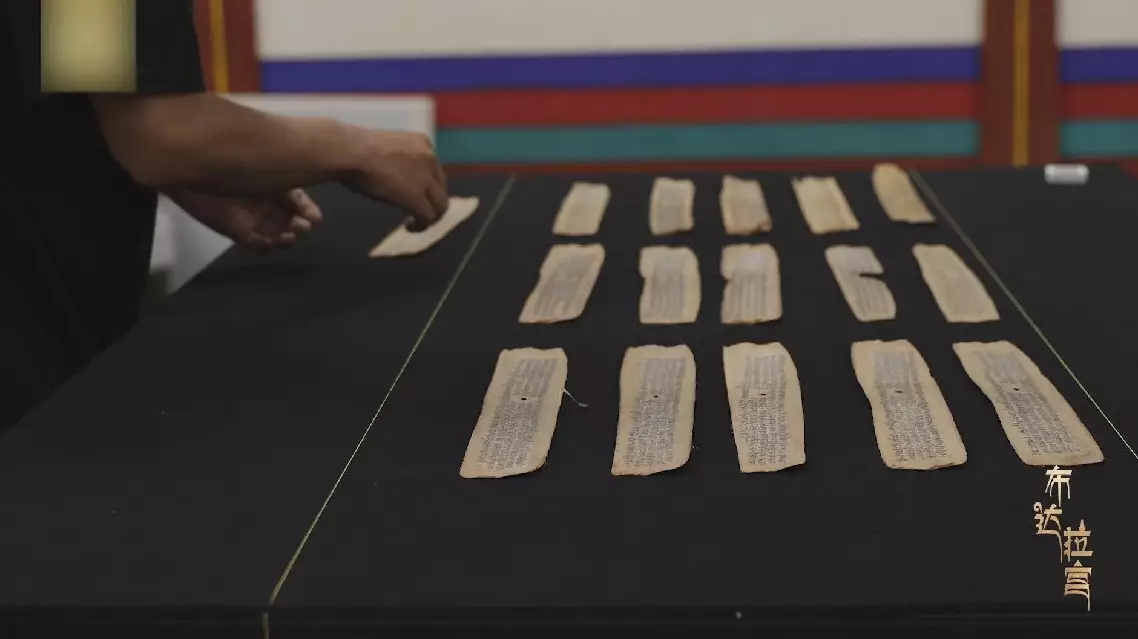
Potala Palace in China's Xizang preserves ancient palm-leaf scriptures