Typhoon Bavi is bearing down on China's eastern seaboard, lashing Zhejiang Province with winds exceeding 140 km per hour and prompting emergency responses across the region.
As the typhoon approaches, both Dongtou District, located in Wenzhou City, and Taizhou City are feeling the full force of Bavi, as its 10-grade wind radius moves in.
In Dongtou District, an orange alert for storm surge has come into effect. Some local scenic spots and guesthouses have closed due to the intensifying winds and rain.
Meanwhile, temporary restrictions have been imposed on all local cross-sea bridges, prohibiting the movement of all people and and vehicles.
In Taizhou, all fishing boats have been anchored at port and fishermen evacuated. Local authorities conducted door-to-door home inspections on Saturday, as a precaution for later evacuation should any building is rendered inhabitable during the storm.
In addition, firefighters from across Zhejiang are converging on Taizhou.
At around 15:00 Saturday, category 10 wind radius of the typhoon reached Huadian Wind Farm in the waters northwest of Pishan Island in Zhejiang's Yuhuan City.
Average wind speeds at the site exceeded 120 km per hour, with maximum instantaneous gusts surpassing 140 km per hour.
Surveillance camera footage showed that huge waves churned in the waters, and the gales, combined with torrential rain, formed a dense curtain of rain that intertwined with the surging waves, causing a sharp drop in visibility.
So far, all 32 wind turbines at the farm have been safely shut down, and on-duty staff members are sticking to their posts to monitor the rain, wind conditions, and equipment status around the clock.

Typhoon Bavi barrels toward Zhejiang coast, triggering storm surge alert, mass evacuations
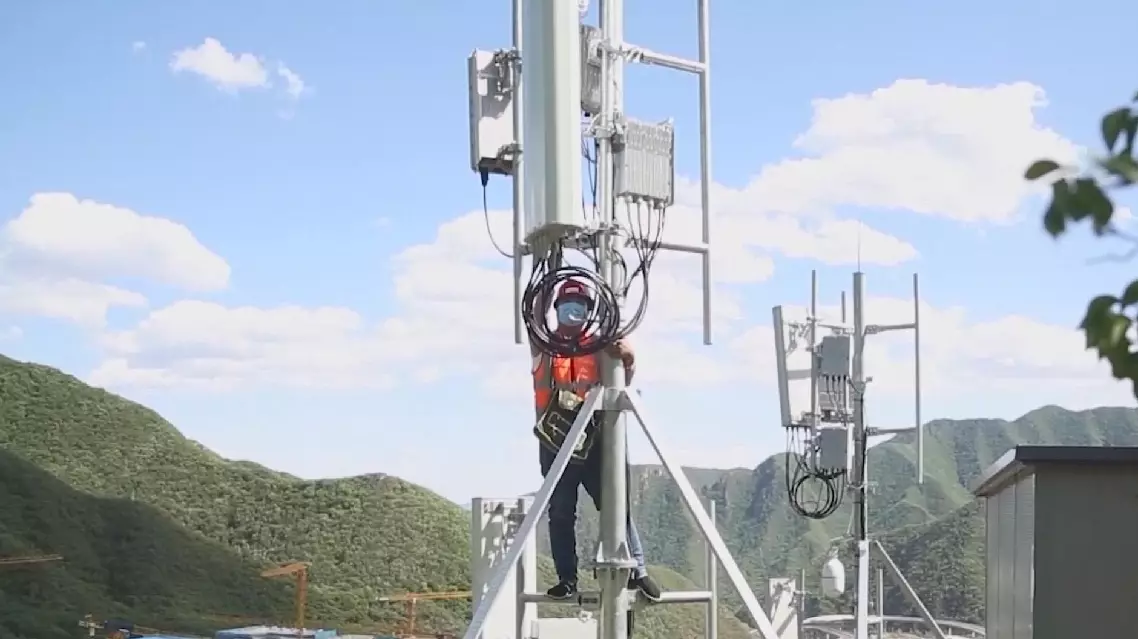
China will push for the rollout of next-generation communication networks ahead of market demand in the coming five years, a senior official with the Ministry of Industry and Information Technology (MIIT) said on Wednesday at the annual International Postal and Telecommunications Expo (PT Expo).
The push mirrors the development plan recently issued by the ministry for the information and communications industry during the 15th Five-Year Plan period (2026-2030).
According to the plan, a new-generation communications network with comprehensive coverage and leading performance is expected to be fully established by 2030, the 5G user penetration rate will reach 95 percent, gigabit-capable broadband will connect to 320 million households, and intelligent computing power will reach 9,800 EFLOPS -- a unit of computing performance, with each unit representing one quintillion floating-point operations per second.
"We will systemically promote the development of an application-driven and appropriately future-oriented next-generation communications network, push broadband networks toward dual 10-gigabit evolution, and advance the construction of low-Earth orbit satellite internet systems. We will also holistically optimize a communications network that links ground and sea, expand and improve computing facilities, and strengthen computing-network integration and the interconnection of computing power, so as to better support the national integrated computing network," said Yu Xiaohui, vice minister of the Ministry of Industry and Information Technology.
The move came as breakthroughs in digital intelligence technologies -- represented by artificial intelligence -- brought opportunities for the development of information and communication.
As of the end of July, China had deployed over 5.15 million 5G base stations, with early-stage deployment of 10-gigabit optical networks already underway and intelligent computing power standing at 2,185 EFLOPs, according to official data.
China will also deepen the integration of terrestrial and satellite networks, including commercial applications for smartphone direct-to-satellite services and the Internet of Things (IoT), ramp up research and development for 6G base stations, and advance the development of standards in key information and communication sectors, such as computing power networks and quantum communication, according to the development plan.
The PT Expo this year is being held from Tuesday to Thursday in Beijing.
China to push ahead-of-demand rollout of next-generation communications networks