China's Shenzhou-23 astronauts have spent nearly 50 days aboard the Tiangong Space Station in orbit, where they conduct a rapidly expanding range of scientific experiments while maintaining the orbital complex, marking yet another milestone in the nation's manned spaceflight program.
Over the past week, the crew conducted tests, biomechanics research and brain function studies on the effects of microgravity on human health and performance, according to the China Manned Space Agency (CMSA).
The in-orbit biomechanics data will enable ground researchers to map muscle-tendon interactions under microgravity, while the brain-function studies will shed light on how prolonged spaceflight alters human cognitive control and neural performance.
The Shenzhou-23 crew also maintained and upgraded equipment for combustion and fluid physics experiments and installed new research modules.
Besides, the three astronauts conducted routine inspections and maintenance of various devices in the space station, and performed tests on the upgraded body mass measurement device, which made its debut aboard the space station.
Despite their packed schedule, the astronauts continued their daily in-orbit exercise regimen to counteract the physiological effects of microgravity.
China successfully launched the Shenzhou-23 crewed spacecraft on May 24, sending the three astronauts into orbit.
The crew members are mission commander Zhu Yangzhu, Zhang Zhiyuan, and Lai Ka-ying, who made history as the first astronaut from China's Hong Kong Special Administrative Region to travel to space.
According to the CMSA, the astronauts are set to carry out a one-year in-orbit stay experiment. During the extended mission, the crew will fulfill more than 100 new science and application projects, focusing on frontier fields such as space life science, materials science, microgravity fluid physics, aerospace medicine and new space technologies.
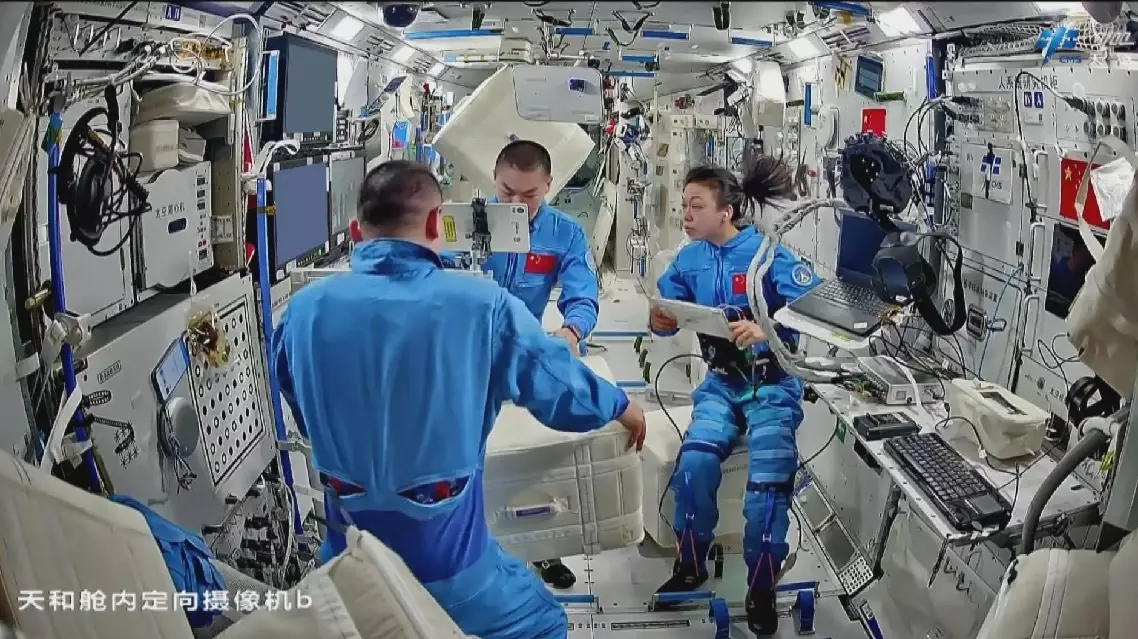
China's Shenzhou-23 crew conduct life sciences, physics experiments in orbit
China strongly deplores and firmly opposes the statement made by Japan's Foreign Minister Toshimitsu Motegi 10 years after the so-called "2016 Arbitral Award on the South China Sea", a Chinese Foreign Ministry spokesperson said in Beijing on Sunday.
The statement blatantly endorses the illegal "award", attacks China's lawful claims and mischaracterizes Japan as a "legitimate stakeholder who uses the South China Sea", said the spokesperson.
Japan is not a party in the South China Sea and is in no position to pass judgment on China's territorial sovereignty and maritime rights and interests in the South China Sea. During World War II, Japan committed innumerable crimes that caused untold suffering on China and its people, including the illegal occupation of islands and reefs in the South China Sea, said the spokesperson.
Now decades later, Japan, in the name of a "stakeholder", is again attempting to meddle in the South China Sea. This reminds people of Japan's history of aggression and expansion, and heightens their vigilance against Japan's neo-militarism agenda, said the spokesperson.
China's sovereignty over the South China Sea islands and relevant rights and interests in the South China Sea were established in the long course of history, and are solidly grounded in the law. China's activities in the South China Sea are fully legitimate, lawful and beyond reproach. China's rights in the South China Sea can by no means be denied by the makeshift "arbitral tribunal", said the spokesperson.
In rendering the "award", the "arbitral tribunal" exceeded its authority and abused its jurisdiction. The "award" is naturally illegal, null and void, and has no binding force. It has gravely undermined the sanctity and authority of the United Nations Convention on the Law of the Sea, and dealt a serious blow to the international rule of law, said the spokesperson.
China neither accepts nor recognizes the "award", and opposes and will never accept any claim or action arising from it, the spokesperson added.
By turning a blind eye to the glaring flaws in the "award" while openly endorsing it, Japan has laid bare its double standards and hypocrisy, said the spokesperson.
What Japan really cares about is not the international rule of law, but meddling in and destabilizing the South China Sea. For some time, Japan has been stepping up collaboration with the Philippines and expanding its export of weapons and equipment to the country. Japan has also deployed military forces overseas on many occasions and launched offensive missiles. These actions go far beyond the scope of self-defense, break free from Japan's Constitution and norms in the international law, and challenge the post-war international order, said the spokesperson.
China urges Japan to stop smearing China, stop sowing disinformation in the South China Sea, and stop undermining peace and stability in the region, said the spokesperson, adding that China will continue firmly defending its territorial sovereignty and maritime rights and interests in the South China Sea.
Any attempts to challenge China's lawful rights and interests and undermine peace and stability in the South China Sea are doomed to fail, the spokesperson said.
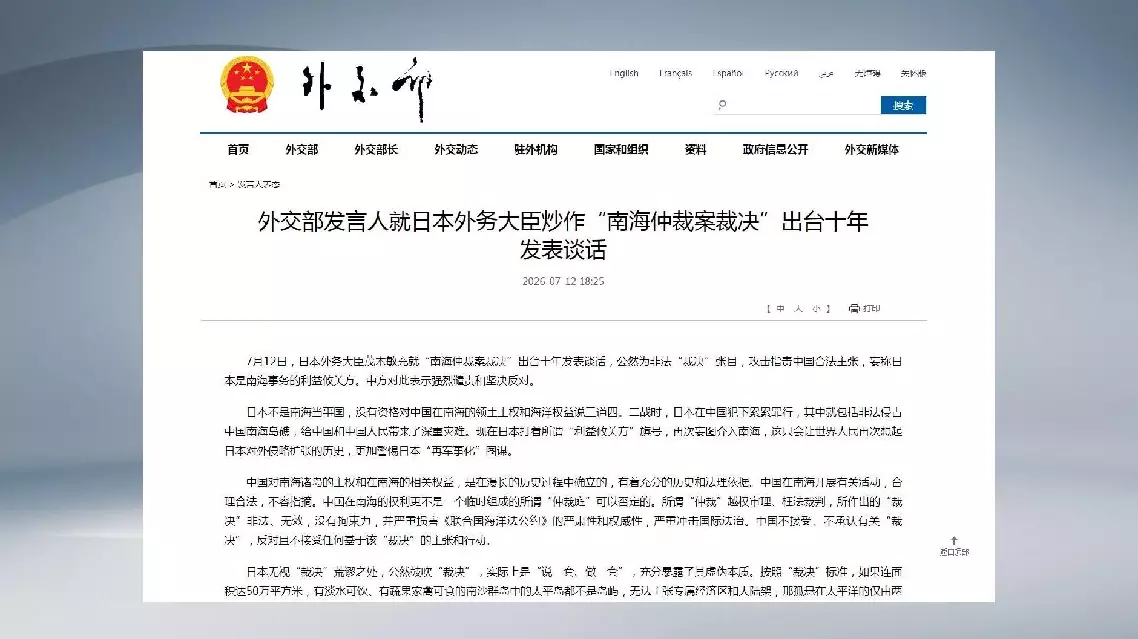
China strongly deplores Japanese FM's statement on South China Sea: spokesperson