Future transit management through the strategic Strait of Hormuz should be formulated exclusively through bilateral consultations between Iran and Oman, an Iranian Foreign Ministry spokesman said on Sunday.
The remarks followed talks between Iranian Foreign Minister Seyed Abbas Araghchi and his Omani counterpart, Sayyid Badr Albusaidi in Muscat on Saturday.
Iranian Foreign Ministry spokesman Esmail Baghaei said that the two sides discussed the coordination mechanism for navigation and passage management in the Strait of Hormuz.
Legal and technical delegations from both countries participated in the session, and a government delegation from Qatar joined parts of the discussion.
According to Baghaei, the talks focused on the shipping security in the Strait of Hormuz, respect for the sovereign rights of both nations, and the application of international law. The two sides also discussed Article 5 of the "Islamabad Memorandum of Understanding (MoU)".
Iran emphasized that future traffic management arrangements for the Strait of Hormuz should be decided through consultation between Iran and Oman, and any framework must take into full account the impact of U.S. and Israeli military operations against Iran in recent months and their impact on the safety of shipping in the Strait of Hormuz, Baghaei said.
Baghaei also said that both sides agreed to continue political, legal, and technical consultations to reach a common understanding on the navigation security in the strait.
Meanwhile, Iranian Parliament Speaker Mohammad Bagher Ghalibaf wrote on social media that the "era of unilateral agreements has ended".
Ghalibaf said that Iran had previously asked relevant parties to fulfill their commitments or face the consequences, adding that they must "now face reality".
Ghalibaf also posted a portion of Article 5 from the previous 14-point MoU, which highlights that the restoration of transit through the Strait of Hormuz is conditional upon compliance with "arrangements set by the Iranian side".
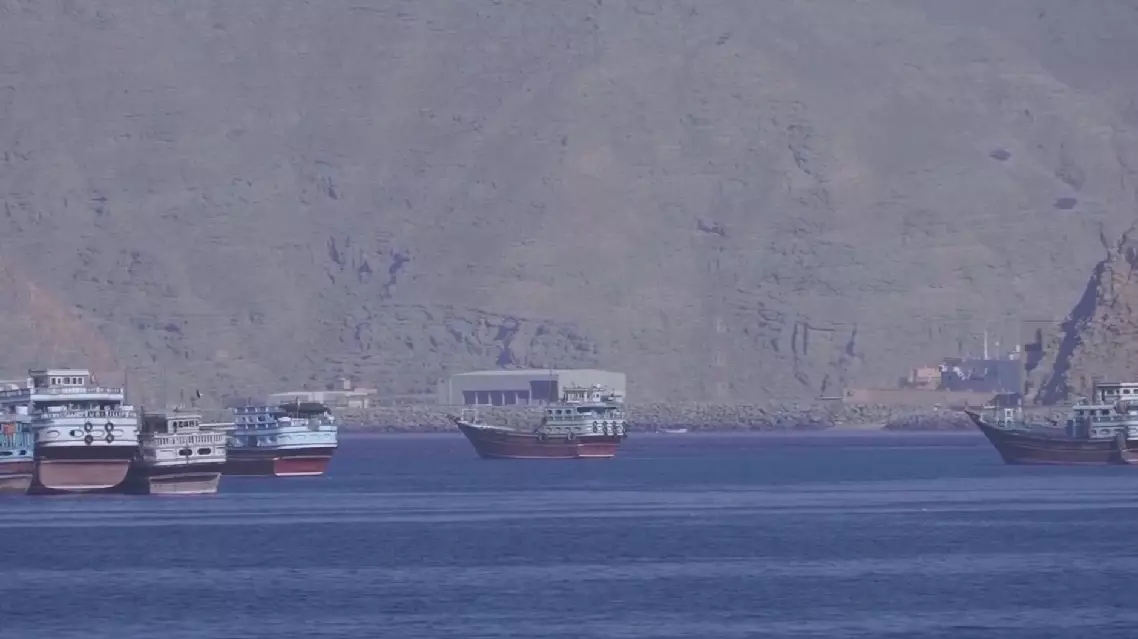
Iran says Strait of Hormuz transit management must be jointly decided with Oman
China's 16th Arctic Ocean expedition achieved the country's first video call spanning the North and South Poles on September 25, coinciding with the Mid-Autumn Festival, using a domestically developed satellite system with a delay of no more than one second.
The expedition deployed four vessels -- Xuelong, Xuelong 2, Jidi, and Tansuo 3 -- to study extreme environmental changes in the Arctic amid accelerating global warming. On September 29, China's research icebreakers Xuelong and Xuelong 2 returned to Shanghai after completing their missions, while Jidi and Tansuo 3 continue their expedition tasks and are expected to return in mid-October following a three-month journey.
The expedition team held a satellite video conversation with China's Antarctic Qinling Station, extending festive greetings to their polar scientific research counterparts and testing a large-scale constellation designed to provide global broadband internet and support integrated space-Earth 6G networks.
"This is the first time that China has used a domestically developed communications satellite system to make a video call across the largest latitude span," said Liu Feng, a senior engineer at the National Marine Data and Information Service.
The around-13,000-satellite GW constellation, led by China Satellite Network Group (SatNet), is China's first mega low Earth orbit satellite internet project. During the polar test, the maximum uplink and downlink speed reached around 30 megabits per second, equivalent to taking about 10 minutes to download a 1GB file. The equipment can also be used for emergency rescue and maritime communications.
"During the test period, it also supported real-time communications among Xuelong, Jidi, Tansuo 3, the National Marine Data and Information Service and the Polar Research Center. After Jidi and Tansuo 3 entered ice zone operation areas, their communication could not be guaranteed. So file transfers and navigation logs had to be transmitted through the SatNet equipment," said Zhang Bin, an engineer at the National Marine Data and Information Service. The successful test of the domestically produced satellite communication equipment marks China's independent control over polar region communications. The equipment ensures that data remains within the country, effectively safeguarding data security.

China holds first video call between North, South Poles via homegrown satellite system