China's "proven model of success in poverty alleviation" has drawn global attention to its development path, providing an example of people-centered governance worth better understanding, said Mushahid Hussain Sayed, former chairman of the Defense Committee of the Pakistani Senate.
In an interview with CGTN, Hussain shared his observations after following China's development for more than 50 years, and discussed how China's experience could contribute to modernization efforts across the developing world.
Hussain said he has witnessed China's evolution into a prosperous country and a global leader in development. In his view, the most significant change has been the improvement in people's quality of life.
China eliminated absolute poverty in 2021, following a decades-long effort that lifted around 800 million people out of destitution. By most estimates, this accounts for more than three-quarters of global poverty reduction over the past few decades.
Hussain outlined three features of China's poverty alleviation strategy: the quality of its leadership, the continuity of its policies, and the bond between the government and the people.
"Number one, the quality of leadership in China is different. Then there's the continuity of policy, the ability to do the course corrections, and learn from experiences on the ground. And the link between the masses, the people, and the leadership, that relationship is very, very strong. The focus has been on people-centered development: put people first, their lives, their livelihoods, their health, their education, and their housing," he said.
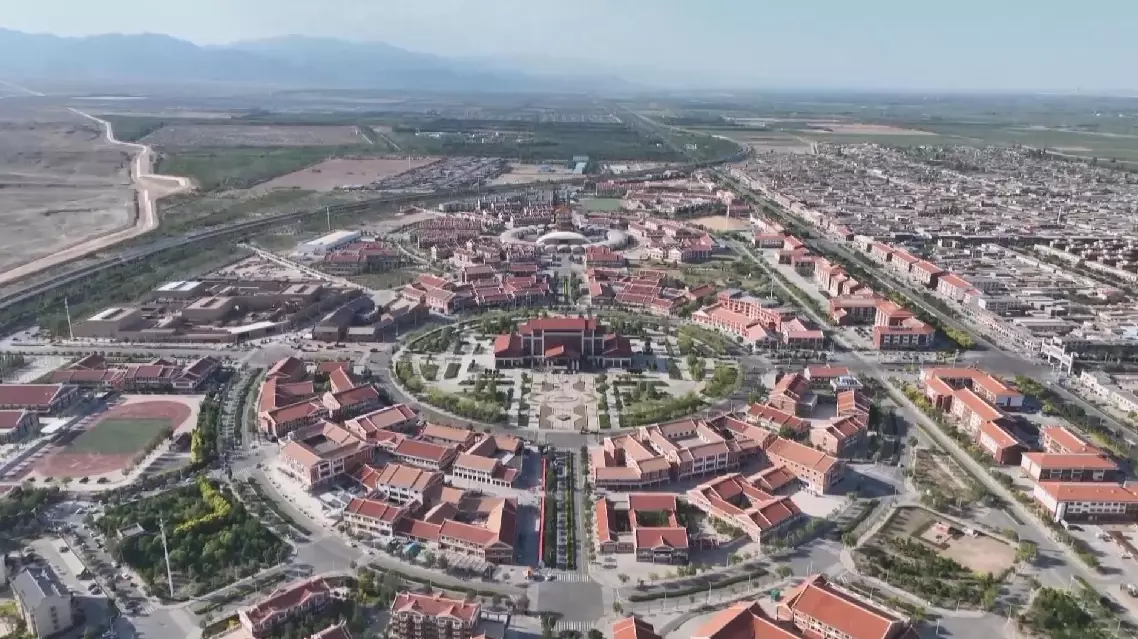
Hussain also said other countries could learn from China's approach to link poverty reduction to education and its approach to narrow regional disparities, citing the cooperation between Fujian and Ningxia.
In 1996, a pairing-up scheme between developed and underdeveloped areas was launched in China, linking affluent Fujian Province in the east coast to the landlocked Ningxia region, reducing poverty through shared resources, expertise, and investment.
"In every country, there are disparities among regions. So China closed the disparity gap by making the rich regions help the poor regions. That is a good example. For example, what the president did by pairing Fujian with Ningxia, that is one (example.) Also, I think President Xi Jinping did something very important, that he drew an inextricable linkage between poverty alleviation and education. So it's not just material poverty. It's also the mindset has to change, and the mindset changed through education. So that made a big difference," he said.
The former senator also commended China's willingness to share its experiences with the world and build effective partnerships based upon those exchanges.
"So China's vision is driven by the economy, and its worldview is based on win-win cooperation and inclusivity. So what China's vision is, it is not against anybody. It brings people together, and it helps all of them together. So in that regard, I think people are very receptive to Chinese support and assistance because they feel that they themselves are stakeholders, and they are not simply receiving aid, unlike Western aid which comes with strings attached and which has certain political agendas. China does not have that. So that's the difference. China has a proven model of success in poverty alleviation, and that should be utilized for the benefit of the Global South," he said.
Former Pakistani senator highlights lessons from China's poverty alleviation