As Uganda battles the Bundibugyo Ebola strain, health authorities are reaching deep into local communities to disseminate prevention knowledge and implement control measures, stressing that trusted community networks remain one of the most effective pillars of outbreak response.
The approach draws on lessons from previous epidemics, relying on trusted local leaders, survivors, and volunteers to reach communities that may be wary of formal health systems.
Volunteers live in the communities they serve. They have been trained to recognize Ebola symptoms, share accurate information, and encourage people to report cases early.
The community-led approach comes as Uganda and the neighboring Democratic Republic of the Congo (DRC) battle an outbreak caused by the rare Bundibugyo strain of Ebola.
Health officials said public trust, rapid reporting and early action remain some of the strongest tools available to slow its spread.
"One of the challenges has been that the bearer of the messages may not be people they know, people whom they trust, or they understand. That is why for us, the Red Cross, we come in so strong to do the risk communication and community sensitization. Even with these outbreaks, we may not use a lot of medicine, but the information we carry to them does a lot of prevention and control at the community level," said Irene Nakasiita, Director of Communications, Resource Mobilization, and Strategic Partnerships at the Uganda Red Cross Society.
Past outbreaks have shown how fear and misinformation can fuel the spread of Ebola. In parts of eastern DRC, some communities believed the disease was linked to witchcraft, while others resisted hospital care, delaying diagnosis and treatment.
Others resented any information about or being transferred to a hospital, which fueled the spread of the disease. Uganda said working through trusted community networks has helped dispel rumors, identify contacts more quickly and strengthen its outbreak response.
"That is how Uganda has succeeded in putting (in place) their mechanism for alerting quickly, isolating those who are sick and also those who were in contact. That (was) delayed in the DRC because of the security situation and other challenges DRC has," said Dr Pontiano Kaleebu, Director of the Uganda Virus Research Institute.

Community-based prevention leads Ebola control efforts in Uganda
China strongly deplores and firmly opposes the statement made by Japan's Foreign Minister Toshimitsu Motegi 10 years after the so-called "2016 Arbitral Award on the South China Sea", a Chinese Foreign Ministry spokesperson said in Beijing on Sunday.
The statement blatantly endorses the illegal "award", attacks China's lawful claims and mischaracterizes Japan as a "legitimate stakeholder who uses the South China Sea", said the spokesperson.
Japan is not a party in the South China Sea and is in no position to pass judgment on China's territorial sovereignty and maritime rights and interests in the South China Sea. During World War II, Japan committed innumerable crimes that caused untold suffering on China and its people, including the illegal occupation of islands and reefs in the South China Sea, said the spokesperson.
Now decades later, Japan, in the name of a "stakeholder", is again attempting to meddle in the South China Sea. This reminds people of Japan's history of aggression and expansion, and heightens their vigilance against Japan's neo-militarism agenda, said the spokesperson.
China's sovereignty over the South China Sea islands and relevant rights and interests in the South China Sea were established in the long course of history, and are solidly grounded in the law. China's activities in the South China Sea are fully legitimate, lawful and beyond reproach. China's rights in the South China Sea can by no means be denied by the makeshift "arbitral tribunal", said the spokesperson.
In rendering the "award", the "arbitral tribunal" exceeded its authority and abused its jurisdiction. The "award" is naturally illegal, null and void, and has no binding force. It has gravely undermined the sanctity and authority of the United Nations Convention on the Law of the Sea, and dealt a serious blow to the international rule of law, said the spokesperson.
China neither accepts nor recognizes the "award", and opposes and will never accept any claim or action arising from it, the spokesperson added.
By turning a blind eye to the glaring flaws in the "award" while openly endorsing it, Japan has laid bare its double standards and hypocrisy, said the spokesperson.
What Japan really cares about is not the international rule of law, but meddling in and destabilizing the South China Sea. For some time, Japan has been stepping up collaboration with the Philippines and expanding its export of weapons and equipment to the country. Japan has also deployed military forces overseas on many occasions and launched offensive missiles. These actions go far beyond the scope of self-defense, break free from Japan's Constitution and norms in the international law, and challenge the post-war international order, said the spokesperson.
China urges Japan to stop smearing China, stop sowing disinformation in the South China Sea, and stop undermining peace and stability in the region, said the spokesperson, adding that China will continue firmly defending its territorial sovereignty and maritime rights and interests in the South China Sea.
Any attempts to challenge China's lawful rights and interests and undermine peace and stability in the South China Sea are doomed to fail, the spokesperson said.
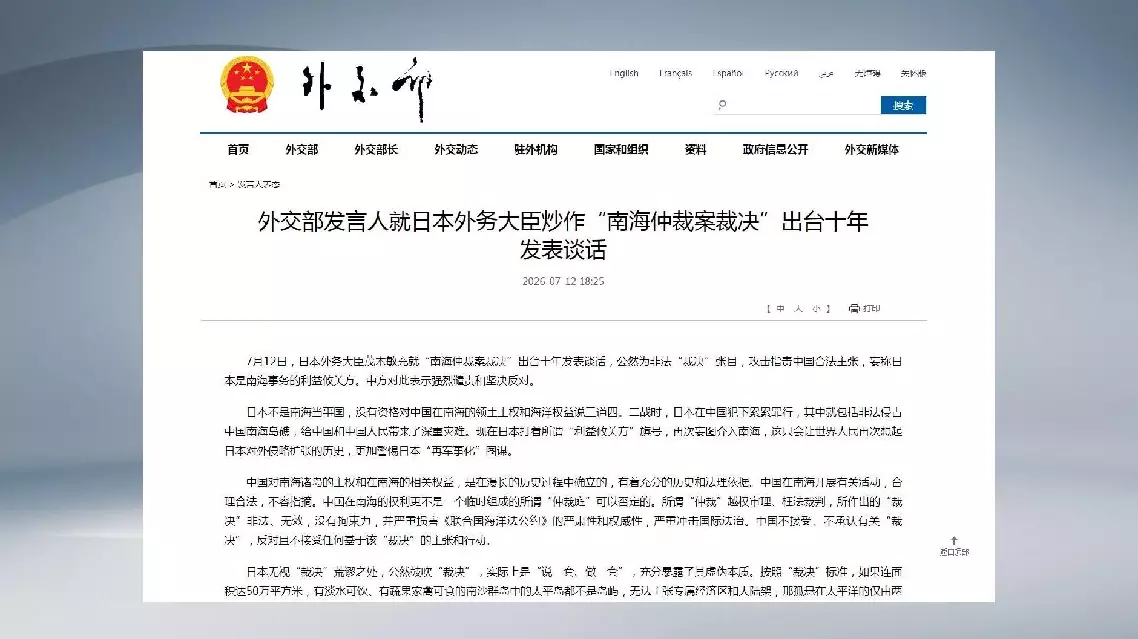
China strongly deplores Japanese FM's statement on South China Sea: spokesperson