Cities across eastern China have initiated comprehensive preparatory measures against Typhoon Bavi, the ninth typhoon of the year, to safeguard their residents and infrastructure.
The typhoon, with the maximum wind force at its center reaching 40 meters per second when landing, first churned ashore at Yuhuan, a county-level city administered by the city of Taizhou in east China's Zhejiang Province, at around 23:20 Saturday, before making a second landfall in Yueqing City under the city of Wenzhou at around midnight Sunday.
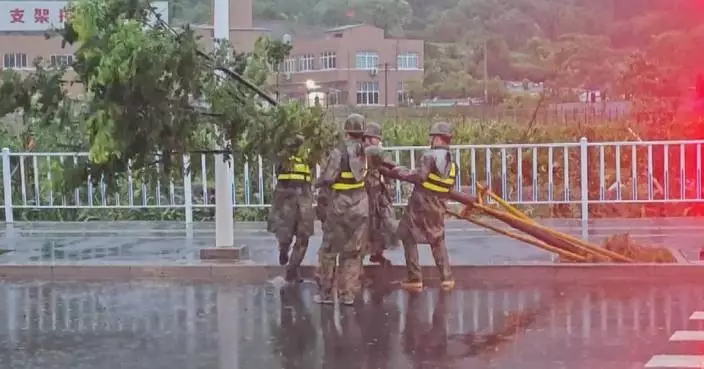
Affected by the typhoon, Shanghai experienced strong winds and rain on Saturday evening. Overnight, the winds intensified and rain poured down heavily. Roadside trees were blown down by strong winds amid the torrential showers. As a precaution, Shanghai had organized the evacuation of nearly 300,000 people in total, and activated 905 emergency shelters across the city for flood prevention and disaster relief.
To ensure the safety of rail transit lines, Shanghai Metro Line 3 and the Pujiang Line were placed under speed restrictions across their entire routes on Sunday. Additionally, all ferry services in Shanghai were suspended starting at 04:40 on Sunday. Under the combined influence of Bavi's long-distance moisture transport and a mass of cold air, Beijing experienced heavy rainfall from Saturday night through Sunday morning.
In the suburban Miyun District, over 60 millimeters of torrential rain fell within 24 hours. Meanwhile, parts of Shunyi, Pinggu, and Tongzhou Districts recorded more than 100 millimeters of rainfall in the same period -- reaching the level of a severe rainstorm -- which also triggered short-term waterlogging in some low-lying areas. Nine districts in Beijing activated a Level-I emergency response for flood control on Saturday afternoon after a red alert for torrential rain was issued for these regions.
The municipal emergency management office warned of a high risk of flooding in medium and small rivers, flash floods and geological hazards in mountainous and hilly areas, as well as waterlogging in low-lying areas.
As authorities intensified flood control efforts, around 104,000 people across the city had been relocated as of 16:00 on Saturday. In addition, 73 elderly care facilities were temporarily closed, with 1,902 elderly people evacuated, according to the office of the Beijing municipal flood control and drought relief headquarters.
As a precaution, 188 scenic areas and 167 tent campsites have been closed, 4,376 rural homestays have been suspended and construction work at 3,318 sites has been halted.
A total of 27,418 rescue workers have been placed on standby across the city to respond to potential emergencies.
Scattered showers and thunderstorms also swept across much of Tianjin on Saturday, bringing moderate to heavy rain in some areas and torrential rain in a few isolated spots in the coastal municipality.
As of 16:00 on Saturday, Tianjin's central urban area recorded an average precipitation of 28.93 millimeters, with a maximum hourly rainfall intensity of approaching 100 millimeters around Tianping Tunnel in Beichen District.
"With waterlogging reaching 20 centimeters in depth, we coordinated with the traffic police to promptly close the road to vehicles. The current drainage capacity stands at approximately 1,000 cubic meters per hour. As rainfall intensifies and the depth of accumulated water continues to rise, we are continuously increasing drainage efforts here," said Zhang Wei, deputy director of the Seventh Drainage Management Office of the Tianjin Municipal Drainage Management Affairs Center.
Under the combined influence of moisture from the periphery of the typhoon and a cold vortex over northeastern China, Liaoning Province was hit by persistent heavy rainfall and strong winds on Saturday, with multiple localities issuing rainstorm warnings.
The provincial flood control and drought relief headquarters raised its emergency response for flood control from Level IV to Level III on 13:00 on Saturday.
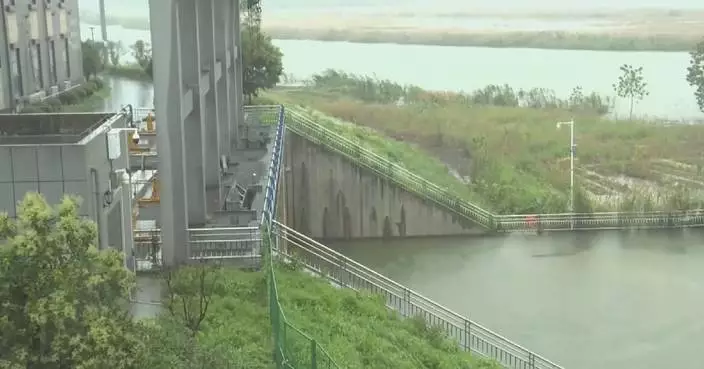
Approximately 10,000 emergency response and rescue personnel were pre-deployed, and reservoirs were proactively discharged in advance to free up storage capacity.
Meanwhile, comprehensive efforts were made to evacuate residents from hazardous areas. As of 16:00 on Saturday, a cumulative total of 23,643 people had been safely relocated across the province.
China has a four-tier emergency response system, with Level I being the most severe.

Ferocious winds, lashing rains prompt emergency typhoon responses in parts of China