Thailand faces a future with fewer children, fewer workers, and a rapidly aging population, as its fertility rate is now among the lowest globally.
In 2025, the total number of births in Thailand was only 416,574, setting a record low in 75 years, while the number of deaths reached 559,684, more than 140,000 above births, indicating that the population has experienced negative growth for the fifth consecutive year.
From school closures to a shrinking labor force, Thailand is entering a demographic shift that could reshape society for decades.
In Bangkok, there was a school at the heart of its community, with 2,780 students at its peak, but after 60 years and only 569 students left, the school gates shut forever.
"There was a decline in the number of children. With fewer children, our income decreased," said Pholanan Suphanphasuj, manager of the Thanormpitvittaya School.
This school closed because there simply weren't enough children to keep it open. Today, it stands bare -- another casualty of Thailand's collapsing birth rate.
With one of the world's lowest fertility rates, there are dire projections that Thailand's population could halve from 66 million to 33 million in the next 60 years. The impact of that would be severe: labor shortages, mounting pressure on welfare systems, and long-term damage to its economy.
Behind those numbers are millions of personal decisions. For 39-year-old Supajutha Sontrareerat, she has built the life she wants, with a stable career, financial independence, and freedom, but children are not part of her plan.
"When I was a child, I dreamt of having a family and children. As I grew older, my perspective changed. I feel like there's still work and things I want to do. I have many other passions, and I feel like I can find happiness in a different way, which is not dependent on having children," she said.
But for many others, it's a choice shaped by cost, pressure, uncertainty -- a future that feels too expensive to build a family in. Different reasons lead to the same outcome: a fertility rate that has fallen far below the level needed to maintain the population.
"So, typically what we call the replacement rate is at 2, so one woman on average should have about two children in order for the population to be able to sustain its size. But for Thailand, our recent number has dropped below one. And compared to the rest of the world, we are definitely right at the top of the lowest fertility rate in the world," said Dr. Manasigan Kanchanachitra, an associate professor at the Institute for Population and Social Research of Mahidol University.

Thailand faces aging population with lowest fertility rate in 75 years
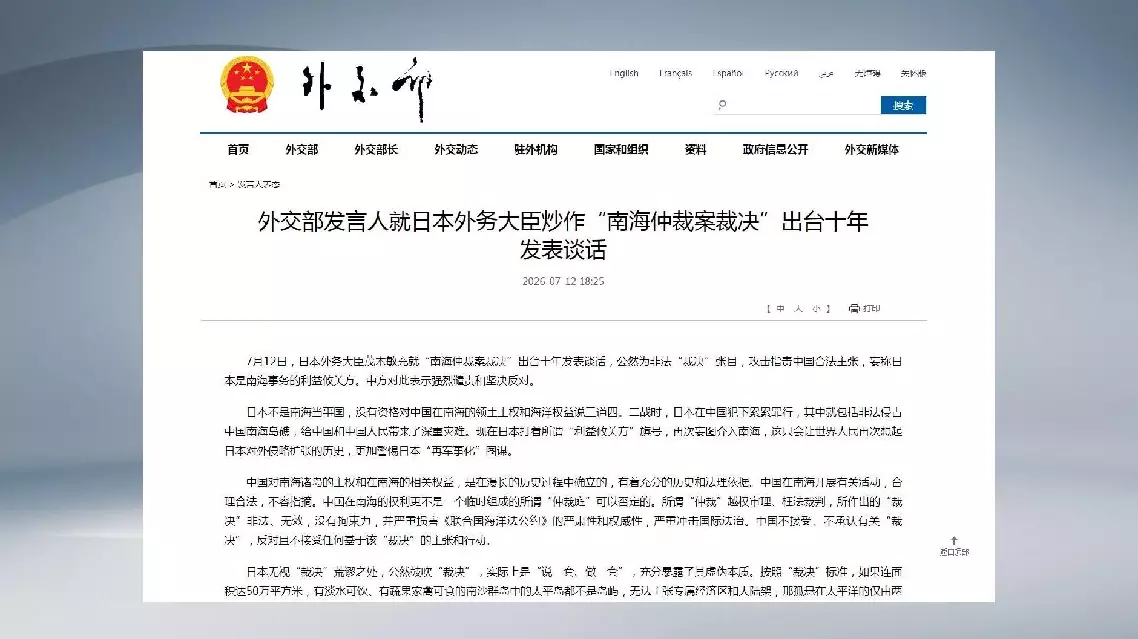
China strongly deplores and firmly opposes the statement made by Japan's Foreign Minister Toshimitsu Motegi 10 years after the so-called "2016 Arbitral Award on the South China Sea", a Chinese Foreign Ministry spokesperson said in Beijing on Sunday.
The statement blatantly endorses the illegal "award", attacks China's lawful claims and mischaracterizes Japan as a "legitimate stakeholder who uses the South China Sea", said the spokesperson.
Japan is not a party in the South China Sea and is in no position to pass judgment on China's territorial sovereignty and maritime rights and interests in the South China Sea. During World War II, Japan committed innumerable crimes that caused untold suffering on China and its people, including the illegal occupation of islands and reefs in the South China Sea, said the spokesperson.
Now decades later, Japan, in the name of a "stakeholder", is again attempting to meddle in the South China Sea. This reminds people of Japan's history of aggression and expansion, and heightens their vigilance against Japan's neo-militarism agenda, said the spokesperson.
China's sovereignty over the South China Sea islands and relevant rights and interests in the South China Sea were established in the long course of history, and are solidly grounded in the law. China's activities in the South China Sea are fully legitimate, lawful and beyond reproach. China's rights in the South China Sea can by no means be denied by the makeshift "arbitral tribunal", said the spokesperson.
In rendering the "award", the "arbitral tribunal" exceeded its authority and abused its jurisdiction. The "award" is naturally illegal, null and void, and has no binding force. It has gravely undermined the sanctity and authority of the United Nations Convention on the Law of the Sea, and dealt a serious blow to the international rule of law, said the spokesperson.
China neither accepts nor recognizes the "award", and opposes and will never accept any claim or action arising from it, the spokesperson added.
By turning a blind eye to the glaring flaws in the "award" while openly endorsing it, Japan has laid bare its double standards and hypocrisy, said the spokesperson.
What Japan really cares about is not the international rule of law, but meddling in and destabilizing the South China Sea. For some time, Japan has been stepping up collaboration with the Philippines and expanding its export of weapons and equipment to the country. Japan has also deployed military forces overseas on many occasions and launched offensive missiles. These actions go far beyond the scope of self-defense, break free from Japan's Constitution and norms in the international law, and challenge the post-war international order, said the spokesperson.
China urges Japan to stop smearing China, stop sowing disinformation in the South China Sea, and stop undermining peace and stability in the region, said the spokesperson, adding that China will continue firmly defending its territorial sovereignty and maritime rights and interests in the South China Sea.
Any attempts to challenge China's lawful rights and interests and undermine peace and stability in the South China Sea are doomed to fail, the spokesperson said.
China strongly deplores Japanese FM's statement on South China Sea: spokesperson