Through expanding overseas market and accelerating the development of sci-tech products, Shanghai is leading the Yangtze River Delta in its bid to become China's international scientific and technological innovation center.
A report recently released by China's Ministry of Science and Technology reveals that Shanghai is ranked first among all Chinese cities in the 2025 sci-tech innovation index.
Walking into Agibot, a Shanghai-based robotics company, guests are welcomed by a group of humanoid robots dancing and performing splits and even front flips.
The company is now the world’s top producer of embodied AI robots, with its 15,000th robot rolling off the line last month.
Yao Maoqing, senior vice president of Agibot, said that international market sales are also expanding.
"Overseas, we have three main regional markets. Europe and the US, the Asia-pacific and the Middle East, and parts of East Asia, such as Japan and the Republic of Korea. These markets are all very interested in robotics, mainly because their manufacturing bases are relatively weaker than China's, and they face greater labor challenges," he said. China is one of the fastest-growing markets of embodied intelligence. And Shanghai takes the lead in both complete robots and robot parts manufacturing. One of the reasons is the complete industrial chain in the Yangtze River Delta Region.
Embodied intelligence is one of China's future industries, according to its 15th Five-Year Plan. The Yangtze River Delta Region has over half of the country's embodied intelligence companies.
Most of the parts needed to build a robot can be found in the region. And with the one-hour traffic circle, companies can upgrade their robots and respond quickly to market needs.
At the end of last year, China decided to expand the international sci-tech center from Shanghai to the entire Yangtze River Delta Region.
The region leads the country in sci-tech innovation. In 2025, the region's research and development investment intensity is 3.45 percent, higher than the national average.
"Humanoid robots are currently one of the hottest cutting-edge industries. Robot development along the Shanghai Nanjing corridor is very well balanced. In particular, core cities such as Shanghai and Suzhou are leading the way, driving growth across the entire industrial chain. We have just established an industry finance collaboration mechanism along the corridor, focused on the integration of embodied intelligence and financial institutions including the banking sector," said Lu Hai, deputy director of the Office of Regional Coordinated Development of Shanghai's Putuo District.

Shanghai leads transformation into global sci-tech innovation hub
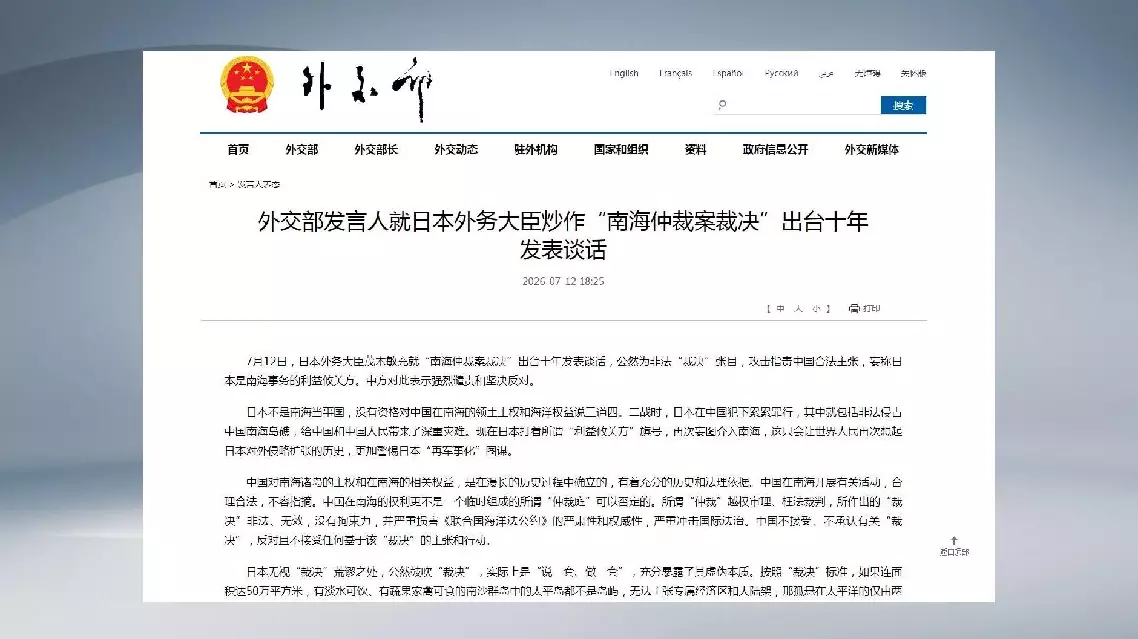
China strongly deplores and firmly opposes the statement made by Japan's Foreign Minister Toshimitsu Motegi 10 years after the so-called "2016 Arbitral Award on the South China Sea", a Chinese Foreign Ministry spokesperson said in Beijing on Sunday.
The statement blatantly endorses the illegal "award", attacks China's lawful claims and mischaracterizes Japan as a "legitimate stakeholder who uses the South China Sea", said the spokesperson.
Japan is not a party in the South China Sea and is in no position to pass judgment on China's territorial sovereignty and maritime rights and interests in the South China Sea. During World War II, Japan committed innumerable crimes that caused untold suffering on China and its people, including the illegal occupation of islands and reefs in the South China Sea, said the spokesperson.
Now decades later, Japan, in the name of a "stakeholder", is again attempting to meddle in the South China Sea. This reminds people of Japan's history of aggression and expansion, and heightens their vigilance against Japan's neo-militarism agenda, said the spokesperson.
China's sovereignty over the South China Sea islands and relevant rights and interests in the South China Sea were established in the long course of history, and are solidly grounded in the law. China's activities in the South China Sea are fully legitimate, lawful and beyond reproach. China's rights in the South China Sea can by no means be denied by the makeshift "arbitral tribunal", said the spokesperson.
In rendering the "award", the "arbitral tribunal" exceeded its authority and abused its jurisdiction. The "award" is naturally illegal, null and void, and has no binding force. It has gravely undermined the sanctity and authority of the United Nations Convention on the Law of the Sea, and dealt a serious blow to the international rule of law, said the spokesperson.
China neither accepts nor recognizes the "award", and opposes and will never accept any claim or action arising from it, the spokesperson added.
By turning a blind eye to the glaring flaws in the "award" while openly endorsing it, Japan has laid bare its double standards and hypocrisy, said the spokesperson.
What Japan really cares about is not the international rule of law, but meddling in and destabilizing the South China Sea. For some time, Japan has been stepping up collaboration with the Philippines and expanding its export of weapons and equipment to the country. Japan has also deployed military forces overseas on many occasions and launched offensive missiles. These actions go far beyond the scope of self-defense, break free from Japan's Constitution and norms in the international law, and challenge the post-war international order, said the spokesperson.
China urges Japan to stop smearing China, stop sowing disinformation in the South China Sea, and stop undermining peace and stability in the region, said the spokesperson, adding that China will continue firmly defending its territorial sovereignty and maritime rights and interests in the South China Sea.
Any attempts to challenge China's lawful rights and interests and undermine peace and stability in the South China Sea are doomed to fail, the spokesperson said.
China strongly deplores Japanese FM's statement on South China Sea: spokesperson