Artificial intelligence (AI) is becoming a universal language across science and society, connecting chemistry with economics and engineering, Nobel laureate Omar Yaghi said.
Yaghi, who won the 2025 Nobel Prize in Chemistry, told China Global Television Network (CGTN) that AI is transforming chemists from molecule specialists into scientists able to collaborate across disciplines.
"AI and robotics are going to help us connect the world a lot better, to have a more connected science. AI is a language that allows me as a chemist or as a material scientist to talk to an economist. That's a language that we both can communicate in and so on, and engineering, and all the other fields. So no longer will chemistry, will a chemist be confined to just knowledge about molecules, but rather a chemist would have knowledge of molecules and materials, but also a working knowledge with all these other fields where they can take their invention, and put it in society in a meaningful way," he said.
Yaghi has joined Tsinghua University full-time to lead the AI Chemistry and Materials Research Institute (AIMATRY) this year.
From July 17 to 20, Shanghai is to host the World Artificial Intelligence Conference (WAIC 2026) with the theme "Intelligent Partners, Co-creating the Future."
For Yaghi, who has always believed that science transcends borders, said such global gatherings are a natural extension of that conviction and his new institute at Tsinghua is built on the same principle.
When asked about his plans for the new center, he spoke of his excitement about the academic environment at Tsinghua and his ambition for the institute to benefit the world.
"I am now in the midst of a sea of great professors doing great things, and more importantly than even that, a sea of great student minds who are hungry to learn, hungry to do something new. And I want to develop our new institute focusing on AI, materials and chemistry, we call it "AMATRI", not only to serve Tsinghua, China, but also to serve the world. After all, science transcends all borders, should transcend all borders. The best science is done by transcending all borders," he said.

AI emerging as universal language across disciplines: Nobel laureate
Serbian fruit farmers, celebrating a apricot harvest after years of crop failures, are now scrambling to sell their produce, as a searing heatwave threatens to spoil the bounty, leaving many with no choice but to sell high-quality fruit to processors at rock-bottom prices.
After several consecutive years of reduced yields due to extreme weather conditions such as frost and drought, orchards across the country are enjoying a bountiful harvest this year, with apricot production expected to reach a record 50,000 tonnes.
However, with a new wave of high temperatures setting in, local farmers are facing the challenge of harvesting and selling the fresh fruit in a timely manner.
Grocka is Serbia's largest and most important apricot-growing region.
After several consecutive years of drought and frost, this year's apricot crop has finally yielded a long-awaited bumper harvest.
Purchasers of a local purchasing station said that the daily sales of the fruit in recent days have stood at around 10 tonnes, but prices vary significantly depending on the destination of the fresh fruit.
"It is used as fresh fruit for export. It is also reused for industrial processing. First-class fruit intended for export has fetched prices this year ranging from 70 (about 68 U.S. cents) to 120 dinars (about 1.17 U.S. dollars) per kilogram of apricot," said Bojan Mitrovic, a fruit buyer.
However, the overall average purchase price is only 35 (about 34 U.S. cents) to 40 dinars (about 39 U.S. cents) per kilogram, he said.
With a new heatwave approaching, temperatures across most of Serbia are expected to exceed 35 degrees Celsius, with some areas projected to reach 40 degrees Celsius.
Fruits such as apricots have an extremely short shelf life.
With a large volume of fresh fruit from the harvest flooding the market within a short period, local cold storage and cold-chain logistics capacity cannot keep up.
Farmers must sell their produce quickly after harvest, forcing them to sell large quantities of high-quality apricots to processing plants at low prices.
Fruit cultivation in Serbia is still primarily carried out in small family orchards.
This fragmented production structure makes it difficult for individual farmers to bear the construction costs of modern cold storage facilities.
As farmers race against time and the weather to harvest and sell their fresh fruit, the Serbian government and the Chamber of Commerce and Industry of Serbia have also taken multiple measures to coordinate the various stages of harvesting, transportation and sales to help fruit farmers cope with the "sweet burden" brought on by the harvest.
"[There are] basically two streamlines. One is being distributed to the Ministry of Economy through the Development Agency, which every year has programs for supporting such endeavors. On the other hand, there is the support especially for the small farmers through national support -- through the Ministry of Agriculture. The Chamber of Commerce has founded the daughter company, which is called Serbia Export. Its main task is to aggregate the offer and to be the middleman in finding and aggregating the small production businesses in Serbia, or relatively small or even the bigger ones, so it can cooperate with, for instance, Chinese partners," said Veljko Jovanovic, an analyst of the Chamber of Commerce and Industry of Serbia.
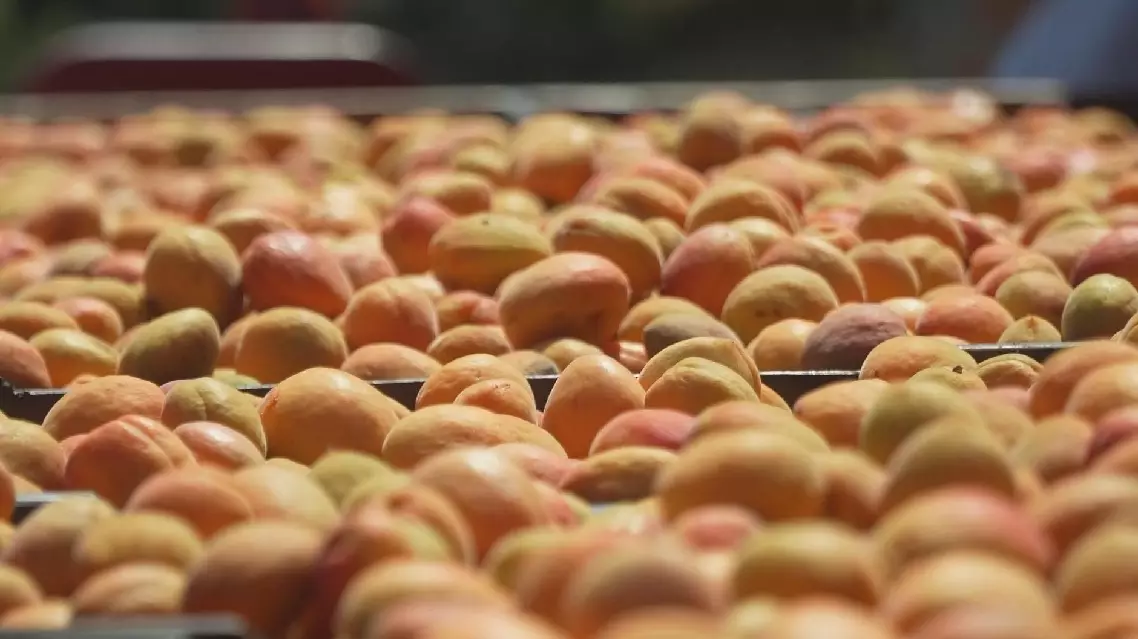
Serbia's apricot harvest turns sour as heatwave bites