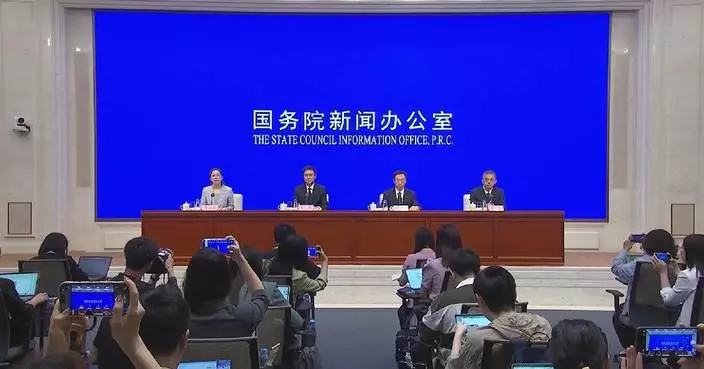
A group of leading Chinese experts on international maritime law released a new research report on Thursday, arguing the 2016 South China Sea arbitration award lacks legal validity under international law, and calling for consultations and negotiations to resolve disputes.
Ten years after the so-called South China Sea arbitration, the comprehensive report systematically dismantles its validity, noting the tribunal exceeded its jurisdiction, misinterpreted the United Nations Convention on the Law of the Sea (UNCLOS) and failed to provide a legitimate basis for its ruling.
Co-authored by top maritime law experts, the report argues the tribunal's 2016 ruling, initiated unilaterally by the Philippines, lacked a legal foundation from the very beginning by forcing a case outside its scope.
"It is a legitimate attitude to refuse to obey the illegal act. First, the Philippines' claims are on the territorial sovereignty and maritime delimitation, and their territorial sovereign issues are not regulated by the United Nations Convention on the Law of the Sea. For the second part, China has already made a declaration to exclude the maritime delimitation, historic titles and bays, to bring to compulsory arbitral tribunal. And lastly, it lacks state consent worldwide," said Zhang Qiyue, a researcher with the Shanghai Institutes for International Studies.
Beyond jurisdiction, the report details severe substantive errors.
Experts accuse the tribunal of arbitrarily expanding its interpretation of key provisions of UNCLOS, and artificially dissecting the Nansha Islands to deny China's territorial sovereignty and historic rights of the waters.
The evidence collection process and certain members of the tribunal are also described as heavily biased.
"The illegal arbitral award cannot create new rules and new norms in international law. It did not settle disputes in the South China Sea. On the contrary, it raised tensions in this region. It's harmful for the peaceful settlement of the regional dispute," said Yu Minna, an associate professor of the School of Law under the Ocean University of China.
The document concludes the tribunal's ruling is essentially a form of political manipulation, cloaked in legal terms.
Beyond exposing the legal flaws and geopolitical manipulation behind the ruling, experts stress a constructive way forward. They argue that the real solution to the South China Sea issue lies at the negotiating table, not in a courtroom.
"In the final part of this report, we call for every party in the South China Sea region, go back to the negotiation and consultation, especially the Philippines. We can see that the negotiation consultation has been a very effective tool for China and other countries in the South China Sea to deal with disputes," said Xu Qi, deputy director of the Institute of Foreign-Related Rule of Law with the Jinan University.
By adhering to the Declaration on the Conduct of Parties in the South China Sea and accelerating negotiations on a binding Code of Conduct, China is demonstrating that direct negotiation, not forced arbitration, remains the anchor for regional stability.

Scholars refute legality of 2016 South China Sea arbitration awards