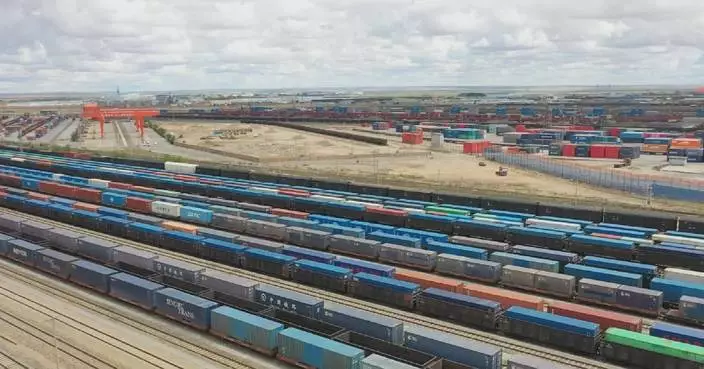
The China-Europe freight train service by way of Fuzhou, capital of east China's Fujian Province, has seen the shipment of 7,918 TEUs of goods with a total import and export value exceeding 1.6 billion yuan (around 235.9 million US dollars) since its launch in 2022, according to data released by Fuzhou Customs on Friday.
A China-Europe freight train carrying 55 containers departed from the Jiangyin Railway Station Logistics Park in the city on Friday, heading for Eastern Europe via Erenhot, the largest land port on the China-Mongolia border. This marked the 77th China-Europe freight train trip handled in Fuzhou.
To keep trains running smoothly and efficiently, the Rongcheng Customs Office, which is under Fuzhou Customs Administration, has made the customs process faster and simpler.
The customs office has introduced a one-stop system that covers everything from declaration and inspection to final release. It also offers 24/7 appointment-based inspections so that goods can be checked as soon as they arrive and released immediately if they meet the requirements, aiming to speed up the whole process.
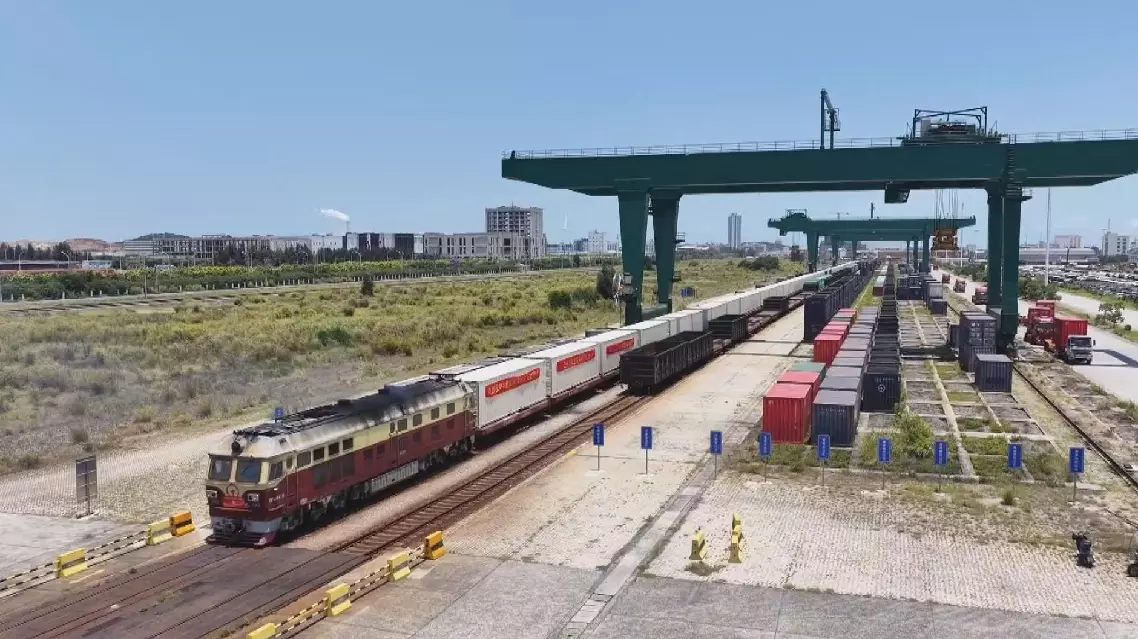
China-Europe freight train from Fuzhou ships 1.6-bln-yuan goods in 4 years
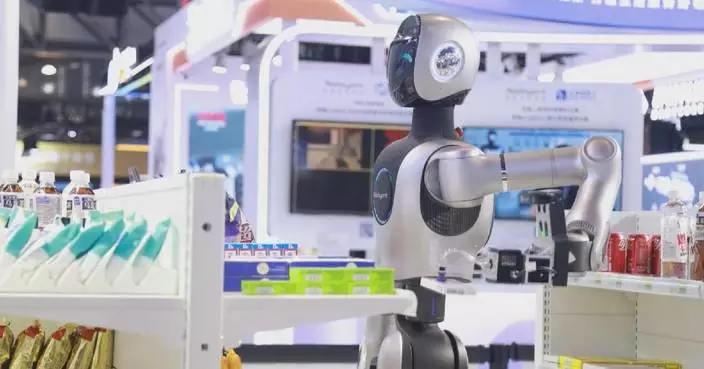
China's steel production giant Baowu Steel Group is showcasing its latest achievements in artificial intelligence (AI) technologies at the ongoing 2026 World AI Conference in Shanghai, aiming at using advanced technology to replace humans in dangerous job positions.
China Baowu Steel Group, as world's largest steel maker, is headquartered in Shanghai, and produces over 130 million metric tonnes of crude steel annually, making it nearly twice the size of its closest global competitor.
In recent years, this traditional manufacturer has introduced robots into its steel production line to lift efficiency and turn high-risk jobs into fully unmanned operations.
"This robot can be used in the scenario of a steel converter, which is vital for testing molten steel quality in steel production. Traditionally, workers carry steel sampling rods from the sampling pump manually. The workplace is extremely dusty and hot, with strong heat radiation from the nearby converter. We plan to adopt robots to take over this work and free staff away from this high-temperature hazardous area," said Ke Tianyang, engineer of Turin Robotics of the Baowu Group.
In 2023, the steel giant realized what is called a "lights-out factory," which refers to an intelligent factory that does not require manual intervention in the entire process of production, storage, and testing, and can be run automatically by machines even when the lights are off.
Earlier this year, the company launched its AI 2.0 strategy, aiming to integrate artificial intelligence across its operations. From steel production and research to corporate governance and customer services, the initiative is designed to accelerate the adoption of smart technologies throughout the business.
"We've launched AI systems for converter furnace foremen and cold rolling operators. Trained on our years of production management know-how, they combine big data and large models to optimize scheduling, lift resource efficiency, boost safety and ease labor burden, enabling a true lights-out factory," said Tian Guobing, chairman of Baosight Software Co., Ltd., a listed industrial software and IT solutions provider with the controlling stake held by China Baowu Steel Group.
Scheduled from Friday to Monday and themed "AI Partnership for a Brighter Future," the 2026 World AI Conference includes more than 140 forums, bringing together 1,400 guests from home and abroad.
For the first time, the exhibition area exceeds 100,000 square meters, with over 1,100 enterprises participating.
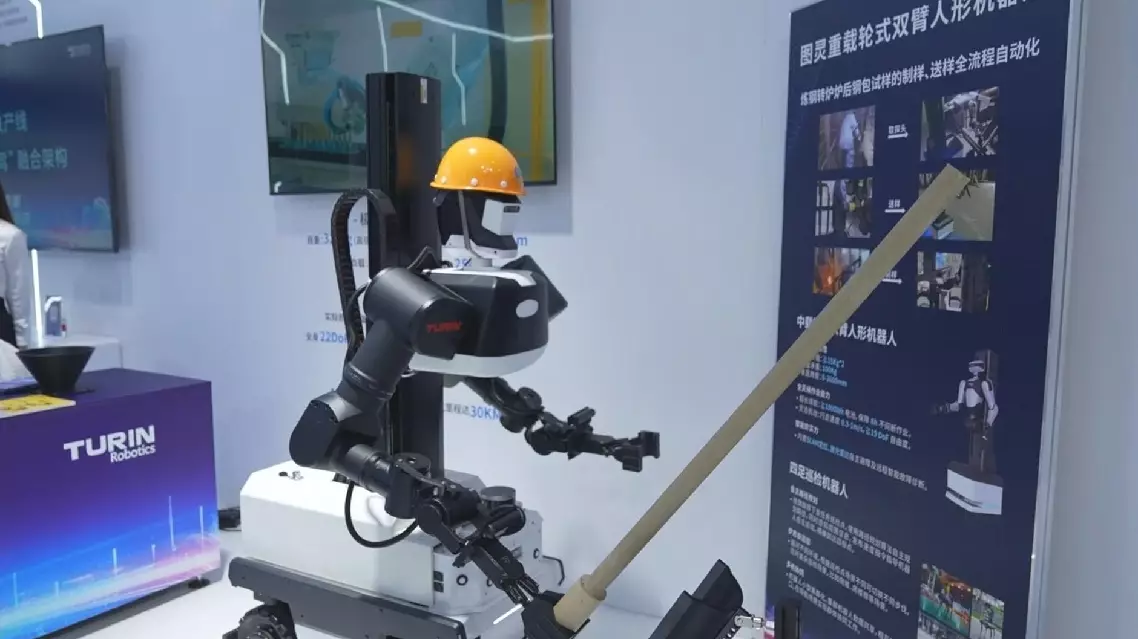
China's steel production giant opens to AI for more efficient operation