A new cross-border tourist train service went into trial operation on Friday between Russia's Far Eastern port city of Vladivostok and the Chinese border town of Suifenhe, opening a fresh corridor for visa-free travel.
The first group of Russian tourists choosing this new tourist route stepped off the train, ready to embark on a four-day adventure in China. At the same time, 180 Chinese travelers also taking this route were boarding the train for the opposite journey.
The entire journey takes eight hours. Integrating tourism resources on the route, the service offers visitors a one-stop, diversified travel experience.
Inside the carriages, one side features standard seating, while the other offers open-plan sleeper berths stacked in two tiers. Soft-sleeper compartments are also equipped with shower cabins.
Some passengers have traveled great distances just to experience the ride.
"I flew over 2,000 kilometers from Zhejiang Province [in east China] just to catch this train. Now I'm really excited to get on board," said Gao Hailong, a Chinese tourist.
Local officials expect the new route to become a major tourism driver, drawing both domestic and international visitors to the region and giving a strong boost to local businesses.
"This has opened up an efficient and convenient cross-border tourism corridor, allowing tourists from both countries to truly 'travel by train' and reach their destinations in a single non-stop journey, while significantly reducing the overall cost of cross-border travel," said Cong Yunhong, deputy director of the Mudanjiang Municipal Bureau of Culture, Sports, Radio, Television and Tourism.
Since China's visa-free policy for Russian tourists took effect in September 2025, border cities in Heilongjiang have stepped up efforts to promote inbound tourism. In the first half of this year alone, the Suifenhe inland port recorded more than 310,000 entries and exits, a year-on-year increase of 30.6 percent.

New tourist train service connects Chinese border city with Russian Far East
Business leaders, researchers and entrepreneurs from around the world gathered at the 2026 World Artificial Intelligence Conference (WAIC), where discussions are focusing on turning AI innovation into cross-border partnerships and real-world applications.
The 2026 WAIC is running in Shanghai from Friday to Monday under the theme "AI Partnership for a Brighter Future."
Across the exhibition halls, conversations often extended beyond product demonstrations, with visitors exploring potential partnerships, supply chains and overseas expansion.
Among them was Paolo Brizzi, chief information officer of Italy's Competence Center for Industry and Manufacturing (CIM), who met with a Chinese AI company to discuss cooperation ranging from industrial applications to entering the European market.
"My point is not to be a customer or a provider of technologies, but to identify parts [where we can] actually collaborate and work together," he said.
The four-day conference has also created opportunities for startups to connect with investors, researchers and potential customers. One startup launched an online networking group on the opening day, attracting hundreds of participants who exchanged ideas, explored business opportunities and sought technical solutions.
Participants said AI innovation depends not only on technological breakthroughs but also on cooperation across industries and countries.
"Collaboration is important because alone you cannot do so much. It needs to be a team support ecosystem," said Florian Wohlrab, CEO of Canada-based OpenHW Foundation.
For many international visitors, the conference is also an opportunity to explore how AI can help address practical challenges. Omar Khan, a participant from Pakistan, said international cooperation is essential to ensuring AI benefits everyone.
"I think, for me, we are all the one. We're human and I think we can cooperate a lot," he said.
Some attendees were looking for solutions to challenges in their home countries. A visitor from Kenya said AI applications such as weather forecast and soil analysis could help improve agricultural productivity across many parts of Africa, where farming remains a cornerstone of the economy.
As countries race to advance AI technologies, participants at this year's WAIC said the conference has become a platform for connecting ideas, technology and demand across borders, helping turn AI innovation into practical international cooperation.
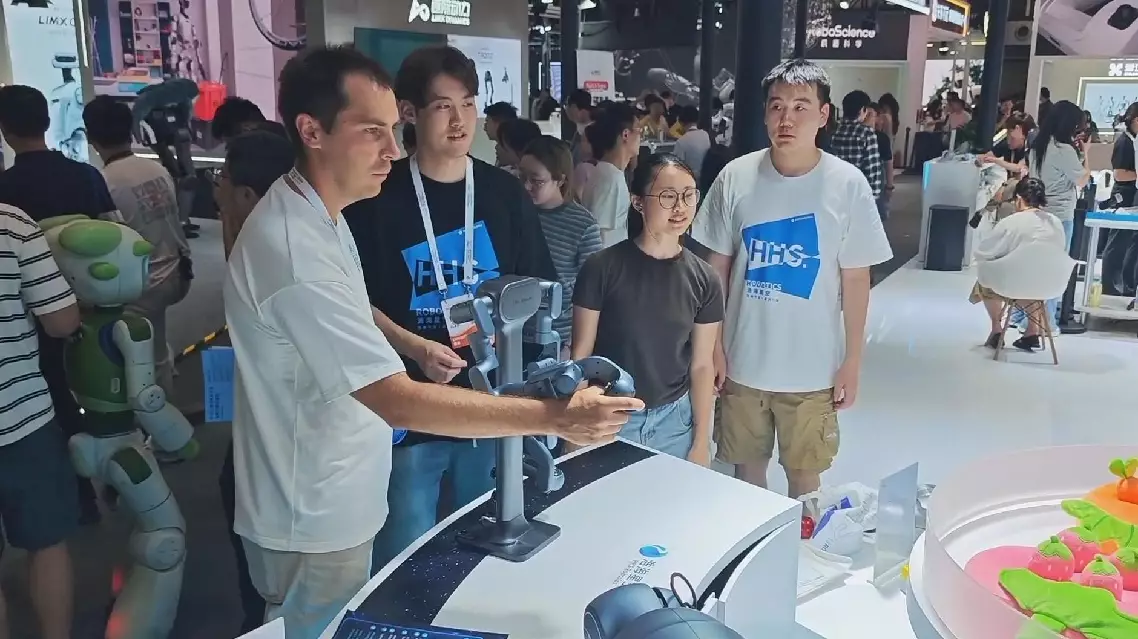
World AI Conference highlights growing demand for global AI partnership