China has positioned itself to play a greater role in promoting international cooperation on artificial intelligence (AI), particularly by encouraging Global South participation and strengthening global AI governance, according to experts and international officials.
China is a global leader in AI development. In 2025, its core AI industries were worth over 1.2 trillion yuan (about 176.6 billion U.S. dollars), while the number of AI enterprises nationwide exceeded 6,200.
The country's open-source large AI models have been downloaded more than 10 billion times in total, continuing to create new and broader opportunities for global cooperation in AI innovation.
On Friday, Chinese President Xi Jinping called for joint efforts to build a just and equitable system for global AI governance, while addressing the opening ceremony of the 2026 World AI Conference and High-Level Meeting on Global AI Governance in Shanghai.
To further advance global AI capacity building, China will provide developing countries with 5,000 opportunities in AI training and seminar programs in the next five years, Xi pledged.
Conference attendees warmly welcomed the commitment, with Chinese experts expressing certainty that foundations are in place for productive cooperation.
"To some extent, an open-source ecosystem is one where everyone can co-build and co-share. Its underlying logic is to enable collaboration and broad participation. The key is to ensure that the vast majority of developing countries, the Global South countries, can access AI, use it effectively, and have the basic right to development. That is the core essence we should focus on now," said Yao Xu, Secretary-General of the Center for Global AI Innovation Governance under Fudan Development Institute.
Officials from developing countries also met the prospect of joint AI development with optimism.
"I think every country can make a particular contribution. There are opportunities for joint projects between China and other nations as well. We have to work collaboratively, or countries to work together to improve and develop AI governance," said Ali Al Shidhani, Undersecretary of Omani Ministry of Transport, Communications and Information Technology.
China's pledge to advance AI capacity building globally opens door to partnerships
Business leaders, researchers and entrepreneurs from around the world gathered at the 2026 World Artificial Intelligence Conference (WAIC), where discussions are focusing on turning AI innovation into cross-border partnerships and real-world applications.
The 2026 WAIC is running in Shanghai from Friday to Monday under the theme "AI Partnership for a Brighter Future."
Across the exhibition halls, conversations often extended beyond product demonstrations, with visitors exploring potential partnerships, supply chains and overseas expansion.
Among them was Paolo Brizzi, chief information officer of Italy's Competence Center for Industry and Manufacturing (CIM), who met with a Chinese AI company to discuss cooperation ranging from industrial applications to entering the European market.
"My point is not to be a customer or a provider of technologies, but to identify parts [where we can] actually collaborate and work together," he said.
The four-day conference has also created opportunities for startups to connect with investors, researchers and potential customers. One startup launched an online networking group on the opening day, attracting hundreds of participants who exchanged ideas, explored business opportunities and sought technical solutions.
Participants said AI innovation depends not only on technological breakthroughs but also on cooperation across industries and countries.
"Collaboration is important because alone you cannot do so much. It needs to be a team support ecosystem," said Florian Wohlrab, CEO of Canada-based OpenHW Foundation.
For many international visitors, the conference is also an opportunity to explore how AI can help address practical challenges. Omar Khan, a participant from Pakistan, said international cooperation is essential to ensuring AI benefits everyone.
"I think, for me, we are all the one. We're human and I think we can cooperate a lot," he said.
Some attendees were looking for solutions to challenges in their home countries. A visitor from Kenya said AI applications such as weather forecast and soil analysis could help improve agricultural productivity across many parts of Africa, where farming remains a cornerstone of the economy.
As countries race to advance AI technologies, participants at this year's WAIC said the conference has become a platform for connecting ideas, technology and demand across borders, helping turn AI innovation into practical international cooperation.
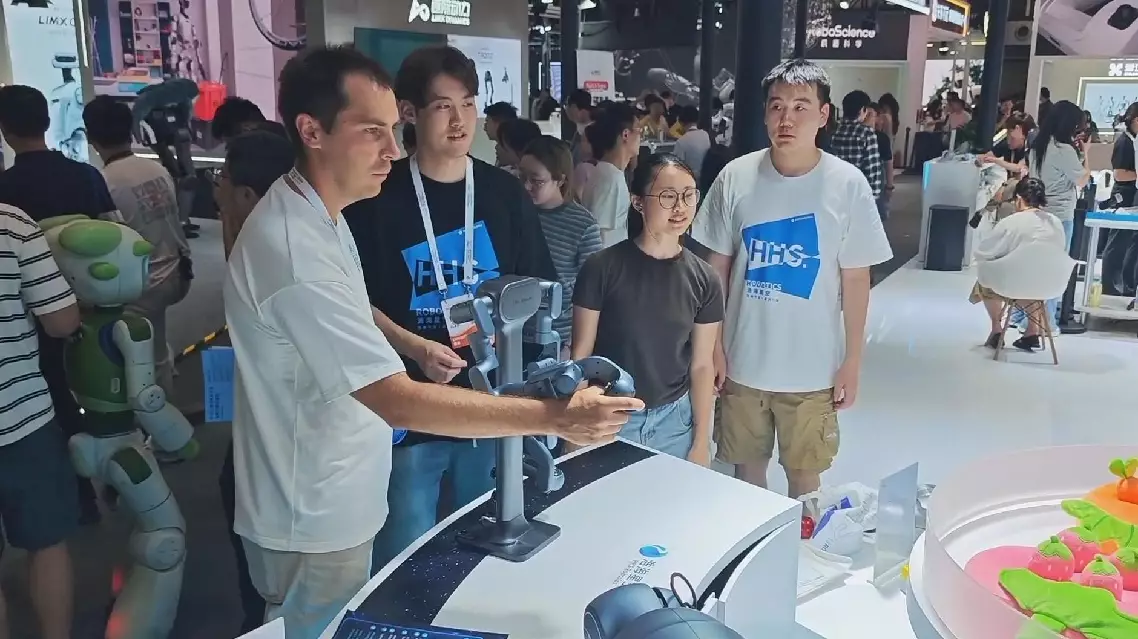
World AI Conference highlights growing demand for global AI partnership