Nobel laureate Omar Yaghi, now a chaired professor at the Tsinghua University of China, is pushing the frontiers of material science with innovations that could reshape energy and water sustainability worldwide.
Yaghi, who won the 2025 Nobel Prize in Chemistry, said in an interview with China Media Group (CMG) on the sidelines of the 2026 World AI Conference in Shanghai that the discovery and development of metal-organic frameworks (MOFs) have unlocked new possibilities in science and industry.
"Metal organic frameworks are new materials that we discovered back in the mid 1990s. Imagine a building block where you make an architecture, you make a building out of a building block, that building block could be used to make different forms, except in our chemistry. It's not just one kind of building block, but it's almost an infinite supply of building blocks. And therefore, it's been leading to an almost infinite possibilities of materials, So we developed a chemistry of being able to link these building blocks together to make different forms," Yaghi said.
"Just like an architect and a builder. So we learned how to shape space on the molecular and atomic level, on the minute level. And in this space, we learned how to modify it so that we can carry out, let's say, hydrogen storage to make clean energy or take CO2 out of the air to make clean air," he said.
"You could even design it so that to do almost a fictional thing, which is to take water out of desert air and make drinking water. This is no longer fiction. This is reality. The water you use does not get destroyed. In fact, it's constantly going back into the atmosphere to join the water natural cycle. So we have built devices that work in the desert with no energy input, aside from ambient sunlight and produce ultra clean water, because the MOF itself acts like a filter to hold water and release it under mild conditions so that the process is energy efficient, and the cost is reasonable," said the Nobel prize winner.
"And once these are commercialized, you're giving each citizen in the world, potentially water independence. So, they can have their own water, they have control over their own water. They can put this water harvester anywhere they want. So, therefore they can live anywhere they want," he said.

Nobel laureate expounds on discovery that could reshape energy and water sustainability
Business leaders, researchers and entrepreneurs from around the world gathered at the 2026 World Artificial Intelligence Conference (WAIC), where discussions are focusing on turning AI innovation into cross-border partnerships and real-world applications.
The 2026 WAIC is running in Shanghai from Friday to Monday under the theme "AI Partnership for a Brighter Future."
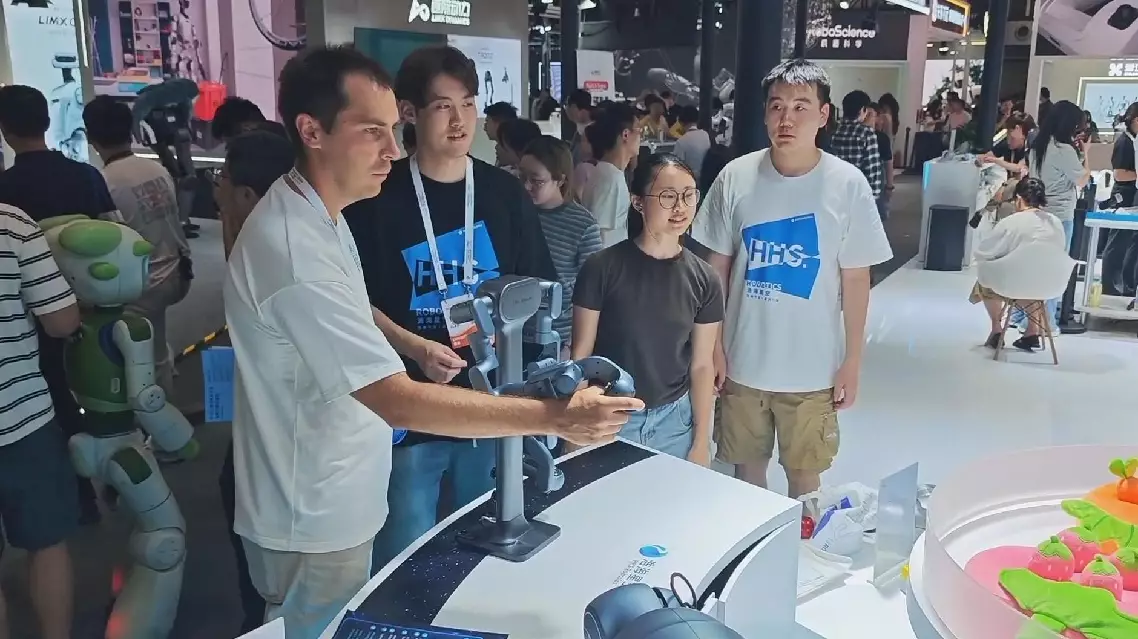
Across the exhibition halls, conversations often extended beyond product demonstrations, with visitors exploring potential partnerships, supply chains and overseas expansion.
Among them was Paolo Brizzi, chief information officer of Italy's Competence Center for Industry and Manufacturing (CIM), who met with a Chinese AI company to discuss cooperation ranging from industrial applications to entering the European market.
"My point is not to be a customer or a provider of technologies, but to identify parts [where we can] actually collaborate and work together," he said.
The four-day conference has also created opportunities for startups to connect with investors, researchers and potential customers. One startup launched an online networking group on the opening day, attracting hundreds of participants who exchanged ideas, explored business opportunities and sought technical solutions.
Participants said AI innovation depends not only on technological breakthroughs but also on cooperation across industries and countries.
"Collaboration is important because alone you cannot do so much. It needs to be a team support ecosystem," said Florian Wohlrab, CEO of Canada-based OpenHW Foundation.
For many international visitors, the conference is also an opportunity to explore how AI can help address practical challenges. Omar Khan, a participant from Pakistan, said international cooperation is essential to ensuring AI benefits everyone.
"I think, for me, we are all the one. We're human and I think we can cooperate a lot," he said.
Some attendees were looking for solutions to challenges in their home countries. A visitor from Kenya said AI applications such as weather forecast and soil analysis could help improve agricultural productivity across many parts of Africa, where farming remains a cornerstone of the economy.
As countries race to advance AI technologies, participants at this year's WAIC said the conference has become a platform for connecting ideas, technology and demand across borders, helping turn AI innovation into practical international cooperation.
World AI Conference highlights growing demand for global AI partnership