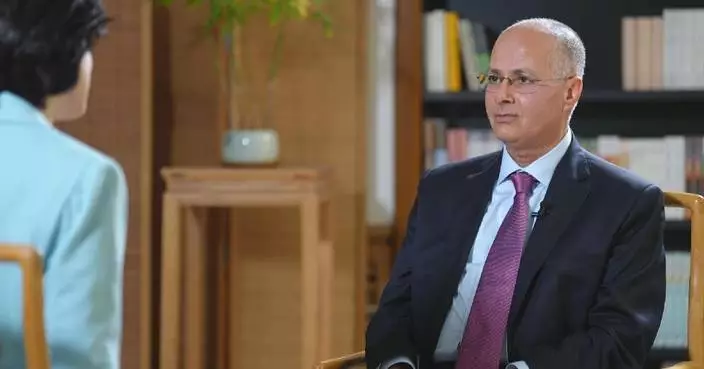
Nobel Chemistry Laureate Omar Yaghi said his scientific career was born out of an accidental encounter with a molecular structure drawing in childhood, encouraging future scientists to maintain long-term focus on their goals despite of hardships and criticisms.
Born into a Palestinian refugee family in Amman, Jordan, Yaghi grew up with over a dozen family members crammed into a single room without electricity or running water.
His life changed at the age of 10 when he stumbled upon a molecular structure drawing in a school library, igniting a lifelong passion for chemistry. He moved to the United States at 15 to study and spent his career researching and teaching at American universities. Now, he has moved to China, becoming a chaired professor at the Tsinghua University.
"I think the natural instinct of a child, when they are in hardship, is to try to think about 'how do I come out of this hardship', 'how do I deal with this hardship?' And I was fortunate because I found something completely unexpected, which was the discovery of molecular drawings in the library when I was 10 years old. And I think I immediately fell in love with them because I viewed them as an escape from the hardship that I had experienced," said Yaghi in an interview with China Media Group (CMG) before the 2026 World AI Conference.
The 2025 Nobel prize winner, renowned for his development of reticular frameworks that can harvest water from desert air, said that his initial interest had no utilitarian motive.
"Of course it would have been poetic to think 'Oh, I would love in the future to discover materials that would address the water scarcity problem in the world and in the desert." But that was not the case at all. I was most interested in the beauty of these molecules. And I've always been interested in the beauty of molecules. So I think as a scientist, we do have to ask difficult questions and try to answer them," said Yaghi.
The Jordanian-American chemist emphasized that a passion for science requires no justification or rigid blueprint, saying it can emerge from anyone, anywhere, regardless of their background or environment.
"The discovery of my interest in chemistry came quite by accident, and it was not intellectual, it was not planned. And I think that we should keep that in mind. Our love for things does not have to be justified. And it does not follow a blueprint. It could come from anywhere and it could be done by anyone, anywhere regardless of their background, regardless of their environment, and regardless of the hardship that they are facing," said Yaghi.
To succeed despite adversity, Yaghi said he relied on keeping a sharp focus on long-term scientific objectives rather than immediate distractions or critics.
"I think what made it, what helped me quite a bit is to look ahead and keep focus on the goal and have always the long view, instead of getting preoccupied with various distractions of the present, is to keep in mind the objective. And that objective, of course in my case, was scientific," said Yaghi.
Acknowledging that critics are inevitable, Yaghi said he never viewed them negatively, choosing instead to filter out unfair attacks while using constructive feedback to sharpen his skills.
"Whenever you are working and you're successful at your work, there will always be detractors, and I never really thought of the detractors as a big negative. I always thought the questions of these critique, the critical questions that people are asking. Some of them are fair and some of them are unfair. I'll take the fair ones and improve my skill and improve my talent, and the ones that I think are unfair, throw them away. So you don't have to worry about it. These negative things never occupied my head. They never rented space in my head. So I kept my head open to self improvement," Yaghi said.
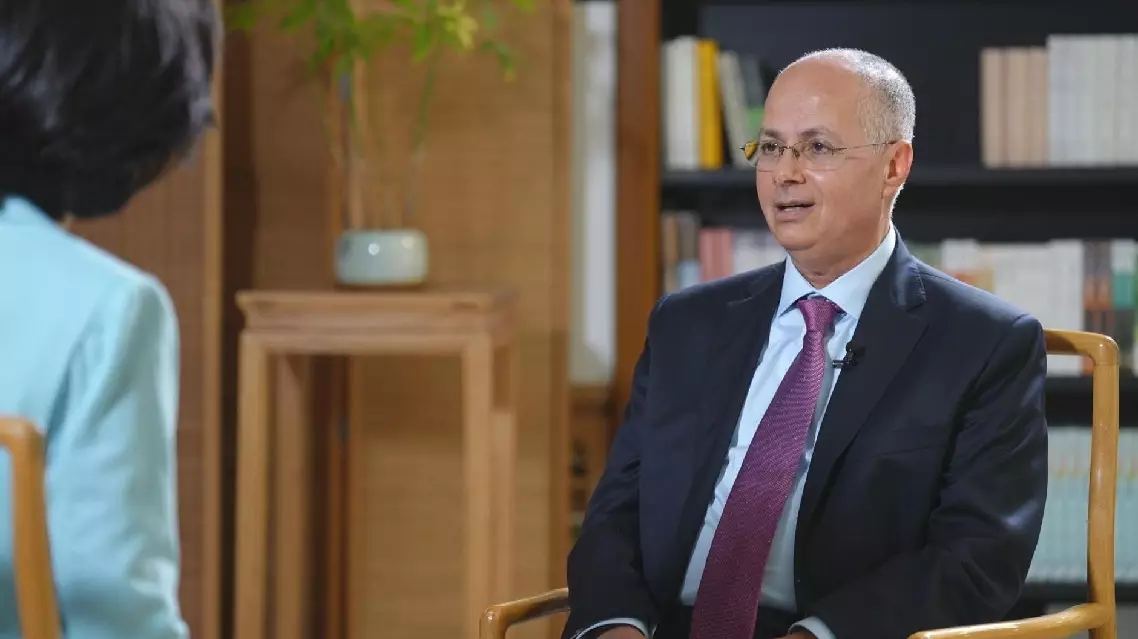
Nobel Laureate Omar Yaghi reflects on how to secure success out of hardships