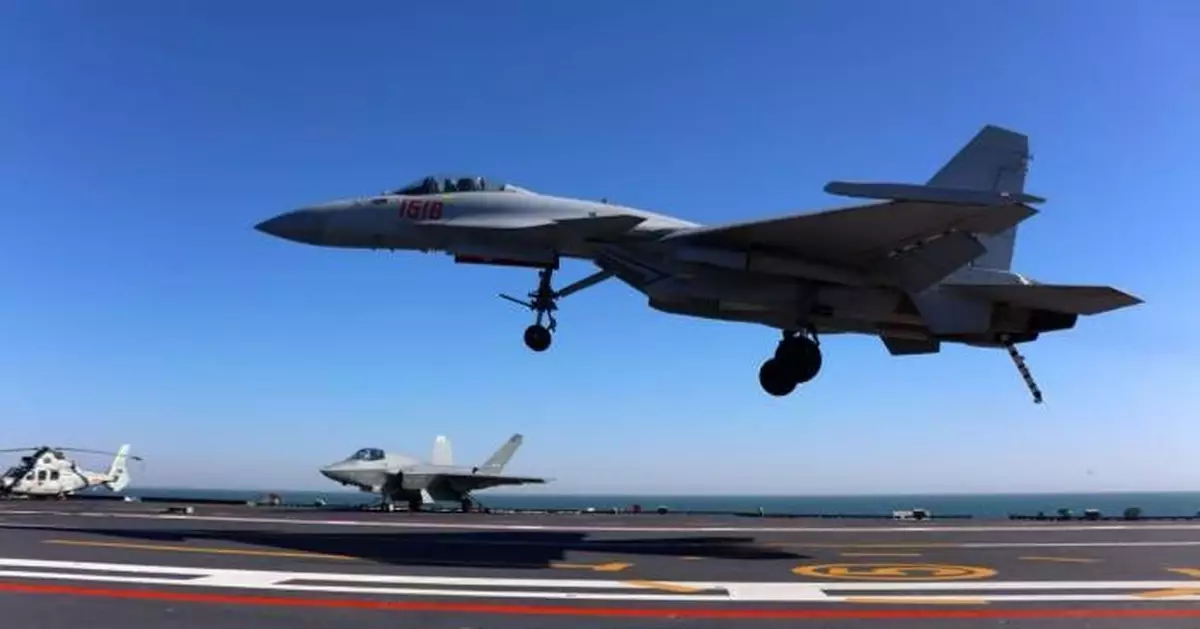
A newly released photograph has put the CNS Fujian’s electromagnetic catapult system in the spotlight. US military website The War Zone (www.twz.com) reported on July 9 that a J-15T carrier-based fighter had launched from the Fujian carrying four YJ-83K anti-ship missiles. It said this was the first time a J-15-series fighter had been seen taking off with four anti-ship missiles.
The fighter had engaged full afterburner before leaving the deck, and the outlines of all four missiles were clearly visible beneath its wings. The image offers more than a dramatic shot. It provides a concrete sign that the Fujian can catapult a heavily loaded aircraft into the air.

J-15T launches under full afterburner with four anti-ship missiles.
The War Zone concluded that Fujian’s electromagnetic catapult is unlocking the J-15T’s strike potential and creating a major deterrent for the US Navy. The report said China’s rapidly developing carrier force is overcoming a long-standing operational constraint: getting heavily armed, heavy strike fighters off a carrier deck.
That basic assessment fits the facts. More directly, however, the photograph is a key indication that Fujian’s electromagnetic catapult has successfully demonstrated heavy-load launch capability.
Why the Catapult Matters
The technical significance is straightforward. The “T” in J-15T denotes the catapult-launch variant, designed to take off at full load from carriers equipped with electromagnetic catapults.
Earlier J-15s on the Liaoning and Shandong relied on ski-jump decks. A ski-jump launch depends on the aircraft’s own speed as it crosses the upward-curving deck to generate lift. The heavier the payload, the less adequate the aircraft’s speed becomes at deck exit. That forces a trade-off between fuel and weapons.
Public footage has shown ski-jump-launched J-15s carrying no more than two YJ-83K anti-ship missiles. Carrying four YJ-83Ks with full fuel would be virtually impossible in ski-jump mode.

Ski-jump carriers limit heavy-load launches.
The YJ-83K is a mainstay subsonic anti-ship missile of the PLA Navy. Each missile weighs about 600 kilograms, meaning four add up to 2.4 tonnes.
Add the J-15T’s own takeoff weight and internal fuel, and the catapult must deliver substantial energy. The photograph shows the aircraft leaving the deck successfully under full afterburner. That points to three developments: stable and reliable electromagnetic-catapult thrust under heavy loads, calibrated carrier-aircraft launch parameters, and successful coordination with the arresting and recovery system.
With these three elements working together, Fujian’s carrier-aircraft launch-and-recovery system has entered a practical operational stage. The system is no longer simply a concept on deck.
A New Strike Equation
The tactical shift is even more direct. A single J-15T carrying four YJ-83Ks could strike at least four maritime targets in one sortie. It could also launch a four-missile saturation salvo against one high-value target.
With a combat radius of about 1,500 kilometers and a YJ-83K range of about 180 kilometers, one aircraft can cover a substantial maritime area. Fujian’s electromagnetic catapult also enables efficient sortie generation. A wave of J-15Ts could put far more anti-ship missiles into the air than carriers operating in the ski-jump era.
That changes the equation. The Fujian carrier group’s anti-ship firepower is moving beyond merely adequate and into a new class.

New carrier aircraft point to a next-generation strike system.
The Next Weapons Test
Still, outside observers should not overstate this development. The YJ-83K is a mature subsonic anti-ship missile that began entering PLA service in the early 2000s.
The supersonic YJ-15 and longer-range YJ-18 have both been in service for years. A stealth cruise-missile version, the YJ-18B, has also appeared publicly. The YJ-15 displayed in military parades is reported to reach Mach 3 to Mach 4 and have a range exceeding 400 kilometers.
The J-15T has now demonstrated that it can carry four medium-range missiles. In theory, it could eventually be adapted for heavier models. If future tests verify the carriage and launch of advanced heavy weapons such as the YJ-15, its strike power would show a more substantial breakthrough.
A Full Carrier System
CNS Fujian’s true value, however, lies in the wider system rather than in any one aircraft. The J-15T handles anti-ship strikes and long-range interception. The J-35 stealth fighter is intended for air-superiority penetration and deep strike, while the KJ-600 fixed-wing airborne early-warning aircraft provides broad-area situational awareness, command, and guidance.
Together, these three carrier-based aircraft types form a complete carrier strike system. The Liaoning and Shandong faced systemic shortcomings: they relied on helicopters for airborne early warning, lacked stealth fighters, and could not launch heavy fighters at full loads.
Fujian is addressing those gaps one by one. The J-15T’s full-load catapult launch is only one milestone in that broader process.
From Photo to Capability
A photograph is not the same as combat capability. Demonstrating the carriage and takeoff of four YJ-83Ks does not mean a full weapons-release test has been completed.
High-intensity sortie training, the rhythm of multiple catapult-launch waves, carrier-group coordination exercises, and realistic confrontation in complex electromagnetic environments all need time to mature. The road from a successful deck launch to sustained combat performance remains a long one.
Two years ago, when Fujian first put to sea, many people were still asking whether its electromagnetic catapult could work. The images now emerging suggest that Fujian has cleared its most difficult stage.
The Signal From Fujian
A single photograph can reveal more than an official announcement. The J-15T’s takeoff from Fujian carrying four anti-ship missiles sends an unmistakable signal: China’s carrier-based aircraft are beginning to realize the payload potential expected of a heavy fighter.
What could not be done before is now being achieved. Ranges once beyond reach are extending. How far this capability can develop will be answered by the live-fire test images that follow.
The Art of Stopping War
** 博客文章文責自負,不代表本公司立場 **
Military Watch Magazine confirms it: the PLA Air Force's fifth-generation J-20 fighter fleet has now broken past 500 aircraft. Eighteen air force brigades have received the type. At roughly 28 jets per brigade, that puts the confirmed total at 504, with another 40 to 60 aircraft in training use.

J-20 is now the largest single-country fighter jet procurement since the Cold War.
New deliveries often surface in outside reporting only months or years after the fact. That means the real number could already sit closer to 600. Either way, the milestone carries weight globally. The J-20 has become the largest single-country military fighter procurement since the Cold War ended.
Put the numbers side by side and the picture sharpens fast. Since mass production began in 2011, the US Air Force has taken delivery of roughly 430 to 450 F-35As, the land-based variant that lines up most closely with the J-20's role. Count the F-35B and F-35C variants too, and Lockheed Martin's overall delivery total does grow larger.
But that comparison hides more than it reveals. The three F-35 variants share little beyond their avionics, and each runs on a separate production line. F-35 deliveries are also scattered across more than 20 countries. Judged at the level of a single air force, the F-35A has already been overtaken. The Chinese Air Force alone now fields more J-20s than the US Air Force has F-35As.

J-20 dominates the F-35A in both total orders and delivery speed.
Look at production trends and the gap only widens. J-20 annual deliveries are now estimated at 100 to 120 aircraft. F-35A annual deliveries, by contrast, have slipped to just 24 to 40, hobbled by technical problems and cost-control struggles. The only jet that can match the J-20's pace is its own stablemate, the J-16, which has likewise delivered close to 500 units.
The F-35 program's troubles run deeper than slow output. Its critical "Technology Refresh 3" upgrade has run into severe technical bottlenecks in recent years, and that has directly disrupted production and delivery pipelines. Some newly built F-35s have reached customers in an incomplete state. Specifically, certain jets left the factory without a full active electronically scanned array (AESA) radar or the complete suite of advanced sensors.
In other words, a considerable share of these supposedly fifth-generation stealth fighters have arrived at the US Air Force, the program's primary customer, functionally unfinished. For a considerable stretch after delivery, they cannot carry out the full combat missions their design specifies. Their initial role has been forced down a notch, in most cases limited to basic flight training or restricted system testing. That falls well short of the initial operational capability expected of a mature, fully equipped fifth-generation fighter.

F-35 upgrade delays are stalling deliveries across the entire production line.
None of that has ever happened on the J-20 production line. Every J-20 that rolls out comes fully equipped, complete avionics suite, complete AESA radar. Not one has ever shipped as a half-finished product.

Mature manufacturing means every jet ships complete, no missing parts.
The contrast is stark. One side delivers over a hundred complete aircraft a year. The other sees shrinking deliveries, with jets sometimes leaving the factory missing components. That gap in industrial capability and program management deserves more scrutiny than the raw headline numbers.
Why has J-20 production reached such heights?
Domestic engine production cleared the biggest bottleneck first. In 2020, the J-20 switched from the Russian-made AL-31FM2 to the domestically produced WS-10C, and output saw its first wave of expansion. In December 2025, the first batch of J-20As fitted with the WS-15 engine was confirmed in test flights, delivering clear gains in power generation, maintenance needs, range and flight performance. Once propulsion stopped depending on outside suppliers, the production line could run at full speed.

Domestic engine breakthroughs unlocked the J-20's production surge.
Cost control matters just as much. Analysis cited in the report notes that the J-20's operating cost runs comparable to the fourth-generation J-11. That stands in sharp contrast to the US military, where the F-22 was retired early over prohibitive operating costs and the F-35's per-flight-hour cost remains stubbornly high, driven further up by upgrade delays and rework.
If a fifth-generation fighter can run at fourth-generation cost, procurement scale can expand dramatically. The Y-20 transport tells a similar story. After switching to the WS-20 engine, its output accelerated too, with external analysis putting active service numbers above 100, closing in on the US military's fleet of 146 C-17As within just a few years. Domestic aero-engines are unlocking production on both the large-aircraft and fighter-jet fronts at once.

Lower maintenance and operating costs made mass deployment possible.
Role diversification adds a third driver. The J-20 is no longer just an air-superiority fighter. The twin-seat J-20S variant has already been unveiled, built to serve as an airborne command post and drone-control platform. A single J-20S can direct multiple GJ-11 stealth drones in coordinated operations, elevating the J-20 from an air-combat platform to an aerial combat node. That shift naturally drives demand higher.

New variants turned the J-20 from fighter jet into combat node.
A January report from the UK's Royal United Services Institute (RUSI) puts the number even higher. It estimates the Chinese Air Force will field roughly 1,000 J-20s by 2030. Set against the global picture, that figure is striking: the US Air Force's combined F-22 and F-35A fleet currently stands at only around 800.
The F-22 side of that fleet has long struggled with a mission-capable rate hovering below 60% due to maintenance issues, meaning perhaps fewer than 120 are truly ready for deployment at any given moment. The J-20 benefits from newer design standards and lower maintenance complexity. With its production line still climbing, the fleet's overall serviceability rate far outpaces the F-22's.

Training drills keep expanding the J-20's tactical role.
One more comparison stands out. At the current pace of 100 to 120 aircraft a year, the J-20 fleet could indeed surpass 1,000 around 2030. China's sixth-generation fighter is expected to enter service in the early 2030s, which means J-20 production may gradually shift toward the sixth-generation program once it peaks.
That "fifth-generation lays the groundwork, sixth-generation takes over" rhythm stands in sharp contrast to the production gap the US experienced between the F-22 and F-35. The F-22 line shut down back in 2009, and it took nearly a decade before the F-35 reached mass-delivery capability. Between the J-20 and China's sixth-generation fighter, the transition looks almost seamless.
Ten years ago, when the J-20 first took to the skies, outside observers were still asking whether it could even be built at scale. Ten years on, the answer speaks for itself: a fleet exceeding 500 aircraft, annual production above 100, and continuously refined A and S variants. China's aviation industry has made a leap over this decade that no slogan could capture as clearly.