
Skip to Content Facebook Feature Image

Chinas J-35 Ski-Jump Flights: USS Ford Stealth Gap

Blog

Chinas J-35 Ski-Jump Flights: USS Ford Stealth Gap
Blog

Blog

Chinas J-35 Ski-Jump Flights: USS Ford Stealth Gap

2026-08-11 23:06 Last Updated At:23:06

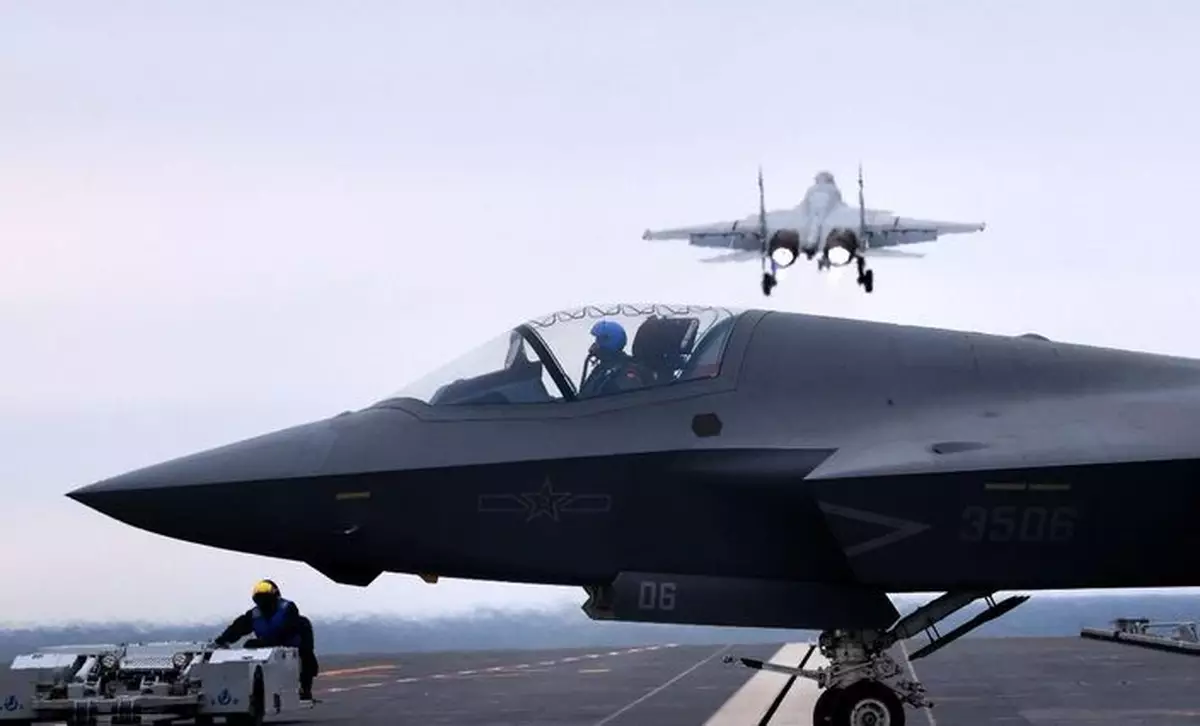
A single photo viral on social media, just turned a rumor into fact. The image captures a J-35, afterburners blazing, tail nozzle spitting a long tongue of flame. At the runway's end, the deck kicks up sharply. That's the unmistakable profile of a ski-jump carrier. Is it the Liaoning or the Shandong? The photo alone can't tell us.

Afterburners blazing, a J-35 roars toward a ski-jump deck under cover of darkness.

Afterburners blazing, a J-35 roars toward a ski-jump deck under cover of darkness.

But look closer. A nighttime launch. An empty sea. A ski-jump deck. Those details scream one thing: this stealth fighter is already combat-deployed. You don't pick a dark night for a test flight.

More Images
Afterburners blazing, a J-35 roars toward a ski-jump deck under cover of darkness.

Afterburners blazing, a J-35 roars toward a ski-jump deck under cover of darkness.

All three Chinese carriers are now ready to launch the stealthy J-35.

All three Chinese carriers are now ready to launch the stealthy J-35.

The gap in stealth fighter deployment? It's widening, and not in the US Navy's favor.

The gap in stealth fighter deployment? It's widening, and not in the US Navy's favor.

One navy adapts. The other stumbles. It's clear who's quicker on their feet.

One navy adapts. The other stumbles. It's clear who's quicker on their feet.

The J-35 on a ski-jump deck: just one milestone in China's stealth transformation.

The J-35 on a ski-jump deck: just one milestone in China's stealth transformation.

For a long time, skeptics doubted the J-35 could ever fly from a ski-jump deck. The problem? Catapult launches and ski-jump takeoffs punish an airframe in completely different ways. An electromagnetic catapult yanks the aircraft forward along its spine. That brutal tug demands a beefed-up landing gear and a reinforced fuselage. The J-35 has already proven it can handle that. It's been flung off the Fujian's catapults repeatedly. So that box is checked.

But a ski-jump takeoff hits differently. The shock doesn't run lengthwise. It slams along the X-axis. As the deck ramps upward, the jet gets a violent nose-up jolt right at the point of departure. Surviving a catapult shot doesn't guarantee you can handle a ski-jump. Basic aeronautical engineering.

Now, you might ask: what about landing? A J-35 slamming onto the deck hits harder and faster than any takeoff. Isn't that a tougher test than the X-axis jolt? Fair point. But takeoff and landing loads are different beasts. Each scenario demands its own round of testing, one by one.

And passing tests is just step one. It doesn't mean the jet is ready to move in. The J-35 is a fifth-generation stealth fighter. Its skin coatings and onboard systems need a whole different level of care compared to the old J-15. The carrier's hangar and maintenance gear must be ripped out and rebuilt. Only after those modifications are done, and the new maintenance routines are proven, can the fighter truly call the ship home.

All three Chinese carriers are now ready to launch the stealthy J-35.

All three Chinese carriers are now ready to launch the stealthy J-35.

So where do things stand? All three of China's carriers can now field the J-35. The ski-jump deck is no longer a barrier. The only bottleneck is the hangar and support system overhaul. For the Dalian Shipyard, that's not a technical headache. The real question is whether the navy has the appetite to do it.

The US Navy's Awkward Reality

Now turn that same question on the US Navy. The picture gets awkward fast. The USS Gerald R. Ford has long insisted it cannot carry the F-35C stealth fighter. The ship was simply not designed for it.

The gap in stealth fighter deployment? It's widening, and not in the US Navy's favor.

The gap in stealth fighter deployment? It's widening, and not in the US Navy's favor.

The Navy's earlier explanation: the Ford's design was frozen before the F-35C entered service. You can't build custom maintenance facilities for a jet that doesn't exist yet. That sounds reasonable. But it falls apart under scrutiny.

First, the Ford is the US Navy's next-generation flagship carrier. Its designer, Newport News Shipbuilding, handled everything: detailed 3D engineering, block construction, final assembly, mooring trials. All of it.

And yet, this is a shipyard with a century of experience. It failed to make any forward-looking provisions for the next-generation carrier aircraft. Not even a reserved maintenance workshop. That is hard to swallow.

Second, it's not that US carriers can't handle the F-35C. It's that the Ford can't. The USS Carl Vinson, commissioned in the 1980s, operates the jet just fine. The Ford, built in the 2010s, cannot. That contrast is striking.

Whether the Ford's electromagnetic catapult system is incompatible with the F-35C is a separate question.  On stealth fighter deployment, the gap between the Chinese and US navies is widening. The J-35 is now the world's first stealth fifth-generation fighter to complete an electromagnetic catapult launch. And every Chinese carrier can handle it.

Meanwhile, the US Navy still relies on the F/A-18E/F as its workhorse. That jet's basic design goes back to the 1970s. In any future encounter at sea, it would be a case of China using stealth fighters to bully older-generation jets.

More than just carriers and jets

China's stealth aviation push is systematic. The entire fleet's combat capability is on the same trajectory. Compatibility for catapult-equipped carriers solved. The needs of ski-jump carriers did not go ignored.  All three carrier lines are advancing in parallel.

On the US side, the Ford has stumbled repeatedly on new systems: electromagnetic catapults, advanced arresting gear. It still hasn't hit its original combat capability targets. The plan to deploy stealth fighters has been delayed again and again.

The contrast answers a clear question: which navy adapts better to a changing battlefield? China's or America's?

One Navy Adapts, the Other Stumbles

Talk of a changing battlefield? It really tests one thing: how a navy uses its carrier aircraft. What a carrier flies dictates how far and how stealthily it can project power.

One navy adapts. The other stumbles. It's clear who's quicker on their feet.

One navy adapts. The other stumbles. It's clear who's quicker on their feet.

Now put a J-35 on a ski-jump carrier. You get a leap in stealth strike capability. A platform once written off as fit only for conventional fighters suddenly joins the fifth-generation package.

For a navy operating three carriers built along different technical paths, a single stealth fighter model changes everything. Training, maintenance, and talent pipelines merge into one. The combat payoff is not just additive. It is multiplicative.

Now look at the United States. The Ford's journey from launch to commissioning was tortuous. And integrating a stealth fighter? That adds another layer of uncertainty. A platform purpose-built for a next-generation carrier is proving slow to actually host the next generation of aircraft. That gap is no accident. It reflects real shortcomings in design and construction.

The Chinese Navy's method: get the platform working step by step, then tailor maintenance to the aircraft's quirks. The US Navy's method: burn time in endless integration struggles between systems and the platform. Which path is more pragmatic? Time has already handed down a partial verdict.

The J-35 on a ski-jump deck: just one milestone in China's stealth transformation.

The J-35 on a ski-jump deck: just one milestone in China's stealth transformation.

Putting J-35 on a ski-jump carrier is just the beginning of China's drive toward a fully stealth navy. The real story is the diffusion of stealth aviation power: from individual platforms to the entire system. Once Liaoning, Shandong, and Fujian all fly the same stealth fighter, China's navy will have far more options for projecting power on the high seas.

For the US military, the problem is stark: how to get the Ford to quickly accommodate the F-35C. That remains a hard problem for its navy. One step forward, one step behind. That neatly captures the different stages these two navies now occupy.


The Art of Stopping War

** 博客文章文責自負,不代表本公司立場 **

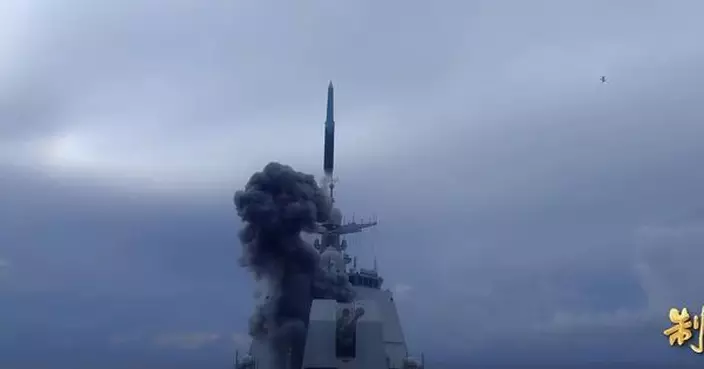
For the first time, a video has captured a Type 052D destroyer launching a YJ-20 hypersonic anti-ship missile from its forward vertical launch system. The footage appears in the theme song MV of the PLA's official documentary "Winning Victory," released to commemorate its 99th anniversary.

For the first time, an MV segment clearly shows a Type 052D destroyer launching a YJ-20 hypersonic anti-ship missile from its forward vertical launch system.

For the first time, an MV segment clearly shows a Type 052D destroyer launching a YJ-20 hypersonic anti-ship missile from its forward vertical launch system.

Previous promotional videos gave us only blurry long-distance shots. Not this time. The official release is rich with detail. High-pressure gas smoothly pushes a uniquely shaped missile out of its launch tube, and the double-cone contours of the hypersonic glide warhead are clearly visible.

The real significance? This footage proves that the Chinese Navy's YJ-20 capability isn't limited to the 10,000-ton Type 055 large destroyer. The more numerous Type 052D destroyers can also launch this hypersonic missile, which has a range of over a thousand kilometers.

Let's talk design. The YJ-20 packs a large solid-fuel booster rocket at its tail. That booster delivers enormous thrust in a short burst, hurling the missile to near-space.

Design-wise, the YJ-20 packs a large solid-fuel booster rocket at its tail, capable of delivering enormous thrust in a short time.

Design-wise, the YJ-20 packs a large solid-fuel booster rocket at its tail, capable of delivering enormous thrust in a short time.

Then it separates, and the hypersonic glide warhead takes over for high-speed glide flight. Public information suggests the missile cruises above Mach 6 in near-space, with a mid-course top speed approaching Mach 10. In the final phase, it decelerates to lock onto its target, then strikes in a near-vertical dive.

The warhead uses a classic double-cone hypersonic glide configuration. This aerodynamic shape gives it the ability to glide with a high lift-to-drag ratio and pull irregular trajectory maneuvers in near-space. Traditional ballistic missiles follow fixed, predictable parabolic arcs.

The YJ-20's appearance on the Type 052D destroyer is tactically significant not just for the weapon's power, but for the large-scale proliferation of this capability.

The YJ-20's appearance on the Type 052D destroyer is tactically significant not just for the weapon's power, but for the large-scale proliferation of this capability.

The YJ-20's flight path is erratic: a nightmare for early warning and interception by air defense systems.

For guidance and penetration, the YJ-20 uses a combined mode: BeiDou satellite navigation, inertial guidance, mid-course data link correction, and terminal active radar guidance. This lets the missile lock onto and track large, fast-moving surface targets even at ultra-long distances, over a thousand kilometers.

Now, in any sea area, a Type 052D equipped with the 850mm universal vertical launch system can launch hypersonic saturation strikes from over a thousand kilometers away.

Now, in any sea area, a Type 052D equipped with the 850mm universal vertical launch system can launch hypersonic saturation strikes from over a thousand kilometers away.

Add in the extreme terminal speed and violent evasive maneuvers, and you have a missile that current shipborne air defense radars struggle to predict and track. The non-parabolic flight path gives them very little time to react.

But the warhead's chemical punch is only half the story. The real killer is kinetic energy. When a hypersonic warhead slams into a ship, the sheer violence of the impact can shred the internal core of a 10,000-ton destroyer or a large aircraft carrier beyond repair.

The real story of the YJ-20 on the Type 052D destroyer is not about raw power. It's about scale. Hypersonic weapons were once the exclusive toys of massive 10,000-ton destroyers or land-based launchers, built in tiny numbers. But the Type 052D changes everything.

It is the workhorse of China's fleet—the most numerous, most widely deployed surface combatant. Now, with the YJ-20, every one of them packs a hypersonic punch. That means hypersonic strike has become a standard feature across the PLA Navy's surface fleet.

Think about how air defense used to work. An enemy fleet only had to watch a handful of big ships. Now, every Type 052D with that 850mm universal VLS becomes a potential hypersonic sniper, able to launch a saturation strike from over 1,000 kilometers away. Suddenly, the adversary's air defense network is drowning in threats. It must track every single Type 052D on the battlefield. The surveillance pressure explodes exponentially.

Now look across the ocean. The gap in technology and deployment is staggering. The U.S. Navy's Zumwalt-class destroyer was supposed to be a game-changer. But its advanced gun ammunition became so expensive that the main guns sat idle—an embarrassing 'no ammo' fiasco.

To salvage these billion-dollar hulls, the Navy ripped out the guns and stuffed in large launch tubes for the Conventional Prompt Strike hypersonic missile. Yet the project has been plagued by delays. Sea trials and modifications keep slipping. It still hasn't reached initial operational capability.

The U.S. approach is a desperate retrofit—massive engineering, glacial timelines, and only a handful of ships can ever be modified. The PLA Navy took a different path. From day one, the Type 052D and Type 055 were designed with large-caliber universal VLS in mind.

The philosophy was simple: 'When the missile is ready, the ship is ready.' That foresight has paid off. China's surface fleet didn't just crack the technology of long-range hypersonic anti-ship strike. It seized an overwhelming advantage in scale, system integration, and routine deployment.

Now, let's talk about the interceptors. The U.S. Aegis system, with its Standard-3 and Standard-6 missiles, is built to stop traditional ballistic missiles on predictable arcs, or supersonic cruise missiles skimming the waves. But a hypersonic glide vehicle is a different beast. It maneuvers in near-space at blistering speeds, jinking to evade.

The Aegis system's computers are pushed to the breaking point. The kill chain—detect, track, intercept—can be overwhelmed in an instant. The entire air defense network collapses.

The PLA's Type 052D destroyer just put its deadliest card on the table. In front of the camera, it cold-launched a YJ-20 hypersonic anti-ship missile from its vertical launch cells, showing every detail. The message? Hypersonic weapons are no longer lab curiosities or rare cameos in exercises.

They are a real, routine, combat-ready capability. In the coming blue-water contest, that deep integration, pairing top-tier hypersonic tech with a large fleet of mainstay warships, will be the most solid support for safeguarding national maritime rights and interests.

Recommended Articles