
US Air Force Secretary Troy E. Meink picked a public stage for a striking disclosure. Speaking at the Air Force Association's Air, Space & Cyber Conference, he said the US Space Force has deployed 'on-orbit space control weapons' capable of 'protecting the joint force from adversary actions.'
He put it bluntly: 'the United States now has on-orbit space control weapons.'
Washington Puts Its Orbital Arsenal on the Record
Reporters pressed for launch timing, deployment numbers, and whether kinetic or non-kinetic methods were used. Meink declined to answer any of those questions. He only stressed that 'on-orbit' was a carefully considered phrase. Making the weapons' existence public can create deterrence. Disclosing specific capabilities could undermine it.
This is the first time a senior US official has so directly acknowledged that the US military has placed weapons with space combat purposes into orbit.
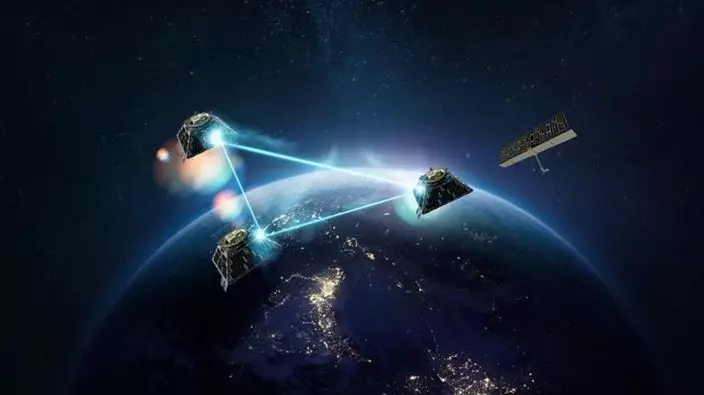
The US is racing to field space defenses and in-orbit counter-space weapons.
The weight of that statement rests on two words: 'on-orbit' and 'space control.' 'On-orbit' means the equipment itself is already located in space. Not an anti-satellite missile, electronic jamming station, or laser system based on the ground.
Most of the anti-space equipment the United States has publicly revealed in the past has been ground-based. It can jam satellites. It cannot be called an on-orbit weapon.
'Space control' is a far broader military concept. Under the US Space Force's operational framework, it covers both protecting its own satellites and communications links. It also covers suppressing, degrading, or even destroying an opponent's space capabilities.
Whether a system is defensive or offensive often has no clear dividing line.
Meink repeatedly stressed 'protecting the joint force from adversary actions.' The framing is clearly meant to cast this disclosure in a defensive light. But the US military has not released any technical information that would let outsiders verify that claim.
To understand that admission, look at what happened earlier. Earlier this month, US Space Command ran its first space maneuver warfare exercise involving in-orbit spacecraft. Its codename: Apollo Maneuver 2026.
According to US statements, this was a 'live-fly exercise.' That means it used real in-orbit spacecraft, not computer simulation alone.
According to disclosures, spacecraft in low Earth orbit, medium Earth orbit, and geosynchronous orbit all participated in coordinated maneuvering. The exercise also tested how to keep satellite maneuvering, maintenance, and replenishment going when space is jammed or attacked.
So-called space maneuver warfare is fundamentally different from the satellite maneuvers of the past. Old satellite maneuvers were mostly used to adjust orbits and dodge debris. Now the United States is explicitly treating maneuvering as a means of gaining military advantage.
The approach uses ground-based radar, optical sensors, and other satellites to determine the positions and orbits of other countries' satellites. Then US satellites change speed and orbit to observe and photograph those spacecraft at close range, or even force them to change orbit.
If jamming or attack equipment is also carried, the satellite could further suppress or damage the target satellite. At that point, it has the basic characteristics of a so-called 'killer satellite.'
Satellite Dogfights Are No Longer Theory
The groundwork was already laid. In January, General Stephen N. Whiting, commander of US Space Command, called for US space forces to shift from static attrition warfare to maneuver warfare.
In June, the US Space Force put the concept to the test. It launched the Jackal satellite first, then sent up another spacecraft, Puma, and had them conduct rendezvous and proximity operations under realistic threat-response scenarios. After Puma reached orbit, Jackal closed in, flew around it, and took photos. Puma changed orbit to shake free. Jackal recalculated the orbit and kept tracking.
The United States did not reveal which spacecraft were used. But platforms such as the X-37B, which stay on orbit for long periods, possess strong orbital maneuverability, and fly highly classified missions, are exactly the kind of equipment this concept could rely on.
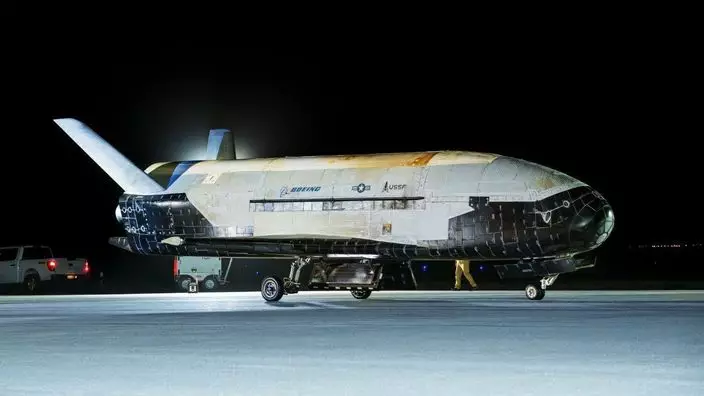
X-37B loiters and maneuvers like few spacecraft can.
The United States is stressing maneuverability for a simple reason. Traditional satellites have a fatal flaw: their orbits are easy to predict. For an ordinary satellite, where it is and when it will pass over a given place can essentially be calculated in advance once the orbital parameters are known.
Whiting has put it bluntly. When spacecraft stay in fixed, predictable orbits, it is basically like telling the enemy your own position. So the United States wants to turn satellites from fixed infrastructure into maneuverable combat units. That would allow them to approach and track adversaries, while also improving their chance of survival and avoiding life as fixed targets.
Yet that does not mean the United States has already opened an absolute advantage over China in space. China is one of the few countries capable of competing systematically with the United States across multiple core areas of military space. More than that, it is the most capable one.
Public statistics from around June this year add perspective. The United States has about 12,000 active satellites, but more than 10,000 of them come from commercial low-Earth-orbit constellations such as SpaceX's Starlink. Those cannot simply be equated with military satellites.
China has about 1,500 on-orbit payloads, a scale already clearly larger than that of Russia, Japan, India and other major spacefaring countries.
What is more striking is the payload mix. More than 500 of China's on-orbit payloads have intelligence, surveillance and reconnaissance capabilities. That can significantly improve China's ability to locate US aircraft carriers, expeditionary forces and aviation forces in the Western Pacific, and to provide targeting information for long-range precision strikes.
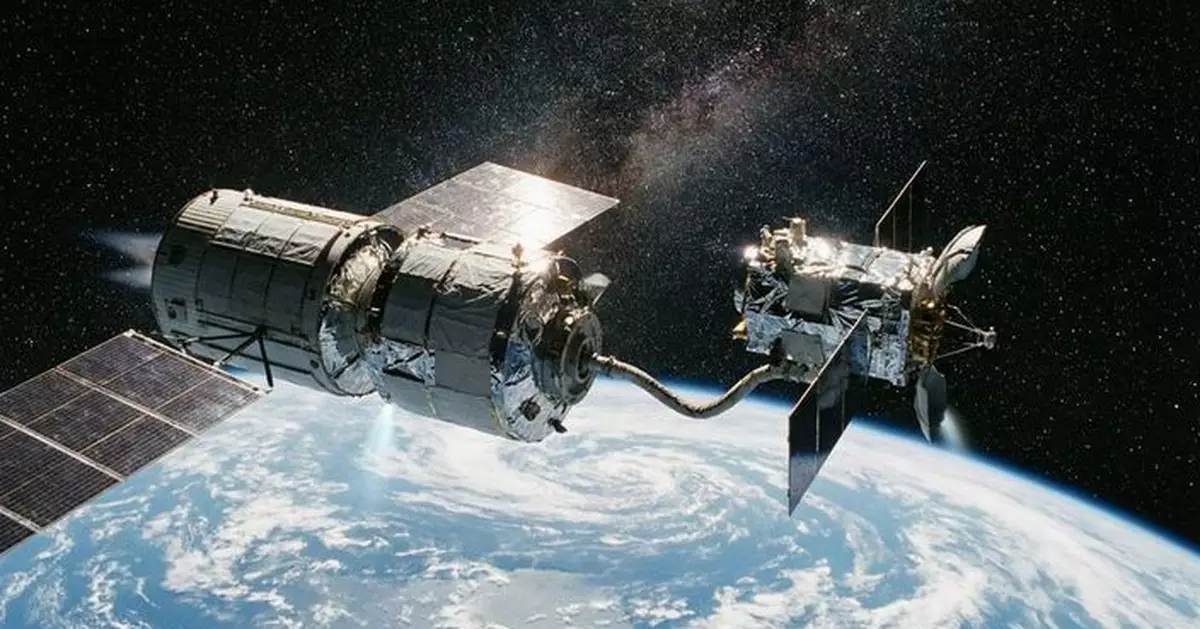
China is catching up in the very area the United States is emphasizing: orbital maneuvering. In the second half of last year, Shijian-21 and Shijian-25 carried out approach, docking, separation and re-docking operations.
The US think tank Secure World Foundation believes the two spacecraft likely conducted an on-orbit refueling test. Fuel is a major constraint on long-term satellite maneuvering. If spacecraft can be refueled in orbit, the sustained combat capability of highly maneuverable spacecraft will improve dramatically.
On space situational awareness, the US Space Force estimates that China has at least 10 satellites dedicated to on-orbit space situational awareness missions.
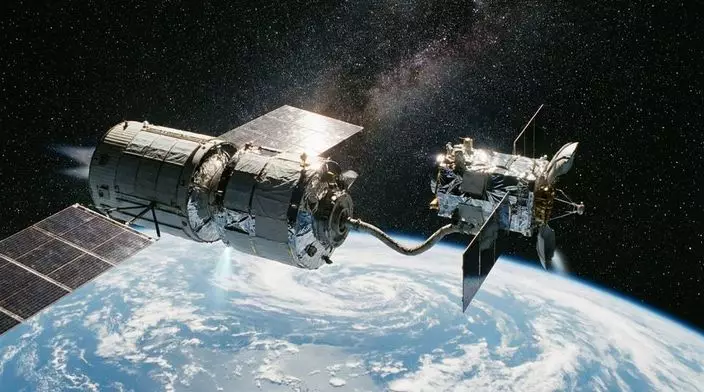
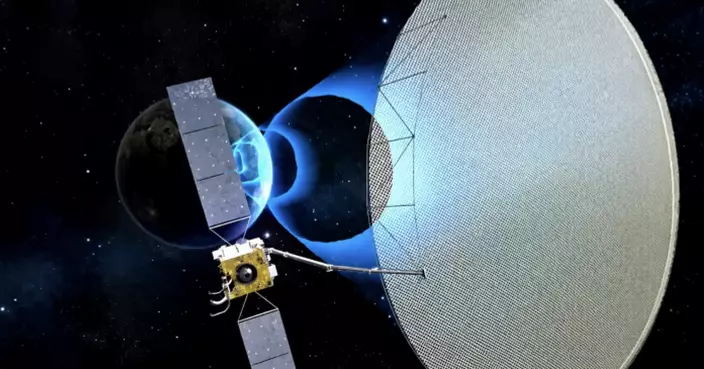
On-orbit docking and refueling keep space platforms fighting.
As countries rely more on satellites for military reconnaissance, communications, navigation, early warning and long-range strikes, these on-orbit assets are beginning to look like high-value attack targets.
The United States is already preparing for that form of warfare. It is trying to build a complete capability that can protect its own satellites and, when necessary, suppress an adversary's space systems.
Of course, the United States is also extremely dependent on satellites. China has already acquired anti-satellite operations, orbital maneuvering and space situational awareness capabilities.
The Coming War No One Will Declare
So when will humanity's first space war break out? There is no clear answer, but the direction is already coming into focus. A space war may not begin with the laser barrages and bursting satellites of movies. The more likely opening is far quieter.
One side's communications suddenly cut off. Navigation signals drift off course. An inconspicuous satellite quietly changes orbit and edges toward another.
There is no explosion, no debris, not even an alarm. For a long time the event may not even be acknowledged as an attack. Precisely the most dangerous aspect of military confrontation in space. There is no natural signal that war has begun. Ambiguity itself is a weapon. Who moved first, or when a war should be considered underway, may remain unresolved for a long time.
That is exactly why Meink's phrase "the United States now has on-orbit space control weapons" carries more weight than an ordinary arms report.
It shows Washington is no longer content to keep the space contest at the level of deterrence and rules. It is pushing real combat options directly into orbit.
Objectively speaking, China-US space competition is entering deep waters and a more intense phase.
If the US side tries to unilaterally rely on so-called "space superiority" to impose strategic suppression, it will be anything but easy in reality.
The Art of Stopping War
** 博客文章文責自負,不代表本公司立場 **