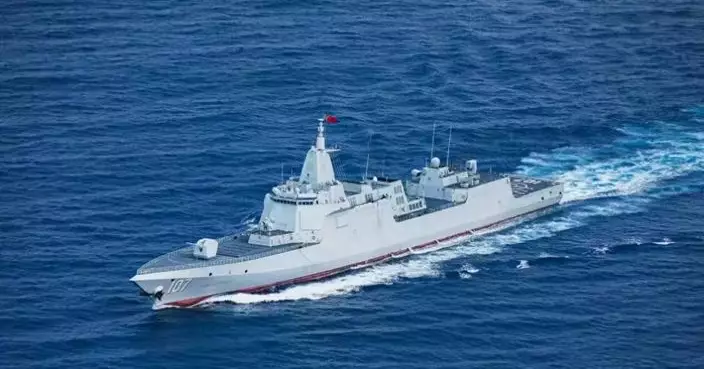
On October 14, the Chinese aircraft carrier Liaoning led its group through the Miyako Strait into the Western Pacific Ocean for far-sea training.
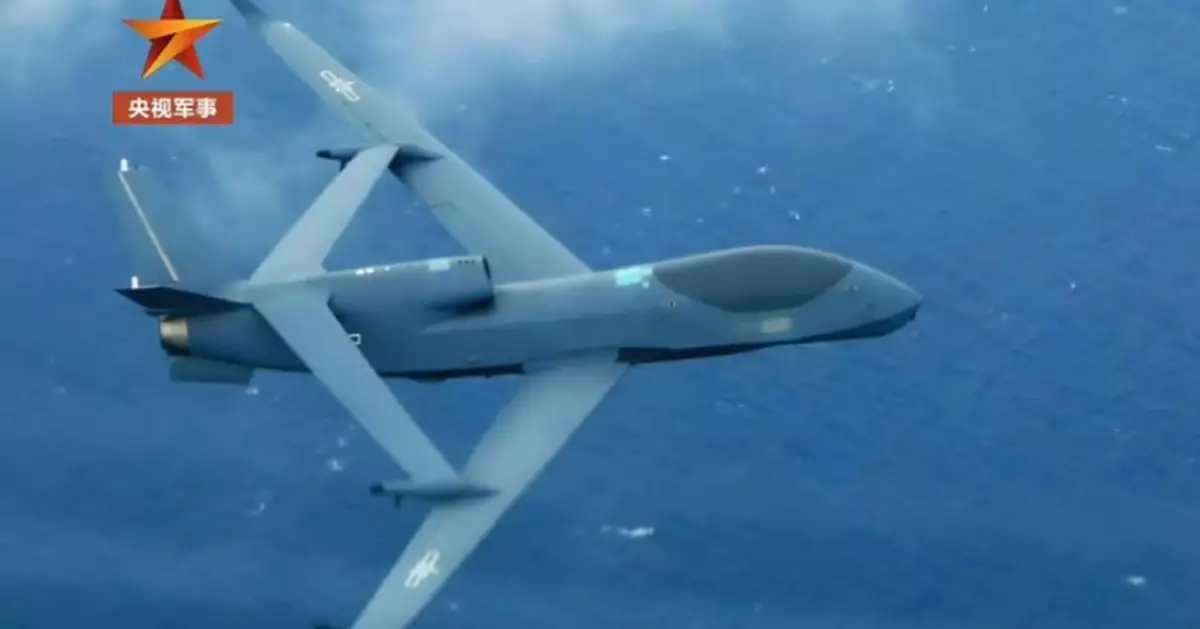
That same day, the Joint Staff Office of Japan's Ministry of Defense released its regular update on PLA ship and aircraft movements. The photos showed more than the carrier and its escorts. A large drone cruised at high altitude, its long, slender wings upturned at the tips. That was the WZ-7.
A Flyby That Says Plenty
The F-15J fighters dispatched by the Japan Air Self-Defense Force tailed it the whole way. From far below, they trained their cameras on it.

Japanese F-15Js shadowed the WZ-7, cameras aimed up.
These photos say plenty on their own. Japan has long relied on close-range visual observation to track PLA ships and aircraft moving in and out of the First Island Chain. The images are usually sharp enough to count the carrier aircraft on deck and read the hull numbers.
Not this time. What the F-15J caught was the WZ-7 as a distant silhouette high in the frame, clear in outline but far away. The camera could reach it only thanks to a telephoto lens and an upward shooting angle. The fighter itself could never climb to that altitude.
Out of Reach
The WZ-7 cruises at around 18,000 meters, can climb to roughly 20,000 meters when it needs to, and flies at more than 750 kilometers per hour, according to public information. That puts it beyond the effective operating range of conventional fighter jets.
Its joined-wing layout, with fore and aft wings staggered and connected, squeezes maximum lift and range out of a limited wingspan. That lets the drone loiter at altitude for more than ten hours. Its job is not to charge into a combat zone and open fire, but to watch from a safe height and record everything moving on the sea and in the air.
The F-15J's problem runs deeper than simply not reaching 20,000 meters. On paper, the fighter's maximum ceiling is close to 19,000 meters, but that figure assumes an empty load, light fuel and ideal weather. A real combat sortie means hauling external fuel tanks and air-to-air missiles. The added weight drags the usable ceiling down.
Up high, the air is thin. Holding speed means keeping the afterburner lit for long stretches, fuel burn multiplies, and the tanks empty fast. Japanese pilots have said in interviews that when tracking the WZ-7, they mostly operate at around 15,000 meters. To get a clear look at the target above, the rear-seat weapons systems officer has to point a camera straight up.

WZ-7 has appeared near the First Island Chain before.
In other words, even if an F-15J claws its way to its maximum altitude, the fuel and time left over are not enough for any kind of response. It has no margin to intercept and no margin to escort and drive the drone off. All it can do is snap a photo from afar and leave it at that.
Those photos are showing up in Japan's Ministry of Defense reports more and more often. They have almost become a fixed image.
Running on Empty
Tokyo knows the problem well. In recent years, the Air Self-Defense Force has repeatedly rewritten its interception rules, cutting back on emergency scrambles against aircraft of unknown nationality and saving its limited F-15J fleet for the missions that matter most.
The fleet itself is wearing out. Aging airframes, scarce spare parts and rising maintenance hours all stack up, and the number of jets ready to fly keeps shrinking.
Japan is pushing ahead with F-15J modernization, aiming to fit new active electronically scanned array radars and long-range missiles, and it is gradually bringing in the F-35. But re-equipping takes time, upgrade slots are limited, and none of it solves the near-term problem of tracking a high-altitude reconnaissance target.
The WZ-7 is no stranger to the First Island Chain. The Air Self-Defense Force has spotted it over the East China Sea and around the Miyako Strait several times before, but Japanese notices back then usually said only "presumed to be a Chinese unmanned aircraft" without confirming the model.
That changed on September 27 this year, when the Southern Theater Command organized a joint sea-and-air exercise around Scarborough Shoal. A CCTV Military report explicitly said the WZ-7 and the KJ-500 took part. It was the first time official media confirmed the drone had joined a theater-level joint exercise.
From the South China Sea to the East China Sea, this aircraft is becoming a routine sight.
A System, Not a Plane
The same thinking shows up across the rest of the fleet. The KJ-500 pulls sea and air targets into a single situational picture, then pushes it out over data links to ships, aircraft, and shore-based command posts.
The division of labor is clear. Unmanned reconnaissance aircraft see far and see long, airborne early warning aircraft gather and distribute the information, and surface vessels handle the response. This chain runs smoothly only because of years spent building communications and data links. Take one platform out of the system, and even the most advanced hardware accomplishes little on its own.

Japan photographed the WZ-7 shows the drone has entered the category of things that must be tracked and recorded.
Seen this way, the scene over the Miyako Strait was less a victory for any single piece of equipment than a shift in how reconnaissance gets done. In the past, Japan used its geographic edge and a dense network of bases along the First Island Chain corridors to watch PLA movements in and out at close range, continuously, and with a fairly clear picture.
Now the PLA has pushed its reconnaissance platforms to high altitude and distant seas. Observation no longer comes from just one direction, and the two sides' situational awareness is moving toward parity. The very fact that Japan photographed the WZ-7 shows the drone has entered the category of things that must be recorded and answered.
One detail is easy to miss. The WZ-7's airframe carries low-observable coatings, and it is smaller than a manned fighter, so its radar cross-section is modest. That compresses the distance at which Japanese radars can pick it up and sharply degrades the continuity of tracking.
What the Air Self-Defense Force sees may not be the whole picture, and what its notices release may not be the full story. That kind of incomplete information works against Tokyo when it tries to judge the intensity and rhythm of the other side's reconnaissance.
The New Normal
Looked at this way, a single low-angle photograph can only say so much. But the trend it captures is unmistakable.
The information asymmetry in the First Island Chain passages is being erased, bit by bit. Reaching 20,000 meters is just a technical detail. What really changes the game is the system behind the aircraft, one that links land-based, maritime and aerial reconnaissance and command assets into a single web.
Japan will keep taking pictures, and those pictures will keep getting published. But what they record is no longer what it was twenty years ago.
The Art of Stopping War
** 博客文章文責自負,不代表本公司立場 **
Just a week ago, observers were still asking who would become the third user of China's homegrown J-10CE fighter. A week later, that question can barely keep up with events. Bangladesh, Azerbaijan and Indonesia have all reported new progress at almost the same time.
The Buyers Line Up
In a matter of days, the overseas customer list for a single fighter jet has jumped from two countries to several. That kind of surge is rare in today's international arms market.
Start with Bangladesh. Reports say the country's price list and budget for 20 J-10CEs have gone public, and negotiations have entered the final stage.
The process has moved fast. Last year China said it would actively push air force cooperation with Bangladesh and deepen practical exchanges. The two sides then reached an intent to sell, and now a detailed quotation sits on the table. At this point, what remains is mainly a question of when the pen hits the paper. What public channels show so far is still the quotation and the progress of negotiations. No formal contract has appeared yet.
The Bangladesh track is no surprise in itself. The country has long used a considerable amount of Chinese equipment for air defense and training. Public records show that man-portable missiles like the FN-6 have even been licensed for local production.
On that foundation, buying the J-10CE is a step up along an existing channel. It is not a new system built from scratch.
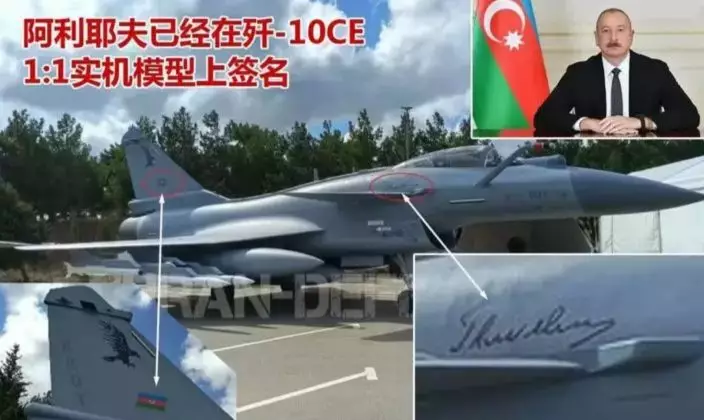
Azerbaijan displayed a full-scale J-10CE model bearing the national flag, an eagle emblem and President Aliyev's signature at the defense exhibition.
Baku's Bold Signal
Azerbaijan is the loudest thread in this story, and the one that demands the most caution. At a defense exhibition in Baku, organizers rolled out a full-scale J-10CE model dressed up in remarkable detail. The vertical tail carries Azerbaijan's national flag and eagle emblem. The fuselage wears the number "27-001," and President Aliyev's signature sits above the canard.
On top of that, reports say Baku has scrapped plans to buy follow-on batches of the JF-17 Block 3 and is preparing to pivot to the J-10CE instead.
The signaling here is hard to miss. The JF-17 Block 3 is a fourth-and-a-half-generation fighter, but it is still a light jet. Public information puts the Azerbaijani Air Force's inventory at roughly a dozen-plus MiG-29s, a handful of MiG-21s and more than ten Su-25s. That is over thirty aging aircraft waiting to be replaced.
The logic writes itself. Use the JF-17 first to bed down the Chinese-style ecosystem of logistics, munitions and data links, then jump straight to a medium-weight fourth-and-a-half-generation mainstay fighter. For a country caught in the Caucasus arms race, it is an understandable path.
But a model, a paint scheme and a signature are all exhibition-floor theater. The claim that Baku canceled its JF-17 order exists only at the level of reports. Neither development has been confirmed by a formal contract, and should not be treated the as a signed deal.
What can be said with confidence is this: Azerbaijan's interest in the J-10CE is now out in the open, and it sits just one step away from a final deal.
Jakarta Closes the Loop
Indonesia's courtship has run the longest. It has also come full circle.
From May to June 2025, the rumor was that Jakarta would buy second-hand J-10s. Observers even debated whether the jets would be early J-10As or the scarcer J-10Bs fitted with passive phased-array radar.
By October 2025, the story had escalated to funding for 42 new J-10CEs. The defense minister said at the time that the fighters would soon be flying over Jakarta.
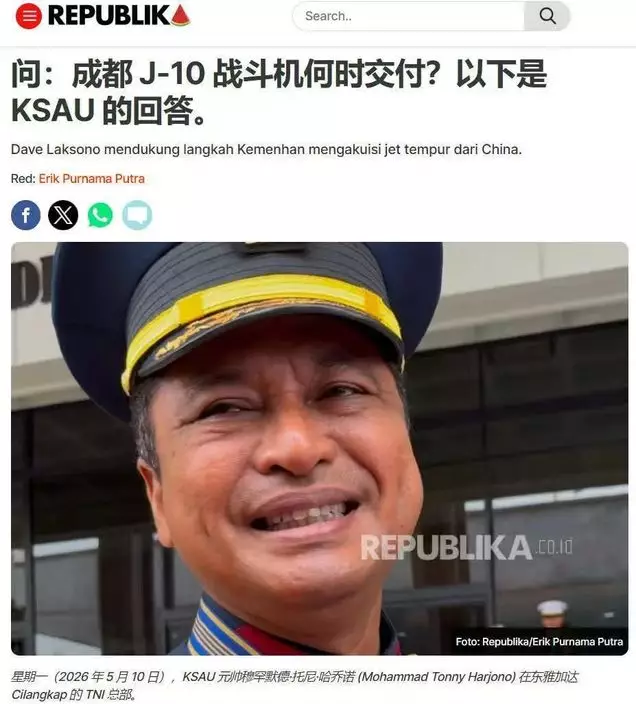
Indonesian Air Force Chief of Staff Haryono, asked about progress on the fighter purchase, urged the public to be patient. Reports say the first batch of J-10s is expected to arrive within six months.
In June 2026, media reports said the number had been adjusted and that the package would include PL-15E long-range air-to-air missiles. Deputy Defense Minister Donny Ermawan Taufanto backed the plan, saying it would strengthen modern combat capability while delivering value for the defense budget.
Then, on October 5, Indonesian Air Force Chief of Staff Hajorono told reporters in Jakarta that the public should patiently await the J-10s. He said the first batch would arrive in six months.
That was the final click. The air force's top professional officer had matched his message to procurement details that had been tightening step by step, closing the loop.
Indonesia's choice looks even more revealing against the makeup of its own fleet. The air force already flies Russian Su-27/30s, American F-16s, French Rafales and British Hawk trainers.
For a buyer accustomed to shopping around, adding a cost-effective medium fighter fills a gap in the system. It also preserves Jakarta's leverage to keep pushing on price and hedge its bets across multiple suppliers.
As for social media claims by users saying they are relatives of Indonesian pilots, some have alleged that the pilots have already gone through training in China. Without any official confirmation, those accounts remain unverified rumors.
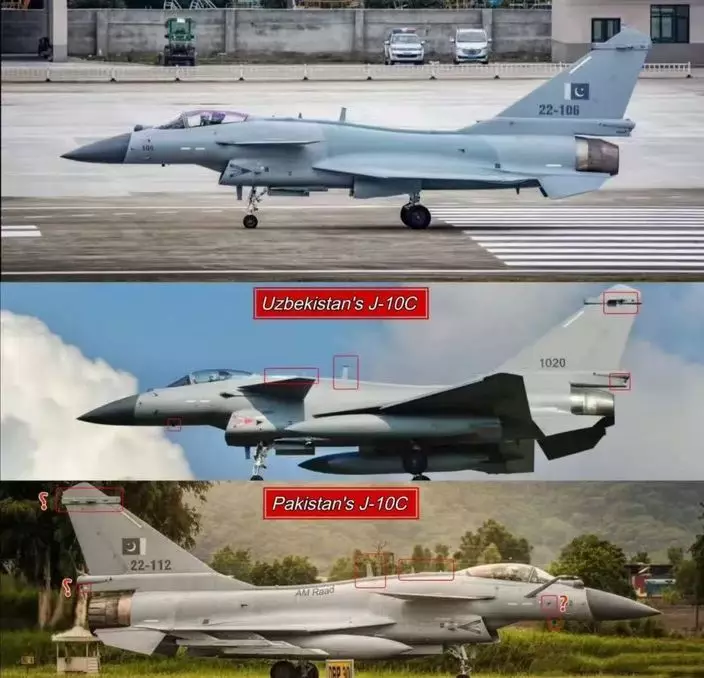
After Pakistan inducted the J-10CE, observers turned their attention to the liveries and movements of potential users such as Uzbekistan.
Combat Sells Jets
Line the threads up and a rough trajectory emerges. Pakistan was the first overseas customer, and around the May 7 air battle the jet got its first real combat test. After that, doubts over whether Chinese fighters had seen actual combat gradually gave way to open discussion.
Uzbekistan was widely seen as the second user. The cold-toned new paint scheme that surfaced in CCTV coverage was generally read as matching its Central Asian livery style.
Then came Bangladesh's quoted scheduling, Azerbaijan closing in as a system user, and finally a bet from a regional heavyweight like Indonesia.
Behind the thread sits a familiar logic of the arms trade. Combat performance is the best advertisement, system integration is the hardest bar to clear, and price is what pulls hesitant buyers to the table.
France's Rafale has dominated the market for years on the strength of the first two. Its product is combat-proven and comes with NATO data links and logistics standards built in.
Now the J-10CE packs all three advantages: combat experience, system integration and price. That gives the expansion of its customer list a solid footing.
Signatures Still Count
A name on a list is not a signed contract. There is still real distance between the two. A budget is a budget, a quote is a quote, and a signature on a model is just a gesture. Only an order committed to paper counts.
Egypt is the ready example. Cairo got a close-up look at the Chinese Air Force's full system during joint exercises. Yet it remained boxed in by U.S. military loans and France's after-sales lock-in, and turned back to order more Rafales.
The lesson is clear. The cost of switching systems remains the most realistic hurdle Chinese equipment must clear as it goes global.
So the real story is not three buyers appearing overnight. It is the J-10CE graduating from "a candidate aircraft with real combat results" to "a mature option with a delivery record." The combat results of the May 7 air battle are all holding a place for the next user on the potential list.
Whether names like Algeria, Saudi Arabia, and Egypt show up depends on whether each can clear the hurdles of U.S. loans, the NATO system, and technical standards.
The international arms trade has always followed one rule: when equipment proves itself in real combat, customers crowd the shelves. The market attention now swirling around the J-10CE is, roughly speaking, one more confirmation of that rule.