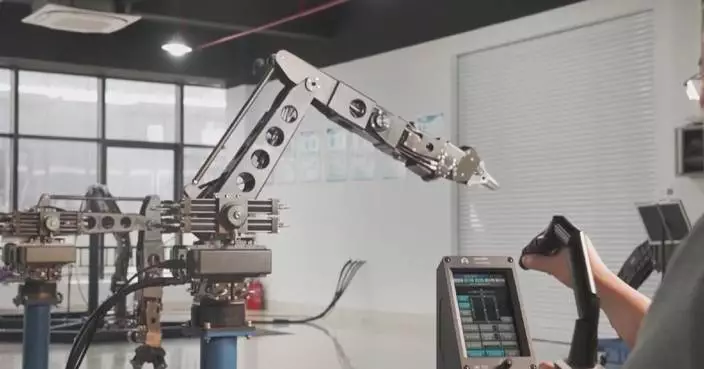
Humanoid robots emerged as the highlight of 2026 World Artificial Intelligence Conference (WAIC), which concluded on Monday in Shanghai, showcasing their ability to master complex physical tasks through rigorous training in varied, real-world environments
The WAIC brought together top scientists, tech entrepreneurs, and investors from around the world to explore AI frontiers and fuel innovation across the field. The exhibition features more than 3,000 products and technologies, with over 300 making their global debut.
At the exhibition, dexterous robotic hands drew widespread attention with a wide range of finely tuned practical skills: writing the traditional Chinese character Fu (meaning blessing), making hand-pulled noodles, making lamb skewers, and even skipping stones across water. The breadth of these abilities put the sophisticated fine motor control and embedded intelligence of modern robotic manipulation on full display.
The core enabler of these complex physical tasks lies in the robotic hands' high-precision tactile sensing system, which acts as the bridge between the robot's "brain" and its physical movements.
"The tactile feedback allows the robot's brain to understand the state of my grasp, giving it a sense of touch. This greatly assists the robot's brain in controlling the execution of movements and ensuring the perfect completion of tasks," said Li Maosong, an exhibitor representing the development team.
According to the team, these capabilities were not developed in laboratory settings alone. The dexterous hand participated in the full "energy relay event" organized by China Media Group, a lead-up program for the upcoming 2026 World Humanoid Robot Games.
Exposure to diverse, unscripted practical scenarios has driven continuous upgrades to the hand's tactile sensing and other core functions, pushing it to complete multiple high-difficulty interactive tasks for the first time.
To put the technology's real-world resilience to the test, the robotic hand was deployed across China in a series of extreme and culturally specific environments.
In Fuding City, east China's Fujian Province, it completed the entire process of tea picking, baking, and pressing tea cakes. In Bazhong, southwest China’s Sichuan Province, it participated in dragon boat racing and making zongzi. Furthermore, by the shores of Sayram Lake in northwest China's Xinjiang Uygur Autonomous Region, it achieved a world-first challenge for humanoid robots: archery while riding a horse.
These rigorous tests have continuously optimized the robot's flexible control, waterproofing, and tactile perception, accumulating a massive amount of raw data to prepare for its eventual entry into society and households.
Xue Ming, a representative of the Energy Relay robot team, noted that the program served as a comprehensive test for core humanoid robot capabilities.
"The energy relay event comprehensively tested four core capabilities: tactile perception, environmental adaptation, graded force control, and whole-body coordination. From tea picking to dragon boat racing and horseback archery, real extreme scenarios force the iteration of hardware and algorithms, jointly boosting the development of China's embodied AI industry," he said.
As a warm-up event for the upcoming 2026 World Humanoid Robot Games, "energy relay event" was designed to demonstrate robots' integrated capabilities across multiple scenarios.
The second edition of the World Humanoid Robot Games is scheduled to take place in Beijing from August 22 to 26 this year. Featuring more than 30 events, the competition will showcase the latest advancements in embodied intelligence and fine manipulation capabilities.

Humanoid robots trained across diverse real-world scenarios steal limelight at 2026 WAIC

Humanoid robots trained across diverse real-world scenarios steal limelight at 2026 WAIC