OSLO, Norway (AP) — Olympic rowing great Olaf Tufte, who competed at seven straight Summer Games and won two gold medals, has died. He was aged 50.
Norwegian media reported a statement by Tufte’s family on Tuesday that he was found unconscious at their farm and died at a hospital in Oslo. He is survived by his wife and two children.
“Tufte brought immense joy through sport to us as a nation,” Norway’s Prime Minister Jonas Gahr Støre said in a statement. “He was one of Norway’s greatest sporting heroes, a decorated Summer Olympian, one of the finest rowers we have ever had, and a great role model to many.”
The two-time champion in single sculls competed at each Summer Games from Atlanta in 1996 through the Tokyo Olympics held in 2021. He won back-to-back titles at Athens in 2004 and Beijing in 2008. In double sculls, Tufte took silver in Sydney in 2000 and bronze in 2016 at Rio de Janeiro.
“He closed out his competitive career at the Tokyo Olympics at age 45, rowing in the men’s quadruple sculls alongside teammates young enough to have been born after his own Olympic debut,” World Rowing said in a statement. “The veteran mentor, still on the water, still leading by example.”
Tufte also was in Paris for the 2024 Paralympic Games and coached Birgit Skarstein to a silver medal in single sculls.
“Alongside his rowing, Tufte ran the family farm, worked as a volunteer firefighter, and built businesses including a concrete company, the clothing brand Tufte Wear and a brewery,” World Rowing said.
The governing body cited a quote from Tufte who once said: “I’m not made for resting. I need to do other stuff otherwise I get bored.”
AP sports: https://apnews.com/sports

FILE - Norway's Olaf Tufte celebrates with his gold medal after winning the mens single sculls final during the Beijing 2008 Olympics in Beijing, Saturday, Aug. 16, 2008. (AP Photo/Chuck Burton, File)
DUBAI, United Arab Emirates (AP) — The United States on Wednesday carried out another wave of strikes on Iran, where air defenses opened fire over the capital, Tehran. Iran launched a missile attack on a Jordanian city on Israel’s doorstep, and alerts were issued in Bahrain and Saudi Arabia.
The 11th night of American airstrikes on Iran came as diplomatic efforts have shown little public sign of progress. Officials on both sides have dug in on their dispute over the Strait of Hormuz, a crucial waterway for global energy that remains largely closed because of Iranian attacks.
Iran has avoided striking Israel since hostilities resumed last month, apparently hoping to keep it from reentering the war. But the missile and drone attack on Jordan’s city of Aqaba, within sight of Israel’s Eilat, raised concerns over a further widening of the conflict after an agreement to halt hostilities collapsed.
The closure of the strait, through which a fifth of the world’s traded oil and gas passed during peacetime, has jolted the world economy with effects far beyond the Middle East. A new threat by Iran-backed Houthi rebels in Yemen to target Saudi shipping in the Red Sea puts another trade chokepoint at risk.
Benchmark Brent crude oil rose to around $94 a barrel in trading, and gasoline prices are once again climbing ahead of U.S. midterm elections this fall.
Jordan’s military said it intercepted four Iranian missiles over Aqaba, while two others fell in “uninhabited areas.” Plumes of smoke could be seen overhead in videos filmed by people in the nearby Israeli city of Eilat. Jordan said it also intercepted four Iranian drones.
Another missile alert sounded in Bahrain, and Saudi Arabia warned residents of the Persian Gulf city of Dammam to seek shelter. Saudi authorities later said the danger had passed, without elaborating.
The U.S. military said earlier Wednesday that it had completed an 11th night of strikes on Iran, with targets including aircraft hangars and drone storage sites.
Iran's state-run IRNA news agency reported explosions across several provinces. Iran's Health Ministry says U.S. strikes over the past 11 days have killed 53 people, including six women and three children, and wounded nearly 600 people.
Iran's paramilitary Revolutionary Guard insisted its retaliatory attacks would continue.
Before the latest strikes, Iranian Interior Minister Eskandar Momeni visited Pakistan, a key mediator in the conflict, seeking to revive diplomacy. But it was unclear what new arrangement might be reached to end the war, which lately has become a battle for control over the Strait of Hormuz.
Iran's Interior Ministry spokesman Ali Zeinivand said “diplomacy isn’t called off” and that messages were still being exchanged, without elaborating, according to IRNA.
At a regional summit in the Philippines, U.S. Secretary of State Marco Rubio denounced Iran’s actions in the strait.
“If we create a precedent in the Middle East where a nation state can decide that they are going to control an international waterway, charge a toll and if you don’t pay them, blow up your ships, we have created a very dangerous precedent which will repeat itself in other parts of the world, including in this region,” he said.
In response to Iran’s attacks, the U.S. re-imposed a blockade on Iranian ports.
Speaking from the Oval Office on Tuesday, U.S. President Donald Trump gave a dim view on possible talks, saying the U.S. had “no interest in meeting.”
He signaled that U.S. forces could soon target an under-construction Iranian nuclear site buried deep under a mountain.
The site, known as Pickaxe Mountain, lies on the south side of Iran’s Natanz nuclear enrichment site, which was bombed by the U.S. during the 12-day war between Iran and Israel in 2025. But Pickaxe Mountain has remained untouched as Iran continues to dig at the site.
Iran has always insisted its nuclear program is peaceful, while resuming the enrichment of uranium to near weapons-grade levels since Trump scrapped a 2015 nuclear deal during his first term. The U.S. and others believe Iran had a nuclear weapons program until 2003 and may reconstitute it in the future.
Associated Press writers Bassem Mroue in Beirut, and Michelle L. Price and Jim Gomez in Manila, Philippines, contributed to this report.
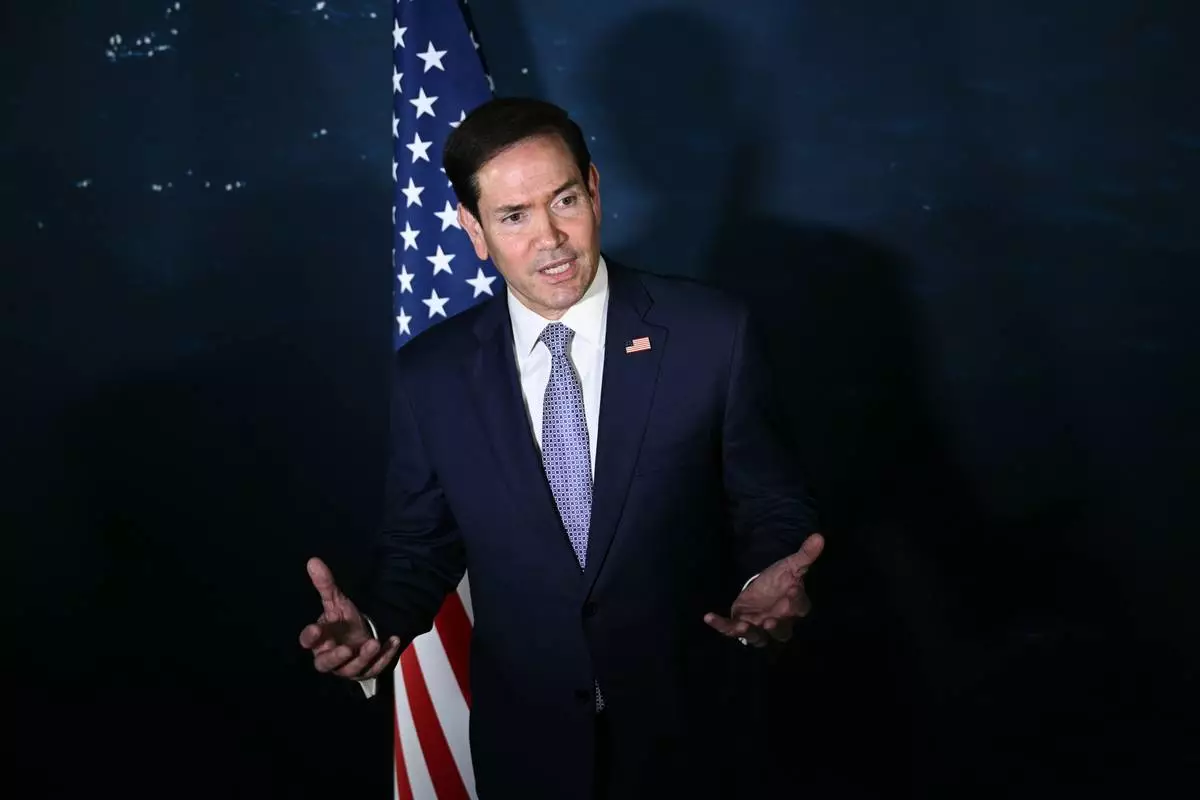
Secretary of State Marco Rubio speaks during a press conference on the sidelines of the Association of Southeast Asian Nations (ASEAN) Foreign Ministers' Meeting in Pasay, Metro Manila, Philippines Wednesday, July 22, 2026. (Brendan Smialowski/Pool Photo via AP)