NEW YORK (AP) — Before Shania Twain became Shania Twain, she was a child performing in Canadian bars, singing to miners, lumberjacks, fishermen and hunters drinking the night away.
“It was a bit more of a rugged crowd. And they were small crowds,” she says in a recent interview with The Associated Press. “I could only enter after the bar closed. That was after midnight because I was underage. And as long as the bar wasn’t still serving, then I could go in and play while everybody was finishing up their last call.”
It was “character building,” she says, painting an image of a bygone era of her life in Northern Ontario and one dramatically opposed to the glitz and glamour associated with the five-time Grammy Award winning country musician. But those days were instrumental to what became her career. “I spent a lot of years dreaming about things that would eventually come but took a little while,” she says.
As Twain describes it, her latest album, “Little Miss Twain,” out Friday, is the period of her life from her earliest performances at age 8 all the way to her late-20s, when she inked her major label record deal.
“There’s this whole gap of life that I’ve never written,” she says. “I wanted to fill in story wise, personal story wise. … It’s a phase of my life that not a lot of my fans would know about.”
A number of the songs on “Little Miss Twain” have been sitting with the singer for many years. “'Rockstars' I was writing probably 10 years ago now, and ‘Northern Town' is one that’s been around for a long time,” she says.
The title track of the record, “Little Miss Twain,” is its emotive heart — a song for her mother, who died in a car crash in 1987, alongside her stepfather, and never got to experience her success. For Shania, it was an opportunity to reflect on “my mother being my manager and my agent, my driver and my coach, even though she couldn’t sing a note,” she said. “She would drive me around to all these stages, underage in the bars, and that’s where I got my experience.”
The song was one of the last ones to make the collection, she says, but “it was this missing piece that came to me.” That's at least partially due to the inclusion of Tanya Tucker, who duets with Twain on the track.
On the chorus, Twain sings “According to my mother / I'm the next Tanya Tucker.”
Twain says of having Tucker on the record: “I don’t know if I would ever really be able to explain in words what it meant and what it would have meant to my mother.”
The song also features her son Eja D’Angelo Lange on background vocals; he appears on a few of the album's tracks. “I get to fulfill a lot of things that my mother would not have been able to share with me,” she says about working with her son. “It’s really beautiful.”
Pulling from her early years allowed Twain to focus on some of her musical loves in and outside of country music. Listen closely and you'll hear “Motown, the country and western that my grandparents used to play like Marty Robbins” she says. “There’s a lot of rock edge stuff in there. ‘Faded Blue Jeans’ is very much a bluesy rock song” — it features Queens of the Stone Age's Josh Homme.
The multi-genre moments on the album, with credits that also include Ronnie Wood, work for Twain's current voice, which now features a wizened rasp. “I don’t have the little sweet sound I had years ago, but I have a new sound that I actually like,” she says. “And I think I write songs a bit differently because of it.”
A number of years ago, Twain contracted Lyme disease, which affected her voice. In 2018, she had implants placed in her larynx. “It’s a very unusual procedure to have for a singer,” she says. “I had damaged nerves in my larynx. So the vocal cords were perfectly fine.” The surgery worked, and the continued result is a kind of gravelly tone, a vocal fry, and additional distinction to her already unmistakable voice.
When her audience listens to “Little Miss Twain” for the first time, Twain hopes they will leave the experience with “a sense and a feeling of the atmosphere that I grew up in, the environment that shaped me, the experiences that developed me as a person and as an artist,” she says.
She wants them to get to know the cover singer at the local bar, the woman who didn't have childhood success. “I hope they learn,” she takes a beat, “about the missing chapter of who I am.”

FILE - Shania Twain hosts the 61st annual Academy of Country Music Awards in Las Vegas on May 17, 2026. (AP Photo/Chris Pizzello, File)

FILE - Shania Twain performs during the Calgary Stampede in Calgary, Alberta, Canada on July 5, 2025. (Photo by Amy Harris/Invision/AP, File)
DUBAI, United Arab Emirates (AP) — U.S. President Donald Trump has warned Iran that the U.S. will destroy one bridge or power plant each time Iran shoots at a ship in the Strait of Hormuz.
The warning came after the U.S. carried out another wave of strikes on Iran, where air defenses opened fire over the capital, Tehran. Iran launched a missile attack on a Jordanian city on Israel’s doorstep, and alerts were issued in Bahrain and Saudi Arabia.
In his warning on social media, the president returned to earlier threats to target civilian infrastructure in retaliation for Iranian attacks.
“From this point forward, any time the Islamic Republic of Iran shoots at a ship in the Strait of Hormuz, whether it be by Missile, Rocket, Drone, or any other device or weapon, the United States will bomb and destroy ONE BRIDGE OR POWER PLANT,” Trump wrote on social media.
The 11th night of American airstrikes on Iran came as diplomatic efforts have shown little public sign of progress. Officials on both sides have dug in on their dispute over the Strait of Hormuz, a crucial waterway for global energy that remains largely closed because of Iranian attacks.
Iran has avoided striking Israel since hostilities resumed last month, apparently hoping to keep it from reentering the war. But the missile and drone attack on Jordan’s city of Aqaba, within sight of Israel’s Eilat, raised concerns over a further widening of the conflict after an agreement to halt hostilities collapsed.
The closure of the strait, through which a fifth of the world’s traded oil and gas passed during peacetime, has jolted the world economy with effects far beyond the Middle East. A new threat by Iran-backed Houthi rebels in Yemen to target Saudi shipping in the Red Sea puts another trade chokepoint at risk.
Benchmark Brent crude oil rose to around $94 a barrel in trading, and gasoline prices are once again climbing ahead of U.S. midterm elections this fall.
Jordan’s military said it intercepted four Iranian missiles over Aqaba, while two others fell in “uninhabited areas.” Plumes of smoke could be seen overhead in videos filmed by people in the nearby Israeli city of Eilat. Jordan said it also intercepted four Iranian drones.
Another missile alert sounded in Bahrain, and Saudi Arabia warned residents of the Persian Gulf city of Dammam to seek shelter. Saudi authorities later said the danger had passed, without elaborating.
The U.S. military said earlier Wednesday that it had completed an 11th night of strikes on Iran, with targets including aircraft hangars and drone storage sites.
Iran's state-run IRNA news agency reported explosions across several provinces. Iran's Health Ministry says U.S. strikes over the past 11 days have killed 53 people, including six women and three children, and wounded nearly 600 people.
Iran's paramilitary Revolutionary Guard insisted its retaliatory attacks would continue.
Before the latest strikes, Iranian Interior Minister Eskandar Momeni visited Pakistan, a key mediator in the conflict, seeking to revive diplomacy. But it was unclear what new arrangement might be reached to end the war, which lately has become a battle for control over the Strait of Hormuz.
Iran's Interior Ministry spokesman Ali Zeinivand said “diplomacy isn’t called off” and that messages were still being exchanged, without elaborating, according to IRNA.
At a regional summit in the Philippines, U.S. Secretary of State Marco Rubio denounced Iran’s actions in the strait.
“If we create a precedent in the Middle East where a nation state can decide that they are going to control an international waterway, charge a toll and if you don’t pay them, blow up your ships, we have created a very dangerous precedent which will repeat itself in other parts of the world, including in this region,” he said.
In response to Iran’s attacks, the U.S. re-imposed a blockade on Iranian ports.
Speaking from the Oval Office on Tuesday, U.S. President Donald Trump gave a dim view on possible talks, saying the U.S. had “no interest in meeting.”
He signaled that U.S. forces could soon target an under-construction Iranian nuclear site buried deep under a mountain.
The site, known as Pickaxe Mountain, lies on the south side of Iran’s Natanz nuclear enrichment site, which was bombed by the U.S. during the 12-day war between Iran and Israel in 2025. But Pickaxe Mountain has remained untouched as Iran continues to dig at the site.
Iran has always insisted its nuclear program is peaceful, while resuming the enrichment of uranium to near weapons-grade levels since Trump scrapped a 2015 nuclear deal during his first term. The U.S. and others believe Iran had a nuclear weapons program until 2003 and may reconstitute it in the future.
Binkley reported from Washington. Associated Press writers Bassem Mroue in Beirut, and Michelle L. Price and Jim Gomez in Manila, Philippines, contributed to this report.
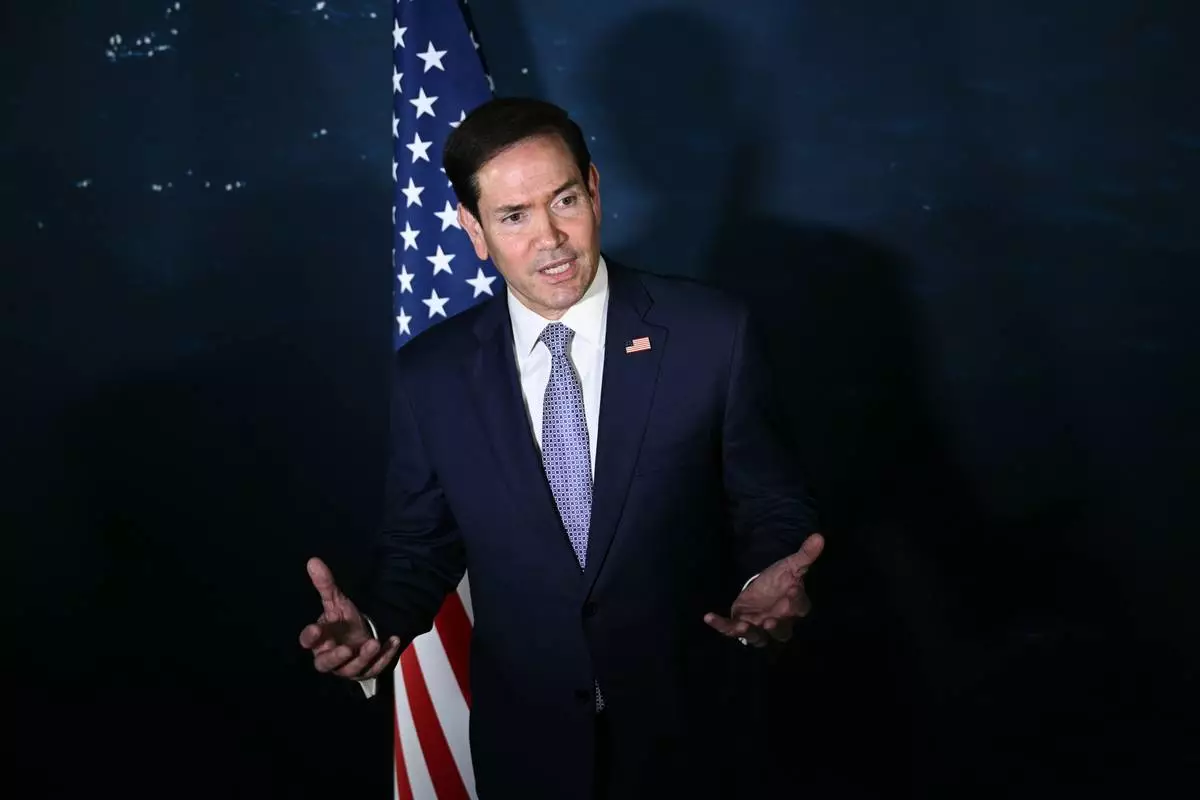
Secretary of State Marco Rubio speaks during a press conference on the sidelines of the Association of Southeast Asian Nations (ASEAN) Foreign Ministers' Meeting in Pasay, Metro Manila, Philippines Wednesday, July 22, 2026. (Brendan Smialowski/Pool Photo via AP)