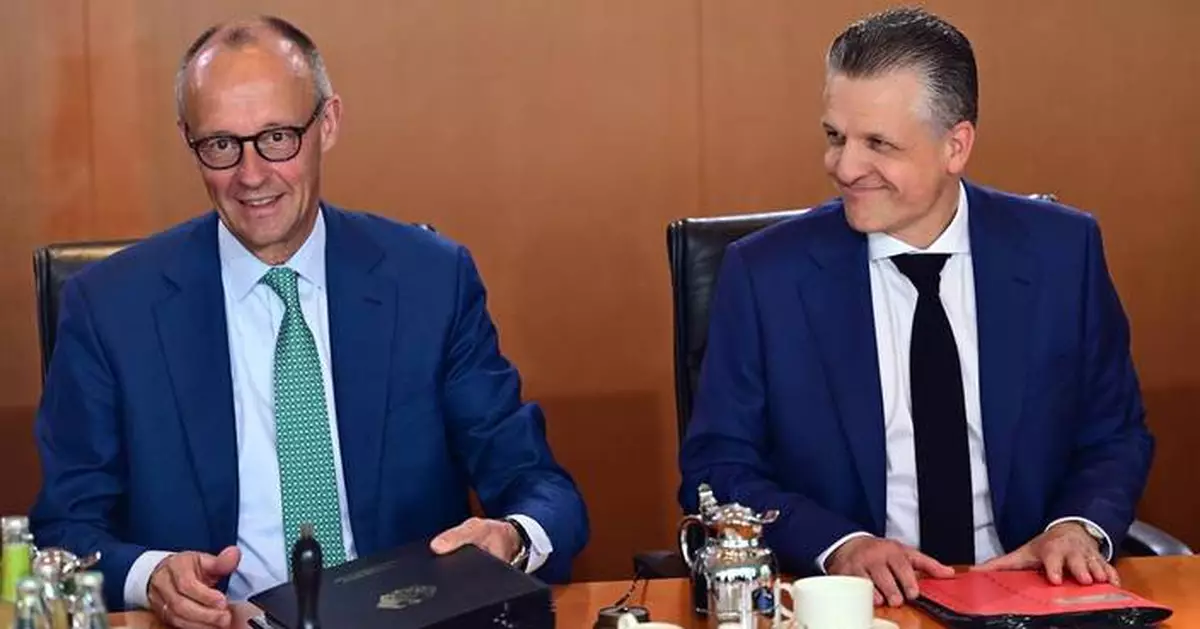
BERLIN (AP) — German Chancellor Friedrich Merz reshuffled top posts on Friday as he tries to boost the fortunes of his deeply unpopular government ahead of regional elections in which a far-right party could get its first state governor.
Merz took office less than 15 months ago with pledges to reform and turn around Germany’s economy, Europe’s biggest, after years of stagnation. But that economic turnaround has been slow to start. And the middle-of-the-road coalition of Merz’s center-right Union bloc and the center-left Social Democrats, two traditional rivals, has yet to persuade voters that it can produce results.
Click to Gallery
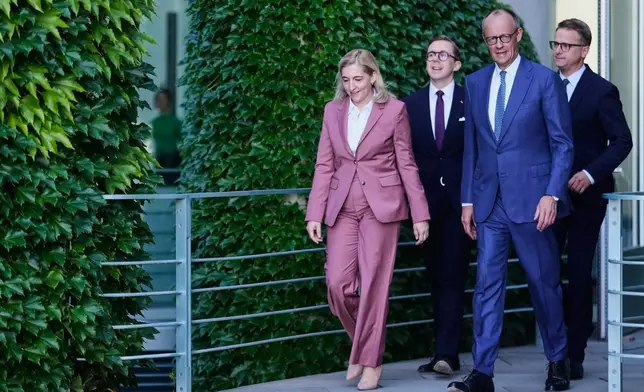
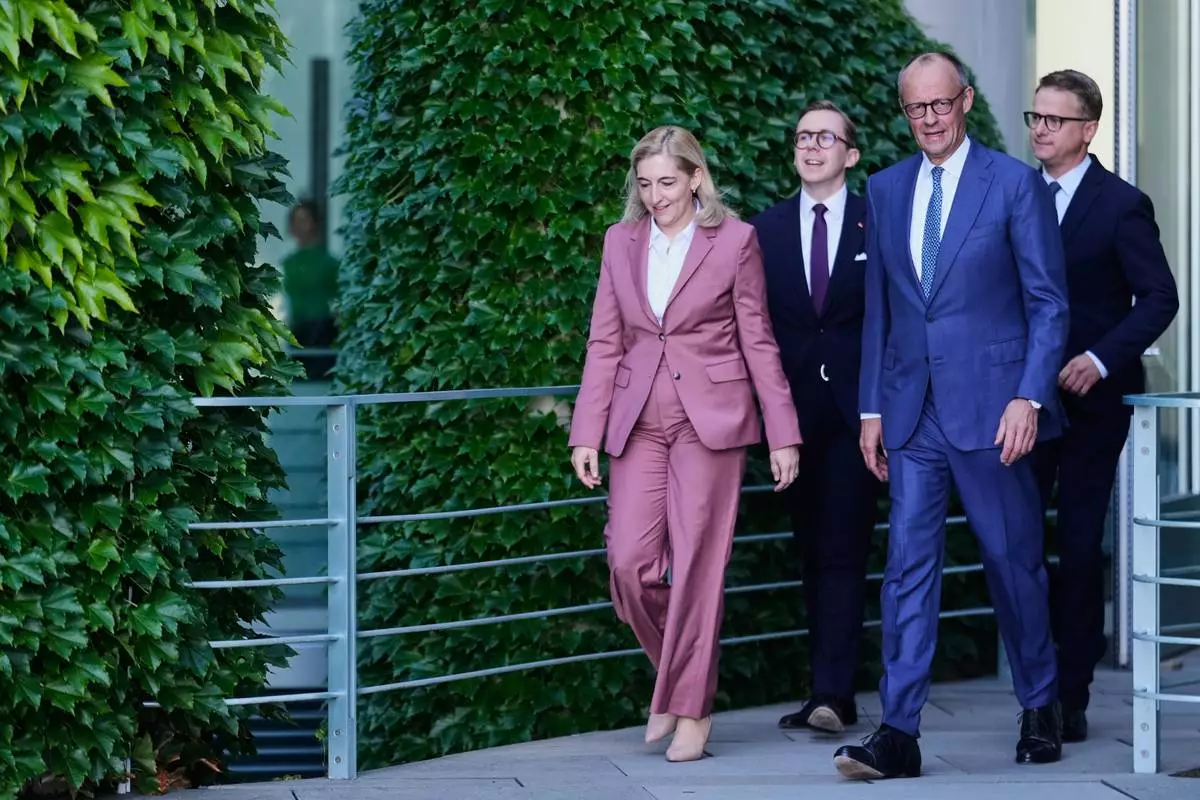
Chancellor Friedrich Merz, second from right, arrives with Nina Warken, left, Philipp Amthor, second from left, and Carsten Linnemann, right, for statement about planned personnel changes in his government at the chancellery in Berlin, Germany, Friday, July 24, 2026. (AP Photo/Markus Schreiber)
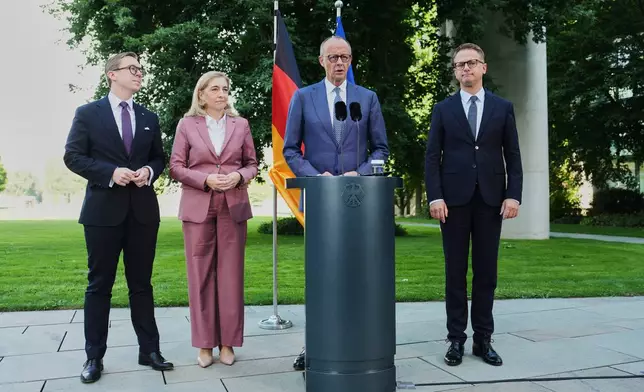
From left: Federal Chancellor Friedrich Merz arrives with Philipp Amthor, Nina Warken and Carsten Linnemann and for statement about planned personnel changes in his government at the chancellery in Berlin, Germany, Friday, July 24, 2026. (AP Photo/Markus Schreiber)
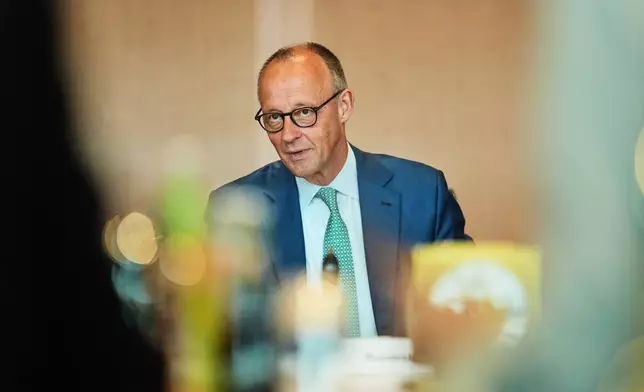
German Chancellor Friedrich Merz arrives for a cabinet meeting at the chancellery in Berlin, Germany, Wednesday, July 22, 2026. (AP Photo/Markus Schreiber)
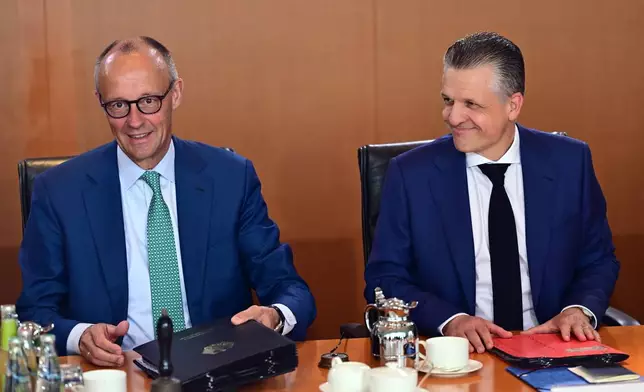
German Chancellor Friedrich Merz, left, and Thorsten Frei, Head of the Federal Chancellery and Federal Minister for Special Tasks attend the cabinet meeting at the chancellery in Berlin, Germany, Wednesday, July 22, 2026. (Sebastian Gollnow/dpa via AP)
That has resulted in Merz’s popularity sinking to rock-bottom levels, while the far-right Alternative for Germany, or AfD, has gained support on the back of widespread discontent.
Merz took the opportunity to make a series of changes after a senior ally quit as the leader of his party’s parliamentary group over personal conduct that undermined his credibility. Merz plans to put his chief of staff, Thorsten Frei, in that job.
The German leader said Health Minister Nina Warken will take Frei’s place at the chancellery, a post that is key to the smooth functioning of the government. She will be the first woman to take that job. Another close ally, Carsten Linnemann, the general secretary of Merz’s Christian Democratic Union party, will become health minister.
Merz said there will be further Cabinet changes, but didn’t offer details. He said those decisions will take “a few days yet, and perhaps more time.”
“The personnel changes follow a clear line,” he said. “We want a government that works with great vigor and pleasure and also represents the personal diversity of our society and politics. We are a reform government and want to continue showing that.”
The governing parties face three difficult regional elections in September. In the eastern region of Saxony-Anhalt on Sept. 6, AfD is hopeful of winning a majority that would give it control of a state government for the first time.
After months in which voters were turned off by squabbling in the coalition, Merz’s government recently embarked on big plans for potentially painful change — including a proposed reform of the creaking pension system that would include raising the retirement age gradually, income tax cuts for low- and middle-income earners and an effort to slash red tape.
“The government has found its rhythm, despite some criticism,” Merz declared last week. “We have delivered, and we have recognized the dimension of the tasks we face.”
Only days later, though, he faced a new distraction. Jens Spahn quit as leader of the Union’s parliamentary group — one of the most powerful positions in the coalition — after it emerged that he and his husband had used the services of a surrogate mother in the U.S. to have a baby.
Surrogacy isn’t allowed in Germany. Merz’s party opposes allowing it, a position that it reaffirmed at a convention in February, and Spahn himself had spoken out against it in the past. That prompted accusations of double standards.
Frei will now take Spahn’s job, a position he’s widely considered better suited to than coordinating the chancellery. Frei was the Union’s parliamentary chief whip under Merz when the center-right was in opposition.
Warken takes his place at the chancellery after shepherding the first of the government’s reforms, meant to curb rising costs in the German health insurance system, through parliament earlier this month.
Merz said she has showed that “she can push through reforms against resistance," praised her as a tough negotiator and said that “she is also at home with the security policy issues” that are important at the chancellery.
Linnemann, a conservative who lacks government experience, will take her place at the Health Ministry. Merz said that “we must maintain the course of reform” in health policy and that requires a “steadfast” minister.
“Friedrich Merz wants to show that this coalition is capable of acting, that he as chancellor is capable of acting,” Uwe Jun, a political science professor at the University of Trier, told Deutschlandfunk radio. “He wants to put it on a faster and stronger path now.”
Merz took no questions and didn't mention several German media reports that he also plans to replace Transport Minister Patrick Schnieder.
Merz’s coalition last year set up a huge fund to underpin an effort to upgrade worn-out transport infrastructure, but frustration remains — for example with the unreliability of the national railway.
Chancellor Friedrich Merz, second from right, arrives with Nina Warken, left, Philipp Amthor, second from left, and Carsten Linnemann, right, for statement about planned personnel changes in his government at the chancellery in Berlin, Germany, Friday, July 24, 2026. (AP Photo/Markus Schreiber)
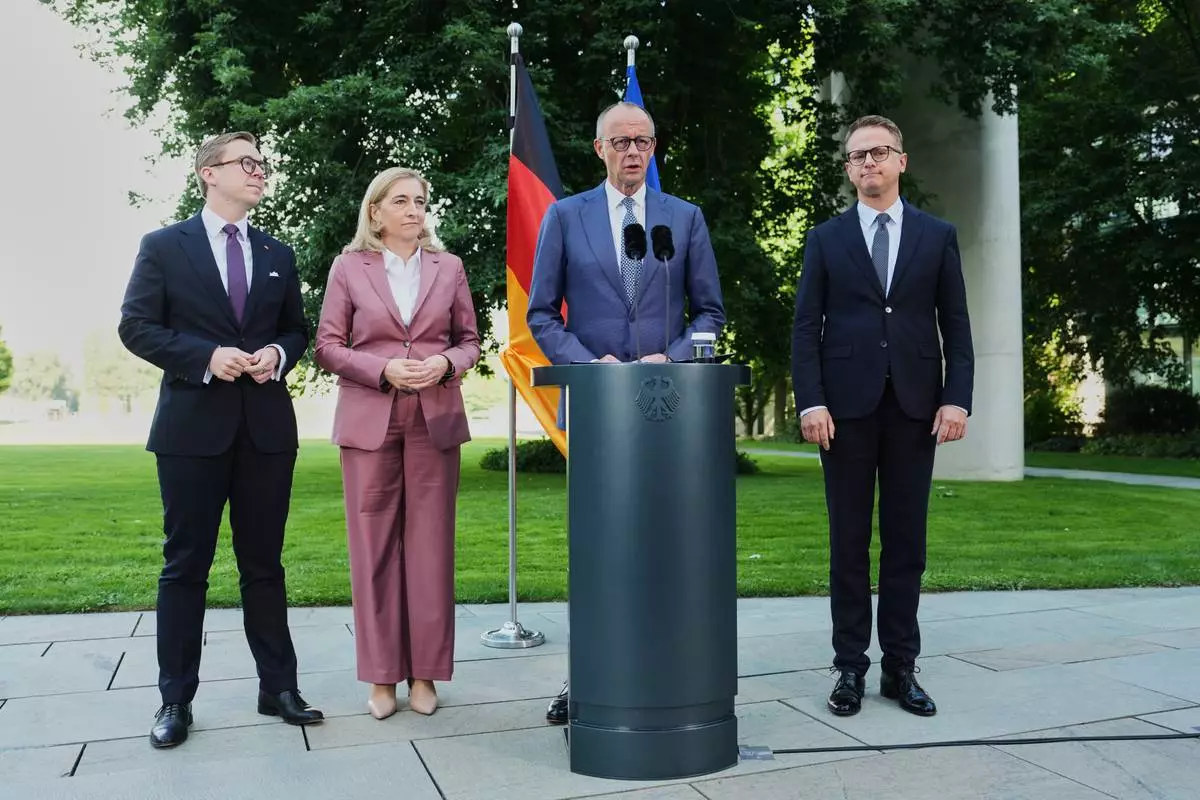
From left: Federal Chancellor Friedrich Merz arrives with Philipp Amthor, Nina Warken and Carsten Linnemann and for statement about planned personnel changes in his government at the chancellery in Berlin, Germany, Friday, July 24, 2026. (AP Photo/Markus Schreiber)
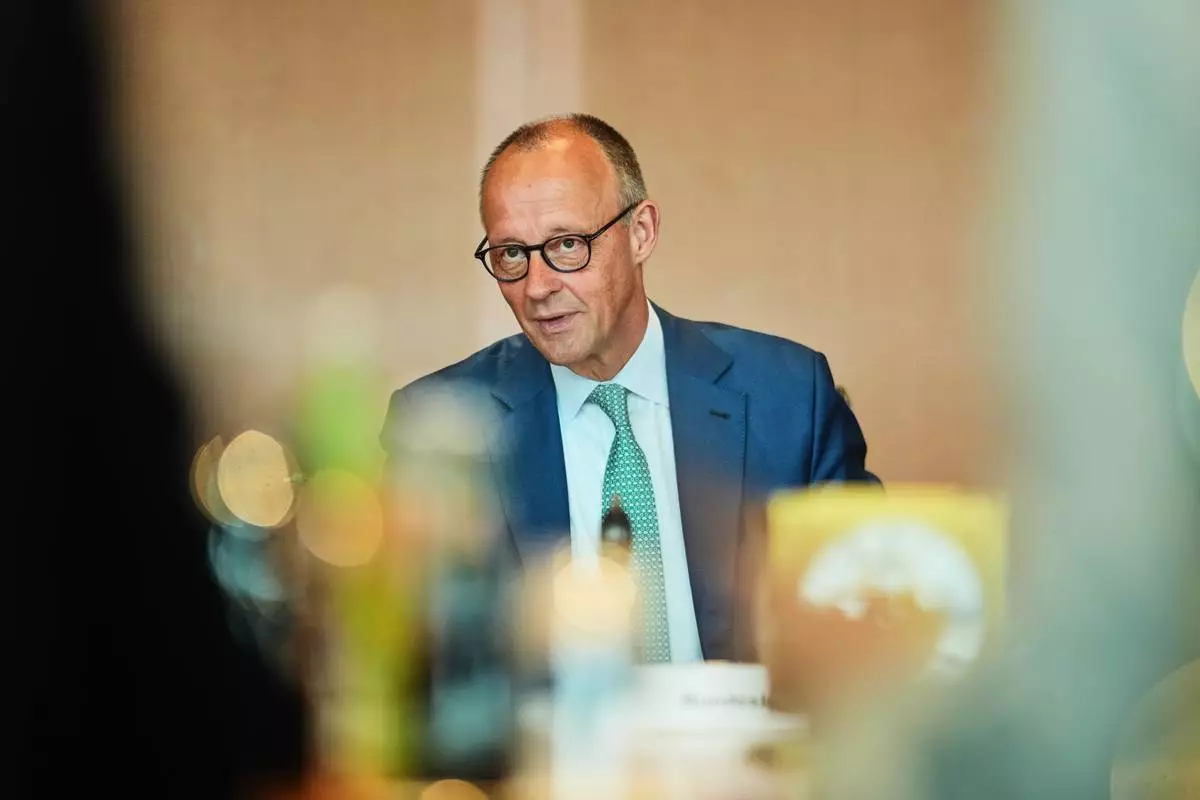
German Chancellor Friedrich Merz arrives for a cabinet meeting at the chancellery in Berlin, Germany, Wednesday, July 22, 2026. (AP Photo/Markus Schreiber)
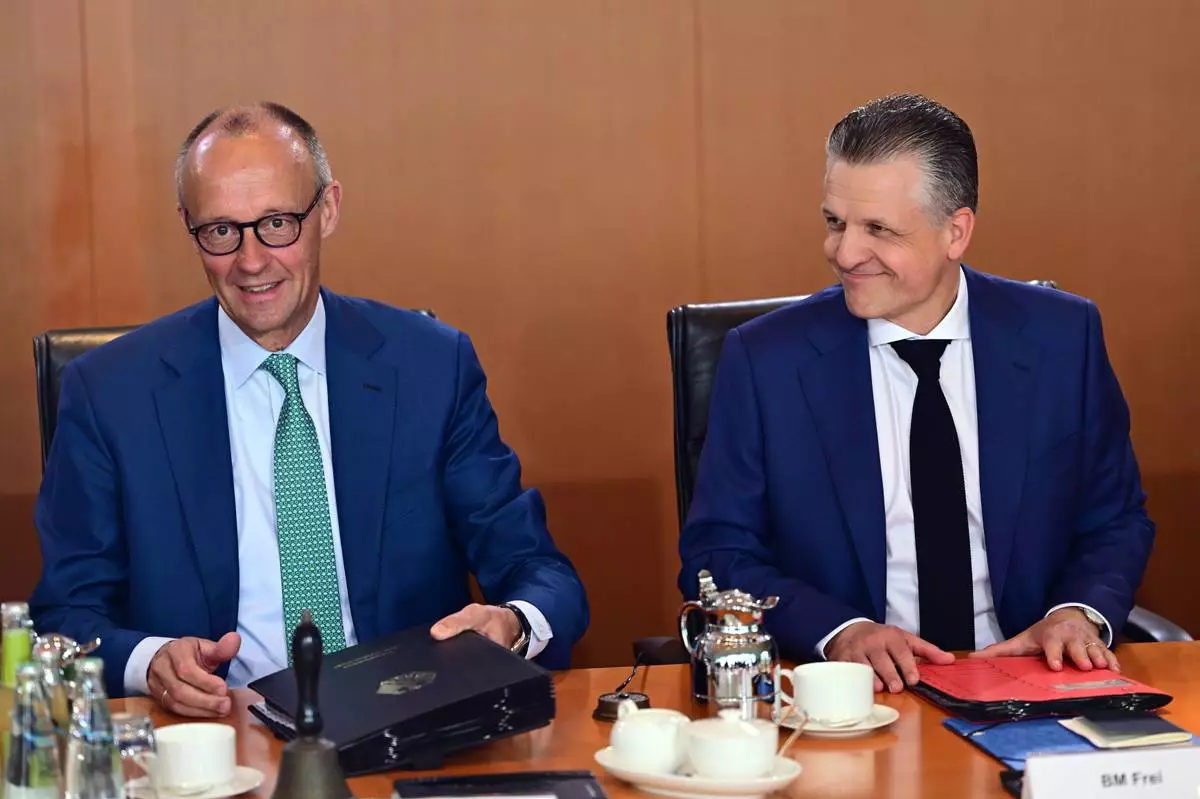
German Chancellor Friedrich Merz, left, and Thorsten Frei, Head of the Federal Chancellery and Federal Minister for Special Tasks attend the cabinet meeting at the chancellery in Berlin, Germany, Wednesday, July 22, 2026. (Sebastian Gollnow/dpa via AP)

MADISON, Wis. (AP) — The police shooting death of a homeless man who wounded an officer with a knife while resisting arrest has roiled Wisconsin's capital city, with protesters and community groups demanding accountability and an end to racial injustice.
Corey Durell Ruiz, 38, was shot and killed on a city street Wednesday, the moments of his death captured in bystander videos that were later posted online. The race of the officer who fired his gun has not been released by police. Ruiz is identified as Black or Latino in Wisconsin court records.
“It does not matter who you are or what your past is, you should not lose your life as a result of an encounter with law enforcement,” Madison Mayor Satya Rhodes-Conway said during a news conference Thursday afternoon.
Wisconsin court records show Ruiz had been in and out of jail over the past decade for mostly misdemeanor offenses including disorderly conduct, drug possession, auto theft, battery and invasion of privacy. He was also convicted of felonies including possession of cocaine and marijuana, robbery, strangulation, resisting an officer and causing bodily harm.
“He’s a human being. He had a family. He has parents who loved him who brought him home, who cared for him,” Common Council President Sabrina Madison said, adding that she’s struggling to understand what she’s seen in videos of the shooting that have circulated on social media.
“My first thought is, when the officer’s walking away, why isn’t he walking away in cuffs,” Madison said. “I’m angry, there’s no way around it.”
Ruiz's family has retained Ben Crump, an attorney who has represented the families of George Floyd, Breonna Taylor and Ahmaud Arbery, who were all shot and killed by the police. Crump said the case must be examined for excessive force.
Frustrated residents marched, and a memorial of flowers and signs grew near the place where Ruiz died. It was just blocks from where two other police killings happened in 2015 and 2012.
A group of about 20 protesters burst into Thursday's news conference, taking the microphone from police Chief John Patterson and arguing with some attendees who said they wanted to hear more about the investigation.
One protester held a sign saying “Corrupt cops deserve to die too!!!”
Moments earlier, the mayor said the shooting would be “rigorously investigated.”
Once the protesters quieted down, the chief resumed his presentation, promising his department's full cooperation with the state investigation.
None of the four officers who were detaining Ruiz wore body cameras, but passersby recorded the confrontation on video, and accused the officers of overreacting.
“I thought, ‘Holy cow — what could have warranted that?’ It looked to me like they had him under control,” David Ortiz-Whittingham, who saw officers swarming and heard the gunshots, said Thursday. “Even now, knowing about the knife, did he have to die for it? Could this have been de-escalated?”
The police chief released few details Thursday, saying a Wisconsin Division of Criminal Investigation probe of the officer-involved shooting must run its course.
Earlier Thursday, Madison's independent police monitor, Aeiramique Glass, said police had not yet shared evidence or the officer's identity with her office, which will review the case and can recommend to the district attorney that charges be filed if warranted. She said the department and city are “obstructing what the community and the public” want.
“Let me do my job,” she said.
Patterson said the police were committed to cooperating with Glass.
Patterson has urged caution in reading too much from the cellphone videos. He said none show the perspective of the officers, and additional video that hasn't been released is being reviewed.
The officer who fired his weapon is an 11-year veteran of the force, the chief said. He and the three other responding officers will be placed on administrative leave pending the investigation by the Wisconsin Division of Criminal Investigation, as required under state law.
Patterson said police were responding to calls that someone was attempting to enter parked vehicles, and the suspect fled on a bike before the officers surrounded him. One deployed a taser, but Patterson said the effort failed to control the man.
In the videos circulating online, the man can be seen standing before he's brought to his knees as the officers struggle to force him into a prone position. Then he falls quickly to the pavement after what sounds like three gunshots, and seems motionless as the officers handcuff him behind his back. Arriving officers then escort one of the officers a short distance away.
Patterson said he did not know the extent of the knife injuries sustained by the officer.
“This situation was clearly dangerous," Patterson said before adding he was saddened by the loss of life.
The shooting happened in the middle of an intersection in the popular Marquette neighborhood, less than 2 miles (3.2 kilometers) from the state Capitol. Bystander videos show numerous cars at the scene, with people watching as it unfolds.
“I saw everything! I saw everything! You did not need to kill him! ... We watched it all!” a woman yells in the video recorded by Ortiz-Whittingham. Three loud shots can be heard among the sirens, followed by screams.
Residents who dealt with two other police killings expressed frustration Thursday.
In 2015, a white police officer shot and killed Tony Robinson, who was biracial, on the same street. Large protests followed, but the district attorney filed no charges, determining the officer was justified. In 2012, Paul Heenan, a white musician, was fatally shot after he had been drinking and mistakenly entered his neighbor's house. That officer was exonerated as well.
The chief acknowledged that the neighborhood “has experienced a lot of trauma” and urged people to support one another.
“I want transparency. I want accountability,” Patterson said.
Black advocacy groups, protesters and politicians are speaking out against the shooting, which has also focused attention on the Madison Police Department’s lack of body-worn cameras. The force of around 500 is among the largest in the Midwest that doesn’t use the devices.
Madison said Thursday that she expects a police request for $400,000 to be approved, enabling the cameras to be phased in over the next three years. Others lamented that cameras weren't already being used.
The mayor said her budget, which has not yet been released, will include funding for body-worn cameras. She said the city needs to put together a policy for their use before the budget takes effect in January.
The shooting has quickly infused itself into the race to succeed Evers as governor, with voting already underway in the Aug. 11 primary.
Democratic socialist candidate Francesca Hong called the shooting “state sanctioned violence” and Democrat Milwaukee County Executive David Crowley said the reports are "painfully reminiscent of the tragedies we have witnessed in Kenosha, Minneapolis, and far too many communities.”
Republican U.S. Rep. Tom Tiffany called on his rivals to let the state investigation “establish the facts without politicians rushing to judgment.”
This story has been corrected to show it is the Wisconsin Division of Criminal Investigation, not the Department of Criminal Investigation.
Associated Press writers Ed White in Detroit and Jake Offenhartz in New York contributed to this report.
Residents react during a press conference regarding the incident where a man was shot and killed on Wednesday by Madison police, Thursday, July 23, 2026, at the police station in Madison, Wis. (AP Photo/Kayla Wolf)
Family members react as they gather at a memorial Thursday, July 23, 2026, in Madison, Wis., where a Madison police officer shot and killed Corey Durell Ruiz on Wednesday. (AP Photo/Kayla Wolf)
People mourn near a memorial at the site where a man was shot and killed on Wednesday by Madison police, Thursday, July 23, 2026, in Madison, Wis. (AP Photo/Kayla Wolf)
A protester holds a photo of Corey Durell Ruiz as they march Thursday, July 23, 2026, in Madison, Wis., after he was shot and killed by a Madison police officer on Wednesday. (AP Photo/Kayla Wolf)
Protesters march after a Madison police officer shot and killed a man Wednesday, July 22, 2026, in Madison, Wis. (AP Photo/Kayla Wolf)
Attendees gesture during a candlelight vigil where a Madison police officer shot and killed a man Wednesday, July 22, 2026, in Madison, Wis. (AP Photo/Kayla Wolf)
Mourners gather around a memorial at the site where a man was shot and killed on Wednesday by Madison police, Thursday, July 23, 2026, in Madison, Wis. (AP Photo/Scott Bauer)
Attendees light candles at a candlelight vigil where a Madison police officer shot and killed a man Wednesday, July 22, 2026, in Madison, Wis. (AP Photo/Kayla Wolf)
Attendees gesture during a candlelight vigil where a Madison police officer shot and killed a man Wednesday, July 22, 2026, in Madison, Wis. (AP Photo/Kayla Wolf)
Gubernatorial candidate Francesca Hong speaks alongside protesters near where a Madison police officer shot and killed a man Wednesday, July 22, 2026, in Madison, Wis. (AP Photo/Kayla Wolf)
Attendees gather at a candlelight vigil where a Madison police officer shot and killed a man Wednesday, July 22, 2026, in Madison, Wis. (AP Photo/Kayla Wolf)
Protesters march after a Madison police officer shot and killed a man Wednesday, July 22, 2026, in Madison, Wis. (AP Photo/Kayla Wolf)