Skip to Content Facebook Feature Image

Shanghai opens new investment office in Greece to boost business ties

China

China

China

Shanghai opens new investment office in Greece to boost business ties

2026-07-25 21:12 Last Updated At:21:37

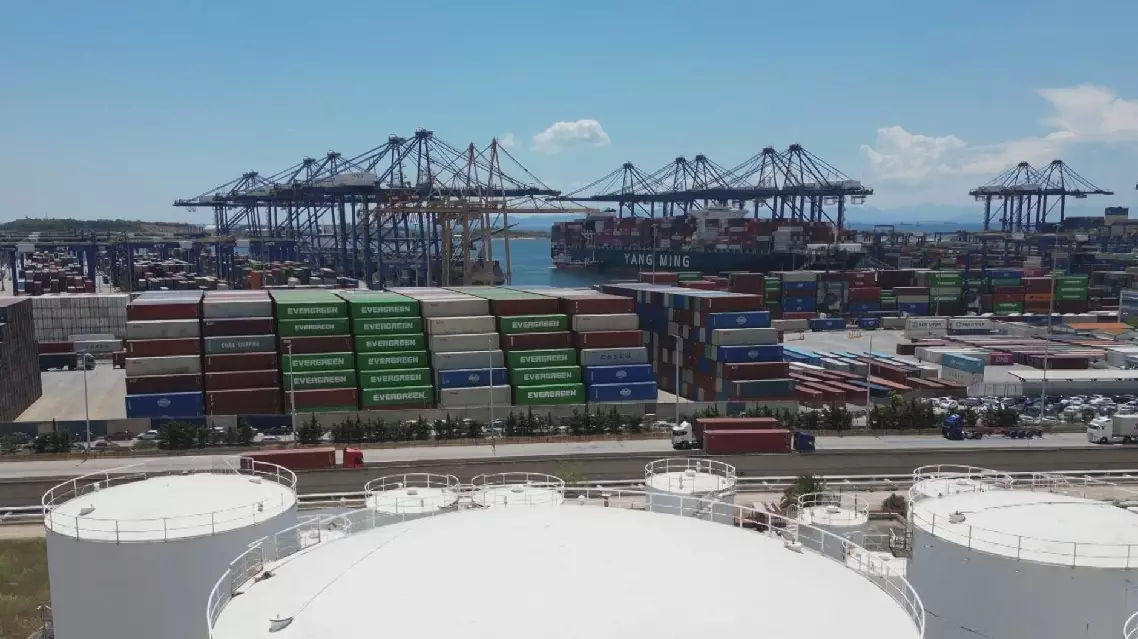
Shanghai opened a new investment office in Piraeus Port on Thursday to deepen its commercial relationship with Greece, even as instability on key shipping routes in the region disrupts global trade.

In a modest office at the heart of Athens' main port, a curtain was drawn back to unveil a new plaque, marking the official opening of "the Pudong Service Center for Overseas Investment Liaison Office in Greece" with a platform designed to link businesses and investment opportunities between Shanghai, Greece, and the wider region.

"Especially in the current international environment, marked by intense geopolitical tensions and transformations, strengthening trade and facilitating investments have become more important than ever," said Stefanos Gkikas, Greece's deputy minister of maritime affairs and insular policy.

The office will assist Greek companies looking to enter the Chinese market and support Chinese firms seeking opportunities in Greece. Its services include investment guidance, regulatory advice, and networking support.

"The establishment of the Pudong Service Center for Overseas Investment Liaison Office in Greece will create a professional cross-border service platform for business matchmaking, resource integration, information exchanges and end-to-end investment support," said Li Ying, Economic Counselor at the Chinese Embassy in Greece.

While the initiative may facilitate cross-border investment, the trade underpinning this relationship still moves largely by sea, through routes where volatility is already forcing shipping companies to reassess risk, cost and journey times.

Yemen's Houthi group said they attacked two Saudi oil tankers in the Red Sea earlier this week, extending the threat to shipping in the region. Meanwhile, traffic passing through the Strait of Hormuz remains at a virtual standstill as strikes in the waterway continue. Ship-tracking data recorded only three crossings a day over the past three days, with the insecurity pushing up oil prices and transport costs.

"If you stop the flow of energy from the Arab world to the world, this means that everything will be more expensive. Inflation will appear and a general recession will come," said George Xiradakis, President of the Association of Banking and Financial Executives of Hellenic Shipping.

The disruption is putting pressure on major trade and energy routes linking Asia, the Middle East and Europe. But the opening of the office also signals that Greece and China are continuing to strengthen business and investment ties despite the uncertainty at sea.
Shanghai opens new investment office in Greece to boost business ties


Shanghai opens new investment office in Greece to boost business ties
Jingdezhen City in east China's Jiangxi Province, reputed as the world's "porcelain capital," has succeeded in reviving its old handicraft porcelain industry sites through functional transformation, with contemporary artisans keeping the traditional porcelain-making techniques alive.

The United Nations Educational, Scientific and Cultural Organization (UNESCO) added China's Jingdezhen Handicraft Porcelain Industry Sites to the World Heritage List on Saturday at the 48th session of the World Heritage Committee held in Busan, South Korea.

The Jingdezhen Handicraft Porcelain Industry Sites are a group of heritage sites representing the handicraft porcelain industry system that developed in Jingdezhen from the 10th to the 19th century.

Porcelain of the highest quality was produced at Jingdezhen, and its blue-and-white porcelain and designs became a prized global commodity and a symbol of Chinese culture and artistry, according to UNESCO.

Since the porcelain industry is still flourishing in Jingdezhen, making full use of the ancient kiln ruins to benefit the present porcelain production has become a goal for the local authorities. They believed that by doing so, traditional skills will be kept in the ancient sites via modern-day's craftspeople.

"For porcelain-making, the handcraft itself is an intangible cultural heritage, and its production is also type of tangible outcome. In that sense, they are inherently intertwined. What we are doing is to make use of the modern factories and bring in intangible-heritage artisans. By turning the place into an industry chain, more people are willing to gather here, forming a good agglomeration effect," said Guan Qiang, president, China Museum Association.

Shangguan Zehua is one of the craftsmen who firstly settled down in the Luomaqiao kiln ruins. For him, the ruins have provided him with endless inspirations.

"This space is great, very rustic. The environment is what I want, especially here, as a ruin that used to produce blue-and-white porcelain ware from the Yuan Dynasty (1271-1368). I also make the blue-and-white porcelain, so I'm willing to come here. This workshop I chose is the best and the biggest in this area, even it is a little bit expensive," said Shangguan.

"Porcelain capital" revives ancient kiln ruins for modern porcelain industry

"Porcelain capital" revives ancient kiln ruins for modern porcelain industry

Recommended Articles