Skip to Content Facebook Feature Image

China covers carbon footprint data for all domestic passenger car models: data

China

China

China

China covers carbon footprint data for all domestic passenger car models: data

2026-07-26 14:25 Last Updated At:07-27 11:57

China has logged the carbon footprint of every passenger car model on the market, creating a unified emissions record that strengthens the auto industry's low-carbon transition and export credentials, according to official data.

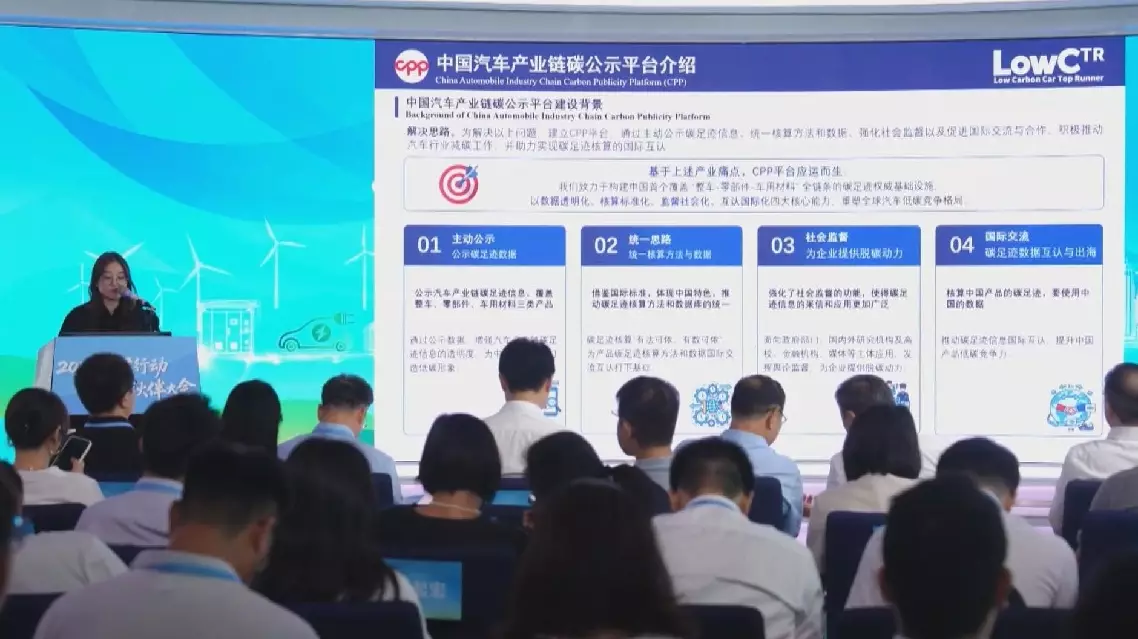
China's Automotive Industry Carbon Footprint Publicity Platform (CPP) collected carbon footprint data on over 12,100 vehicle models from 92 passenger car manufacturers nationwide as of the end of July 2026, covering all domestically produced passenger cars and mainstream imported models, according to the latest figures released by the platform.

Experts say this signals a new phase for China's automotive carbon data management system, which is becoming more comprehensive and systematic.

The country's automotive industry once faced challenges in low-carbon management, including inconsistent standards, fragmented data, and incomplete traceability.

The CPP platform has now established a carbon data chain spanning from upstream raw materials to the vehicle use stage, systematically driving carbon reduction across the entire industrial chain.

"Overseas markets are increasingly demanding detailed carbon traceability and accounting for products. The CPP platform has built a cross-border carbon footprint mutual recognition system, and has become a core platform for mutual recognition of life cycle assessment rules and standards between Chinese and foreign automotive industries," said Zhao Dongchang, a chief expert at the China Automotive Technology and Research Center Co., Ltd. (CATARC).

The platform's data resources are expected to support the establishment of standardized, benchmarkable, and assessable low-carbon development metrics, serving as a "green passport" for Chinese vehicles going global.
China covers carbon footprint data for all domestic passenger car models: data


China covers carbon footprint data for all domestic passenger car models: data

⁠⁠⁠⁠⁠⁠⁠The winners of the 2026 World Laureates Foundation Prize (WLF Prize) were announced in Shanghai on Thursday, with a total of 11 scientists honored, the most in the award's history, following the introduction of a new prize category.

Established in 2021, the WLA Prize is an international science award recognizing exceptional individuals in the fields of computer science, mathematics, life science or medicine.

Ingrid Daubechies of Duke University won the 2026 WLF Prize in Computer Science or Mathematics for her major contributions to applied harmonic analysis, wavelet theory and image compression, as well as her leadership in the international mathematics community.

Yuan Junying of the Shanghai Institute of Organic Chemistry, Wang Xiaodong and Shao Feng of the National Institute of Biological Sciences, and Vishva Dixit at Genentech Inc. won the 2026 WLF Prize in Life Science or Medicine.

They shared the award for elucidating the molecular pathways of distinct forms of programmed cell death and analyzing how those pathways govern diverse physiological functions and disease pathogenesis.

Shao was the first Chinese national to win the award.

The prize introduced a new category this year. Six young scientists under 40 won the WLF Prize for Young Scientists. 

The winners are: Raphaele Juliette Clement from the Max Planck Institute for Solid State Research for advances in solid-state systems for electrochemical energy storage and conversion; Chen Peining from Fudan University for contributions to flexible electronic materials and devices; Ding Shiqian from Tsinghua University for experimental achievements in nuclear quantum precision measurement; Wu Jiajun from Stanford University for work on embodied AI and world models; Xie Weidi from Shanghai Jiao Tong University for AI applications in rare disease diagnosis and treatment; and Zhuang Ziquan from Johns Hopkins University for fundamental contributions to K-stability and birational geometry.

While spotlighting frontier breakthroughs in basic science, this year's prize selection also actively focused on the development of disruptive technologies and the application of innovative achievements.

"The WLF Prize also encourages important contributions to theories. Many applications we see today may stem from mathematics developed decades or even a century ago. So there should be greater investments in this area, which will provide more important safeguards for the development of our large models in industrial applications, safety, and other aspects," said Hua Xiansheng, executive dean of the Institute of Engineering Intelligence, Tongji University.

The 2026 prize was organized by the WLF, with exclusive prize funding from Hongshan and support from the Shanghai Lingang Science and Technology Innovation and Development Foundation.

The formal award presentation will take place during the World Laureates Forum scheduled for Oct 30 to Nov 1 in Shanghai.

China unveils winners of prize for global scientists

China unveils winners of prize for global scientists

Recommended Articles