China's S4000 Stratosphere Airborne Wind Energy System, the world's first of its kind designed to operate at altitudes of up to 4,000 meters, successfully completed a test flight in Yueyang City, central China's Hunan Province, on Friday, marking its first flight test in an urban setting.
Measuring 67 meters long, 40 meters wide and 23 meters high, the S4000 system uses a helium-filled airborne platform to carry lightweight generators to high altitudes, where stronger winds are harnessed to produce electricity. The electricity is then transmitted to the ground through a tether cable. The system operates at an output voltage of 10 to 35 kilovolts and is designed to have a service life of 20 years.
The trial tested the system's attitude control under complex airflow conditions and its power-generation performance in complex electromagnetic environments.
"Our main purpose is to test the system's performance in grid connection. We want to see if its power generation and attitude stability will be disrupted with the generator operating. The urban test flight is to see whether the system can fly safely around residents. Cities are the core power-consuming areas, so ultimately, we must deploy this power system in more populated areas," said Dun Tianrui, chief architect of the system.
"This urban test flight mainly verifies the reliability of the entire airborne system, as well as the feasibility and completeness of project delivery under real-world operating conditions in areas surrounding cities," said Cai Rong, a researcher at the Aerospace Information Research Institute of the Chinese Academy of Sciences.
High-altitude wind energy, which has not yet been developed at scale, holds huge potential due to its advantages, including high wind speeds, stable wind direction, and high wind energy density.
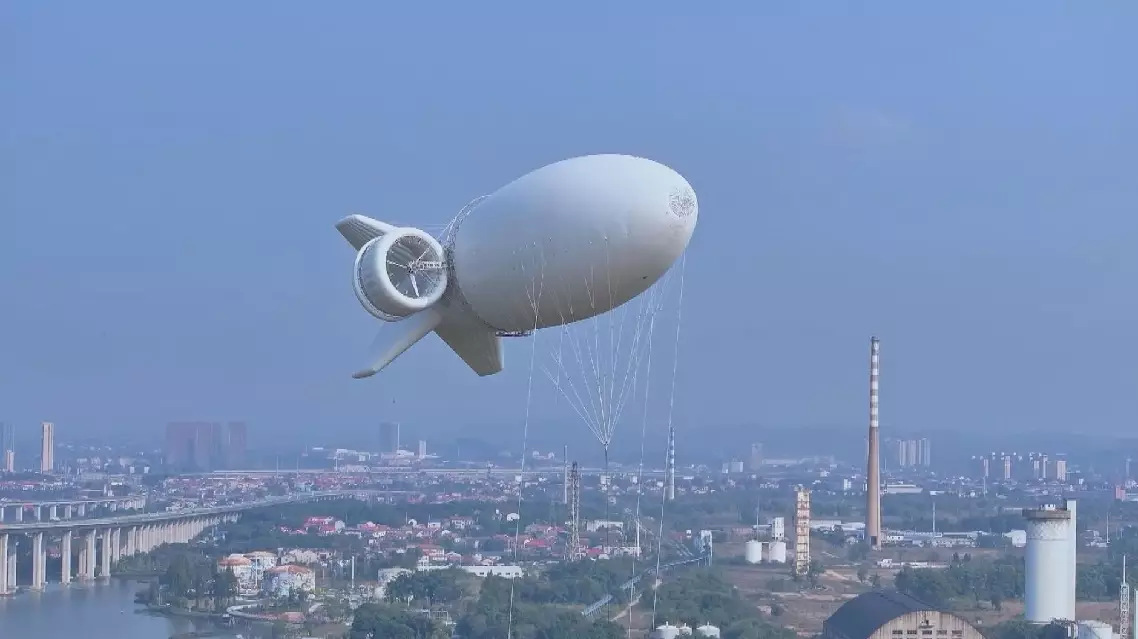
China's 4,000-meter-class airborne wind power system completes first urban test flight