VIENNA--(BUSINESS WIRE)--Jul 29, 2026--
Wave Trockensysteme GmbH will control its industrial freeze dryers with Brain, an AI-based control system developed by Austrian company Interkey. Instead of programming PLC code in an engineering suite, a technician describes the machine in natural language – heaters, motors, sensors, setpoints, safety limits. An AI agent running directly inside the control cabinet generates the control logic, builds the operator interface, configures alarms and guides commissioning. On WAVE's first production unit, commissioning time dropped from twelve weeks to two.
This press release features multimedia. View the full release here: https://www.businesswire.com/news/home/20260728441167/en/
Control engineering as the bottleneck in custom machine building
WAVE builds freeze-drying systems in small series and customer-specific configurations. Mechanical assembly takes weeks – PLC programming, HMI design and commissioning previously took months, and every design change triggered the effort again. Following the results of the first production unit, WAVE plans to deploy Brain across a series of 100 freeze dryers.
“Our machines are custom systems built in small series – control engineering used to be the slowest and most expensive part of every project. With Brain, our technician describes the machine, and the control system takes shape in a dialogue. Commissioning in two weeks instead of twelve fundamentally changes our costing,” said Michael Marcovici, Managing Director of Wave Trockensysteme GmbH.
No cloud, and clear limits for the AI
Brain operates fully offline: control, AI agent and data recording run without any cloud connection, and process data never leaves the plant. What the AI agent is allowed to do on a machine is governed by a five-level permission model, from read-only access to safety-critical actions; every action is documented in an immutable audit log. Emergency stop and hardware watchdogs remain independent of the AI.
“The bottleneck in machine building is no longer mechanics – it is control software. Brain turns months of engineering into a conversation with the machine,” said Interkey founder Moritz Marcovici
Availability
Brain ships as complete hardware – controller, I/O, operator interface and AI agent in a single control cabinet – and will be available from the third quarter of 2026. Information, product videos and reservations at www.interkey.com. Interkey was founded by Moritz Marcovici; Brain was developed to series maturity in close cooperation with WAVE as pilot user. To scale series production and distribution, Interkey is open to discussions with strategic partners and investors.
About WAVE
Wave Trockensysteme GmbH, headquartered in Vienna, Austria, develops and manufactures freeze-drying systems ranging from the compact 25 kg class to continuously operating industrial plants. WAVE systems are in use with food, pet food and pharmaceutical producers across Europe, North America, the Middle East and Asia. www.wave.cc

Brain by Interkey: a complete, AI-programmed industrial control system with integrated power management. An AI agent inside the control cabinet turns a plain-language machine description into PLC logic, operator HMI and guided commissioning — cutting control engineering for large machines, facilities and prototypes from months to weeks. (Photo: Interkey)

The IC570MAX industrial freeze dryer by WAVE. Customers choose their control system: the proven Siemens S7 PLC or Brain, Interkey's AI-based control system that turns a plain-language machine description into control logic. (Photo: Wave Trockensysteme)
NAHARIYA, Israel (AP) — The Israeli military was about to launch a nighttime strike on a group of men in southern Syria when the soldiers noticed the long curls dangling from the temples of their targets. The troops held their fire.
These were not Syrian militants attempting to breach Israel's border, but religious Jews who had slipped into Syria and were on their way back.
The episode, first reported last week by Israel's public broadcaster and confirmed to The Associated Press by the Israeli military, has helped raise the profile of a fringe group of Israeli settlers that has staged numerous incursions into Syria, where they hope to establish Jewish settlements.
Israel's military has occupied the area in southern Syria for more than a year, but forays by civilian settler groups into the region have only recently became a regular occurrence.
The groups, with members numbering in the dozens, have attempted to cross from Israel to Syria every few days in recent weeks. The military is tasked with reining them in and, while most Israelis regard them as fringe, the wider settlement movement in Israel has strong backers in the country's far-right government.
The most prominent of the groups behind the incursions in Syria is known as “Pioneers of Bashan.”
Formed early last year, the Pioneers of Bashan are a group of right-wing Israeli activists aiming to establish Jewish settlements inside Syria. They are named after the biblical region of Bashan, which includes part of modern-day Syria and neighboring Jordan.
They have their sights set on an area of southwestern Syria that includes the provinces of Quneitra, Daraa and Sweida.
Part of this area, including the summit of Mount Hermon, is a “buffer zone” Israel declared in December 2024, soon after the ouster of former Syrian President Bashar al-Assad in an insurgent offensive.
The region was known in Scripture for its fertile land and came to be associated with strength and divine providence. In the Bible, the Israelites under Moses conquered the Bashan from the mythical King Og and it was then handed to some of the Israelite tribes.
Members of the group claim a historical right to these lands and argue that their presence there will help Israel defend the Golan Heights, which Israel captured from Syria during the 1967 Mideast war and later annexed — a move not recognized by most of the international community.
Some claim that Israeli settlement of the areas would protect members of the Druze religious minority after violence erupted last year between Druze groups and Sunni Bedouin tribes and Syrian government security forces. Hundreds of civilians — mostly Druze — were killed in sectarian revenge attacks.
Amos Azaria, a Pioneers of Bashan leader, said the group aims to establish a “humanitarian corridor” from Israel to the Druze enclave of Sweida by depopulating adjacent Sunni-majority areas.
“The entire Daraa district ... must be cleared of the enemies seeking our destruction and instead be filled with Jewish settlement,” said Azaria, a computer science professor at Ariel University in the Israeli-occupied West Bank.
The group seeks first to establish a Jewish outpost in southern Syria next to the Israeli-controlled Golan Heights. Outposts, which settlers often call “young settlements,” describe rustic footholds in territory they desire.
Settlers normally establish outposts in the hope that one day Israel's government will legalize them. That's how many Jewish settlements in the Israeli-occupied West Bank — which rights groups say are major drivers of settler violence and displacement of Palestinians — got their start.
So far their incursions into Syria have been brief. The military has removed the activists before they have been able to build anything.
Videos on the group's X account from July 5 show a group of religious teens seated on the ground with their arms linked together, as soldiers try to pry them apart.
A second video shows soldiers shoving several of the activists and zip tying their hands behind their backs.
A video posted by the group in April shows several dozen activists waving Israeli flags and chanting on the roof of a house said to be on the outskirts of the Syrian village of Hader, in Quneitra, as Israeli soldiers look on.
Israel's military says it takes a firm hand with the border-crossers. It has repeatedly condemned the group for diverting troops' attention from military operations and compromising their security. It says it detains civilians caught crossing the border and hands them over to police, saying it “expects law enforcement authorities to bring those involved to justice.”
Israel’s Channel 12 reported last week that no indictments have been filed so far.
The border-crossers say they have cozy relationships with members of Prime Minister Benjamin Netanyahu’s government. Several government ministers have expressed support for their cause, and the group’s social media platforms document meetings it has held with at least two cabinet ministers, Amihai Eliyahu and Shlomo Karhi.
“We have support from friends in the government and many members of the Knesset,” Azaria said.
Syrian officials have not commented publicly on the attempts by Israeli settler groups to enter Syria.
The Syrian government has condemned Israel’s occupation of southern Syria and frequently calls for Israeli forces to withdraw and for the international community to intervene. Israeli troops have carried out incursions and raids in areas of Syria outside the buffer zone, sometimes clashing with local residents, who have increasingly attempted to block roads to keep them out.
Since Oct. 7, 2023, a similar movement has stages occasional marches along the Gaza border calling to reestablish settlements in the Gaza Strip. Israel removed its 21 settlements as part of its 2005 withdrawal from Gaza.
The Lebanese government has also paid little attention to a fringe Israeli settler group — “Uri Tzafon,” or “Awaken, O North” — that has staged incursions into southern Lebanon. Like Syrian officials, the Lebanese government has focused on calling for withdrawal of the Israeli army from southern Lebanon.
Still, some have warned against entirely discounting the settler groups.
Lebanese Deputy Prime Minister Tarek Mitri wrote on X of the attempts by the Uri Tzafon group to enter the country, “It is true that they are a small and fringe group and they withdrew under orders from the Israeli army.”
But he pointed out that the movement to settle the West Bank began with an embattled band of right-wing religious activists, known as Gush Emunim, “which in its early days was a small group that faced some obstacles and difficulties.”
——
Sewell reported from Beirut. Frankel reported from Jerusalem. AP videojournalist Alon Bernstein contributed to this report from the Golan Heights.

A metal board in the shape of a gunman sits on an old bunker at an observation point on Mount Bental in the Israeli-occupied Golan Heights, Tuesday, July 21, 2026. (AP Photo/Ariel Schalit)
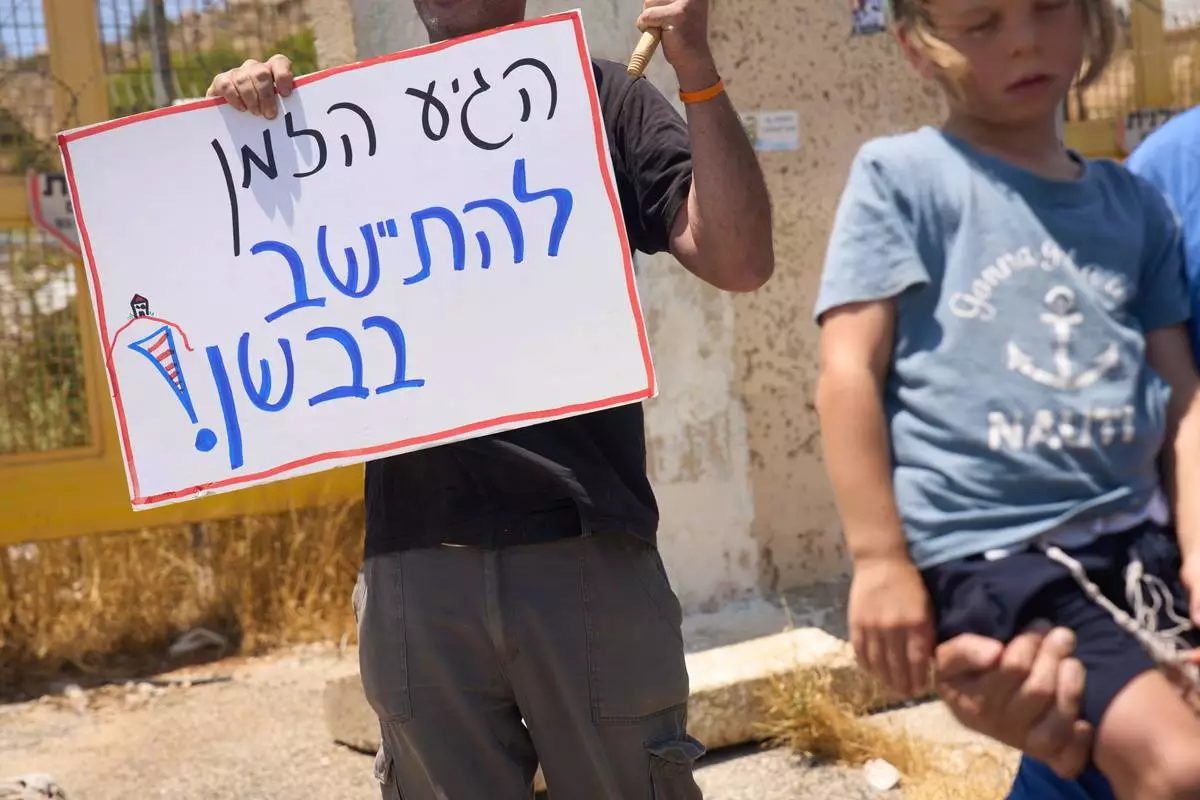
A right-wing Israeli activist holds a sign which reads "Its about time to settle in the Bashan", in the Israeli-occupied Golan Heights, Tuesday, July 21, 2026. (AP Photo/Ariel Schalit)
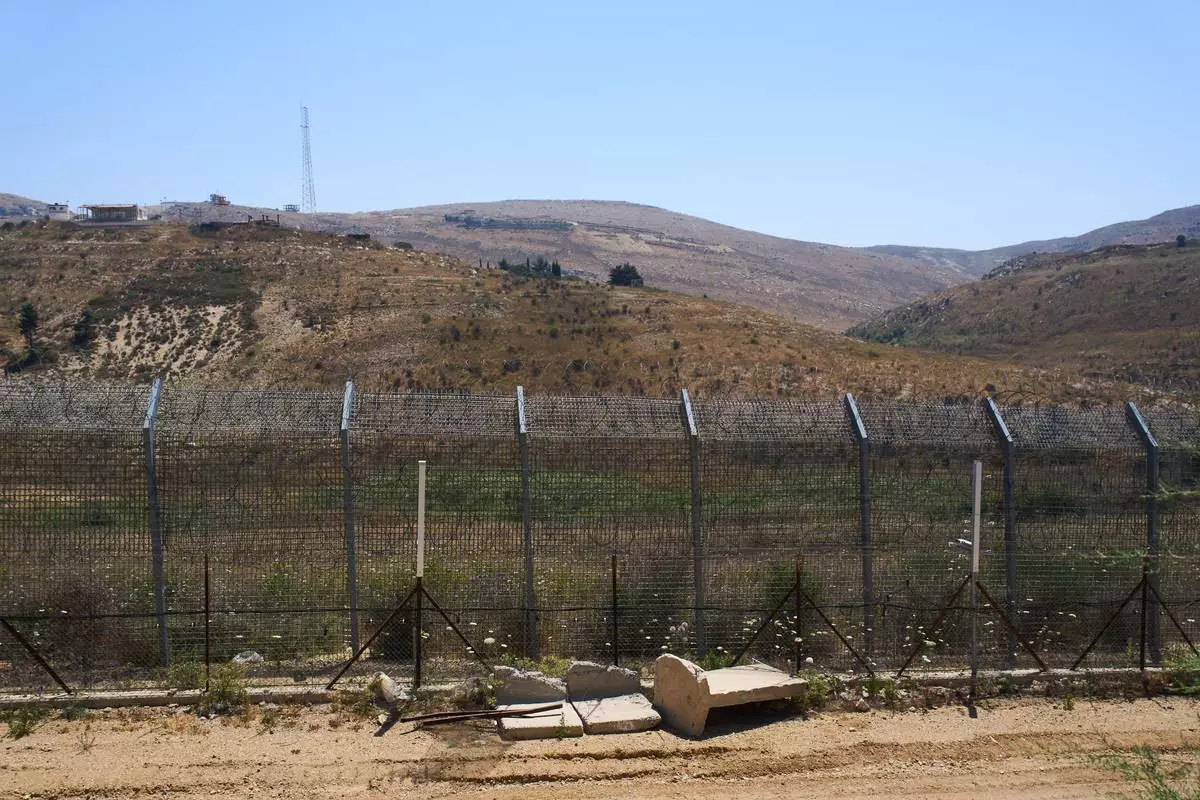
The border between Syria and the Israeli-controlled Golan Heights town of Majdal Shams is seen Tuesday, July 21, 2026. (AP Photo/Ariel Schalit)