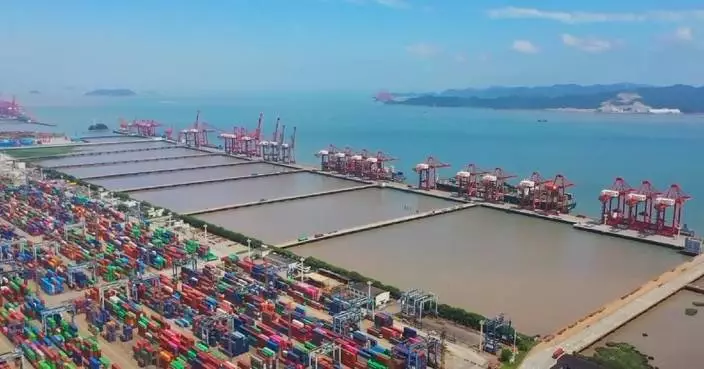
China's trade promotion system issued more than 4.26 million trade-related certificates in the first half of 2026, a 9.64-percent increase from a year earlier, highlighting the continued expansion of the country's foreign trade network.
In a press briefing on Friday, the China Council for the Promotion of International Trade (CCPIT) released the latest statistics showing that the Chinese trade promotion system issued 4.2637 million certificates, including certificates of origin, Admission Temporaire/Temporary Admission (ATA) carnets, and commercial certificates, from January to June.
The value of non-preferential certificates of origin reached 182.09 billion U.S. dollars during the period, up 8.4 percent year on year, while the value of preferential certificates of origin stood at 611.39 billion U.S. dollars, surging 28.3 percent from a year earlier, CCPIT’s data shows.
The value of RCEP certificates of origin reached 51.84 billion U.S. dollars in the first half of this year, a 17.78-percent year-on-year increase.
"This fully shows that China’s foreign trade support policies are taking effect, the dividends of regional free trade agreements are continuing to be released, and the majority of foreign trade enterprises are actively expanding into emerging markets, continuously broadening China's foreign trade 'circle of friends,'" said Yang Fan, CCPIT’s spokeswoman, at the briefing.
The council approved 1,529 overseas exhibition projects in the first six months of 2026, involving 70 organizing units and 61 countries and with a planned exhibition area of 856,000 square meters.
Meanwhile, CCIPT’s dispute resolution and legal service systems handled 17,482 cases, totaling 11.82 billion yuan (1.75 billion U.S. dollars) from January to June, according to the spokeswoman.

China's trade certificates rise 9.64 percent in H1: CCPIT
Heavy rainfall that hit the Sichuan Basin and surrounding areas in western China on Friday is forecast to persist through Monday, according to the China Meteorological Administration.
The persistent heavy rainfall has increased the risk of rain-triggered floods and mountain torrents in parts of southwest China's Sichuan Province. The Sichuan Provincial Department of Water Resources on Thursday afternoon upgraded its emergency response for flood control from Level IV to Level III, while the province's meteorological service issued a yellow alert for rainstorms. Meanwhile, the provincial department of natural resources simultaneously issued a yellow alert for geological disasters.
China has a four-tier, color-coded weather warning system, with red representing the most severe warning, followed by orange, yellow and blue. The emergency response system and flood-control emergency response system also have four tiers, with Level I being the most severe.
Forecasts show the rainfall will persist through around Monday, with heavy downpours expected in cities including Guangyuan, Mianyang, Deyang, Chengdu and Meishan, and even more intense rain in some localized areas.
Emergency flood control preparations and evacuation readiness have been put in place across the affected regions.
To ease the strain on flood defenses, the Wudu Reservoir on the Fujiang River upstream of Mianyang City opened two floodgates on Thursday afternoon, adjusting outflows to free up more storage capacity.
In the northwestern province of Shaanxi, heavy rains triggered by severe convective weather also pounded the provincial capital Xi'an, prompting local meteorological authorities to issue a red rainstorm alert.
In the city's southern suburbs, intense downpours left standing water on roads and under overpasses. All major valleys along the Qinling Mountains have been closed to visitors as a precaution.
Meanwhile, parts of northwest China's Gansu Province have endured several consecutive days of heavy rainfall. From Tuesday evening through Wednesday, water levels in the Dang River, which flows through the city of Dunhuang, surged rapidly, with floodwaters briefly spilling over discharge channels.
Local authorities have taken emergency measures including releasing water from reservoirs in advance to create buffer capacity. Floodwaters have since receded gradually, and as of Friday afternoon, cleanup efforts in inundated areas have been completed, with all major urban roads restored to normal traffic.

Heavy rains to lash parts of China for days